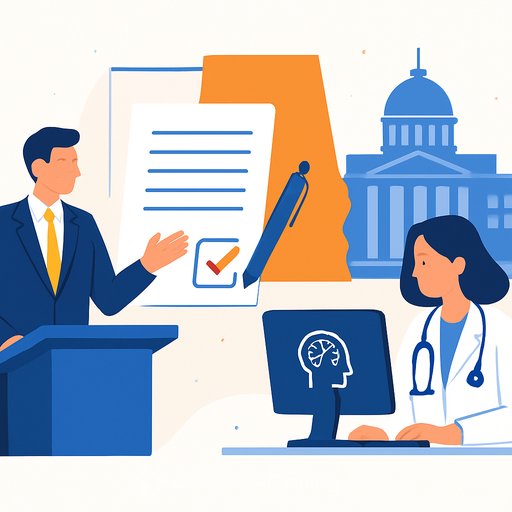
Alabama Senate advances bill to curb AI-only health claim denials
Alabama's Senate has approved a bill that would stop insurers from relying solely on artificial intelligence to deny or reduce coverage for a health care claim. The measure passed 27-0 without debate and now heads to the House.
If enacted, it would still allow AI in claims review, but a licensed physician or other qualified health professional must make any adverse determination. A similar proposal surfaced last year but did not pass.
Key provisions
- No sole-AI denials or reductions of coverage. A clinician must make the final call on any adverse decision.
- AI tools used in coverage review must consider the patient's medical history and clinical circumstances.
- Prominent written disclosure to policyholders (or the group sponsor) when AI is used in coverage decisions.
- Annual certification of AI use to the Alabama Department of Insurance, which would have enforcement authority.
- Status: Passed the Senate 27-0; moves to the House.
Why this matters for insurers
This bill pushes human oversight back to the center of utilization management. It also forces clarity on how AI systems inform decisions, what data they consider, and how you explain that to members and sponsors.
Expect added process controls, tighter vendor agreements, and more documentation in case of audits or appeals. The upside: cleaner decision trails and fewer high-risk denials.
Immediate action checklist
- Map where AI or algorithmic tools influence coverage determinations (preauth, concurrent review, post-service, claims edits).
- Require clinician sign-off for all denials or reductions; embed license and specialty capture in the workflow.
- Upgrade documentation: rationale, guidelines used, patient-specific factors considered, and the identity of the reviewing clinician.
- Tune models and rules to pull in patient history and clinical context; block any auto-denial paths.
- Draft clear AI-use disclosures for members and group sponsors; align with plan documents and denial letters.
- Stand up an annual AI certification process: system inventory, change logs, testing records, monitoring results, and executive attestation.
- Revisit vendor contracts to ensure transparency on data sources, model behavior, explanations, and audit rights; add obligations to support disclosures and human review.
- Retrain UM and appeals teams on new steps, timing, and documentation to keep turnaround times compliant.
Operational implications to plan for
- Throughput and staffing: Extra clinician touchpoints may slow reviews; forecast capacity and set triage thresholds.
- Quality and fairness: Track overturn rates, complaint patterns, and disparities by line of business or population.
- Audit readiness: Maintain decision logs that show the AI's input, the clinician's judgment, and the final outcome.
- Member experience: Update denial letters to reflect clinician review and patient-specific reasoning, not generic templates.
What's next
The bill now moves to the Alabama House. Compliance teams should prep policies and workflows so you can execute quickly if the measure becomes law.
Resources
- Alabama Department of Insurance - regulator named in the bill for certification and enforcement.
- NAIC model bulletin on AI systems - useful context for broader AI governance expectations.
- AI for Insurance - practical guides on claims automation, model governance, and compliance-aware design.
- AI for Regulatory Affairs Specialists - frameworks for certifications, risk monitoring, and audit workflows.
Bottom line: keep AI as decision support, not decision maker. Put a clinician on the hook for denials, document the reasoning, and make your use of AI crystal clear to members and sponsors.
Your membership also unlocks: