
AI news ·
Albanese establishes AI office and sets copyright and datacentre rules
Australia will mandate copyright protections for creatives against unauthorized AI training. The government is also setting strict energy and water rules for datacentres.
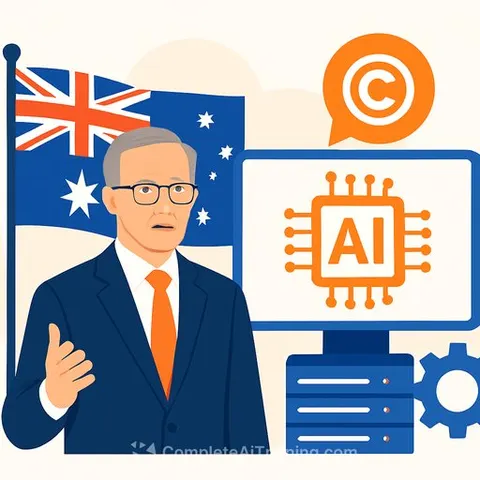
Prime Minister Anthony Albanese has promised Australian writers, musicians, artists and journalists the "strongest possible protection" against AI companies using their work without permission or payment, calling anything less "theft." The government will also establish a new office of AI and set mandatory rules for datacentres, including limits on location, energy use and water consumption.
Copyright and creative control
Albanese made the announcement in a major speech on Wednesday, rejecting the idea that large AI firms like OpenAI and Anthropic could freely use Australian data. "Let me make this crystal clear: not everything produced in Australia is up for grabs," he said. "Australian writers, musicians, artists and journalists must retain ownership and control of their work. Our laws will spell that out, plain as day."
The prime minister said no company should use Australian books, music, art or news to build or train AI without the artist's control over the price and value of their work. "Anything less is theft," he added. Cabinet discussions on copyright reforms are continuing, but the speech was the strongest assurance yet that creatives will be protected.
For professionals working with AI in creative fields, understanding these evolving legal frameworks is increasingly important. Courses and resources on AI for Creatives can help practitioners navigate the intersection of technology and intellectual property rights.
Industry reaction
Annabelle Herd, CEO of the Australian Recording Industry Association, welcomed the guarantees. She said groups like hers were keen to sign licensing deals with AI companies to ensure artists were fairly compensated. "We don't know exactly what most of these AI companies want, they haven't made a public case about what the problem is, but there isn't one," she said. "[Albanese's speech] should be a very strong message to the AI companies, they should pick up the phone and start licensing … we are very good and efficient at licensing at scale."
Anthropic's general counsel, Jeff Bleich, said the company respected the process for establishing Australia's AI framework and took its responsibilities seriously. Microsoft Australia president Jane Livesey said users would embrace the technology if "people trust that AI is safe and well-governed."
Writers, in particular, have been vocal about the risks of unlicensed training data. Many are seeking practical guidance on protecting their work while still engaging with new tools, a topic covered in resources like AI for Writers.
Datacentre standards
Alongside the copyright stance, the government announced binding national standards for datacentres. Albanese said there was "more than enough room for new datacentres, without them competing with new housing." Large-scale facilities will be legally required to underwrite new power supply, pay their full share of grid connection costs, and put at least as much energy into the grid as they take out. They must also generate renewable energy, minimise water use and maximise energy efficiency.
The Business Council of Australia's CEO, Bran Black, welcomed the speech but warned against regulation going "too far" or being "too prescriptive" in case it stifled business. Belinda Dennett, CEO of Data Centres Australia, said she was unfazed by the new standards, noting datacentres were already pursuing renewables and sustainability.
Why this matters for creatives
The government's explicit rejection of free-for-all data mining puts Australian creatives in a stronger bargaining position. If legislation follows the prime minister's rhetoric, AI companies will need to negotiate licensing deals to use local content-a shift that could create new revenue streams for writers, musicians and visual artists. The commitment to "artist's control of the price and value of their work" signals that payment, not just attribution, is on the table. For individual creatives, the practical next step is to stay informed about licensing models and ensure any AI tool they use aligns with these emerging standards.