
AI news ·
Albania's AI minister takes office: can code clean up corruption?
Albania's AI "minister" Diella helps draft and review procurement, while humans still sign off. Faster workflows and cleaner audits-but transparency and accountability must hold.
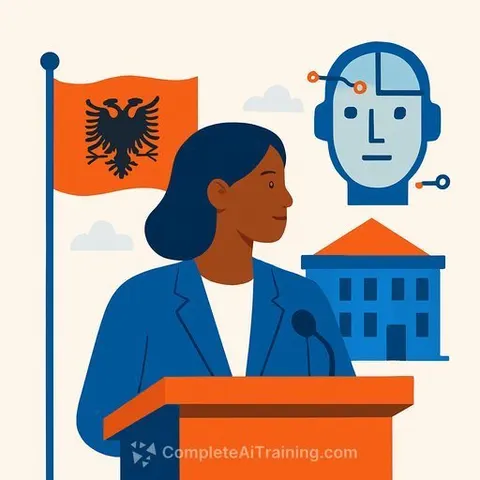
Albania's AI "Minister" Diella: Practical lessons for public-sector leaders
Albania just put an AI system on stage and called it a minister. The avatar has a name (Diella), a brief, and a mandate: clean up public procurement and build trust. Theatrics aside, the substance matters. Diella is a decision-support system embedded in procurement, not a human replacement.
If you work in government, this is a clear signal: AI is moving from pilots to core administrative work. The upside is speed, uniformity, and auditability. The risk is opacity and misplaced accountability. Here's what matters and how to act on it.
What Diella actually does
Built by Albania's National Agency for Information Society with support from major vendors, Diella runs on large language models fine-tuned for Albanian law and fed with real-time government data. It already powers the e-Albania assistant that delivers certificates with digital seals in seconds.
In procurement, Diella supports four stages:
- Drafts terms of reference based on prior practice and legal standards.
- Assesses eligibility criteria for bidders against documented requirements.
- Estimates upper price limits using past contracts plus tax and customs data.
- Surfaces recommendations for reviewers, along with the underlying evidence.
Final decisions stay with humans. That point has been repeated by Enio Kaso, the director behind Diella.
Why Albania is doing this
Corruption has dragged on Albania's growth and EU ambitions for decades. Procurement has been a persistent weak spot flagged in EU rule-of-law reviews and by watchdogs like Transparency International. A centralized AI co-pilot promises fewer backroom favors, less guesswork on pricing, and cleaner records.
Diella is also a narrative move. Prime Minister Edi Rama framed it as the first "non-human" in government to make the concept tangible for citizens and to signal urgency on reform.
Benefits governments can reasonably expect
- Consistent application of rules across agencies and regions.
- Faster document drafting and eligibility checks.
- Data-driven price ceilings that reduce overpayment and collusion.
- Reduced in-person interactions that invite petty bribery.
- Structured logs that make audits simpler and stronger.
- Lower barriers for SMEs if criteria are clearer and fairer.
Risks and open questions
- Transparency: Will Diella's recommendations, data sources, and parameters be publicly visible? Journalists and businesses need verifiable records.
- Data quality and bias: Poor inputs or skewed past awards can encode yesterday's problems into tomorrow's recommendations.
- Accountability: Who answers for errors-the vendor, the AI team, or the approving official? Albania says humans remain responsible. That must be codified.
- Legal status: Diella isn't a sworn minister. Its outputs need a clear legal footing for audits, protests, and courts.
- Scope creep: Albania plans a parallel test for AI vote counting. High-stakes use requires extra safeguards and independent oversight.
A practical playbook for implementing AI in procurement
- Define the narrow tasks first: drafting, eligibility triage, price estimation, de-duplication-not award decisions.
- Publish the rules: data sources, update cadence, prompts, thresholds, and override procedures. Create an accessible model card.
- Standardize data: adopt open schemas for notices, awards, suppliers, and contract performance. See the Open Contracting Partnership.
- Log everything: inputs, intermediate scores, recommendations, overrides, and reasons. Make logs FOI-ready with privacy controls.
- Set human-in-the-loop checkpoints: role-based approvals, conflict disclosures, and dual sign-off for exceptions.
- Independent oversight: external audits, bias testing, red teaming, and a public dashboard tracking impact.
- Limit vendor lock-in: use modular architecture, open APIs, and exportable prompts and embeddings.
- Protect rights: DPIAs, access controls, encryption, and retention limits. Document lawful bases for processing.
- Measure impact: time-to-award, bids per tender, average discount from estimate, protest rates, audit findings, SME participation.
- Communicate clearly: explain what the system does, what it does not do, and how people can challenge outcomes.
- Train your teams: procurement officers, auditors, and ethics reviewers need hands-on practice, not slide decks.
Recommended metrics
- Cycle time from notice to award.
- Average number of bidders per tender and SME share.
- Variance between estimated and awarded prices.
- Share of awards with documented exceptions.
- Protest rate and resolution outcomes.
- Audit findings tied to data quality or overrides.
Technical essentials (keep it simple and secure)
- Retrieval-augmented generation over current laws, policies, and templates.
- Real-time connectors to tax, customs, and supplier registries (read-only where possible).
- Immutable logging with review trails and export.
- Role-based access, least privilege, and admin action alerts.
- Sandbox for testing with synthetic or masked data.
- Fail-safe defaults: if confidence is low, escalate to humans with cited evidence.
Accountability, clearly stated
AI can make bias visible and decisions more consistent. But accountability cannot be vague. Albania's approach keeps humans responsible for approvals. That needs legal codification, published governance, and enforceable redress for vendors and citizens.
As Professor Cary Coglianese notes, uniform systems and better data can improve oversight-if the logs are open and the audits are real.
Bottom line for public leaders
Start with decision support in high-friction, paperwork-heavy workflows. Publish how the system works. Track outcomes. Keep people in charge. If trust and transparency improve, expand gradually.
Skip the hype. Ship the governance.
Further reading and training
- Global benchmarks on perceived public-sector corruption: Transparency International CPI
- Upskill your team on AI for public-sector roles: AI courses by job