Amazon's Bee: A Wearable AI That Lives With You, Not Just In Your Home
CES was full of AI on everything from rings to TVs. Amazon used the moment to put Bee on the map - a clip-on pin or bracelet that records, transcribes, and acts as a personal AI companion.
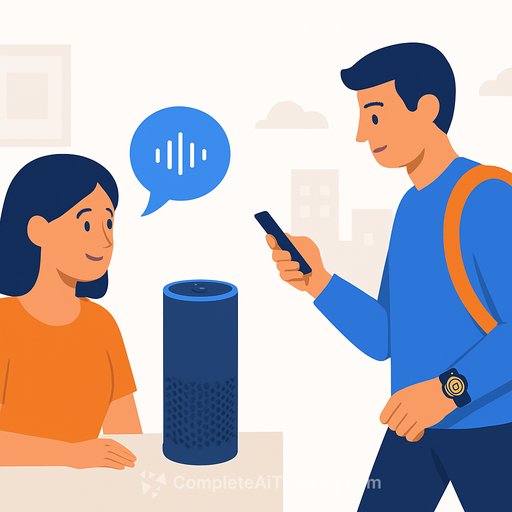
Alexa already covers the home. The upgraded Alexa+ runs on 97% of Amazon's shipped hardware. Bee extends that reach to your day: meetings, classes, walks, errands.
What Bee Does Right Now
Bee captures conversations like interviews, meetings, and lectures. It transcribes what it hears, then discards the audio.
It also functions as an assistant that learns your patterns over time. With permissions, it can use data from Gmail, Google Calendar, your contacts, and Apple Health to surface follow-ups, to-dos, and context you'd otherwise miss.
Early adopters include students, speakers, and older adults who want frictionless recall. Over time, Bee builds a living knowledge graph of your activity and commitments-so you can query your day and track how it changes.
Alexa vs. Bee: Why Both Exist
Amazon tried Alexa in earbuds and glasses before, but those products didn't land against Apple's AirPods and Ray-Ban's Meta glasses. Bee enters as a complementary lane.
As Bee's co-founder Maria de Lourdes Zollo explained, Bee covers on-the-go context while Alexa handles in-home scenarios. Amazon's Daniel Rausch echoed that both experiences will eventually work together for a continuous, day-long assistant.
How It Works (And Where It Falls Short)
Bee uses multiple AI models under the hood. The team is exploring Amazon's models as part of the stack.
Key trade-off: after transcription, Bee deletes the audio. That's good for storage and privacy, but it limits use cases where playback is required for compliance or quote-level accuracy.
Why This Matters For Product, IT, And Engineering Teams
Wearable AI is moving from novelty to workflow. Bee's pitch is simple: low-friction capture, automatic summarization, and context-aware prompts that reduce manual note-taking.
If you're evaluating Bee or similar devices, focus on practical checkpoints:
- Permissions and scope: Which data sources will you connect (Gmail, Calendar, contacts, Apple Health)? What's the minimum viable set?
- Recording policy: How will you handle consent for meetings and customer calls? Document this for legal and HR.
- Retention and deletion: Transcripts vs. audio. If you need audio playback, set that expectation early.
- Security review: OAuth scopes, data at rest, access logs, admin controls, offboarding.
- Change management: Train users on what to record, how to query, and how to act on summaries.
- Metrics: Time saved per meeting, follow-up completion rate, fewer missed commitments.
For frameworks and studies on evaluating enterprise wearables and AI assistants, see Research.
Where Bee Fits Against Competitors
The category is heating up, from ear-based assistants to smart glasses with cameras and voice agents. Apple's AirPods dominate audio, while Ray-Ban Meta glasses focus on camera-first use cases.
Bee bets on always-on capture with a lightweight form factor. For teams that spend their day in calls, classrooms, or client work, that could be enough to earn a pocket spot.
Apple Health integrations raise data sensitivity, so align with your compliance requirements. For smart glasses context, see Ray-Ban Meta smart glasses.
Current Limitations To Note
- No audio playback after transcription limits some legal, journalism, and research workflows.
- Reliance on connected services means permissions, revocations, and audits need clear ownership.
- Continuous use requires strong battery life and wearability; test with real schedules, not demos.
What's Next
Bee's team teased more updates in 2026 and is shipping features like voice notes, templates, and daily insights. Amazon sees Bee as a "personal" companion that will eventually blend with Alexa for a seamless, all-day experience.
Quick Pilot Playbook
- Pick 10-25 users across roles that live in meetings, field work, or classrooms.
- Define consent rules and a simple recording checklist.
- Connect only essential services at first (e.g., Calendar + Email).
- Set success metrics for 30 days: time saved, fewer missed actions, follow-up speed.
- Run a security review and create a deprovisioning path.
Skill Up Your Team
If you're rolling AI into daily workflows, level up your org's capabilities. See curated paths by role and function here:
Bottom line: Alexa owns the home. Bee wants your day. If Amazon stitches them together cleanly, expect a continuous assistant that moves with you from kitchen to commute to conference room.
Your membership also unlocks: