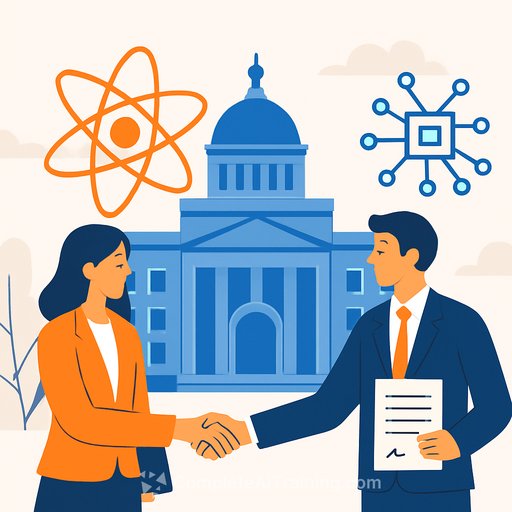
Andhra Pradesh signs MoU to build AI-Quantum University in Amaravati
The Government of Andhra Pradesh and the National Institute of Electronics & Information Technology (NIELIT), under the Ministry of Electronics & Information Technology (MeitY), have signed an MoU to set up India's first dedicated Quantum and Artificial Intelligence university campus in Amaravati.
This move supports the state's plan to build a globally competitive quantum innovation hub through the proposed Andhra Quantum Mission. Amaravati is set to be the nucleus of the state's broader Quantum Valley initiative.
What the MoU establishes
NIELIT, an autonomous scientific society under MeitY, is mandated to advance education, skilling, training, research, and capacity building in emerging technologies. It has Deemed-to-be University status with 12 approved campuses nationwide.
Within this framework, the Amaravati campus will operate as a specialized university hub focused exclusively on Quantum and AI-integrating academic programs, research, industry collaboration, and incubation under one roof.
Academic and infrastructure stack
- Undergraduate, postgraduate, and PhD programs tailored to Quantum and AI
- Advanced research laboratories and industry-linked Centres of Excellence (CoEs)
- Deep-tech incubation and entrepreneurship support
- Global academic and R&D collaborations
Priority domains
- Quantum Computing and Quantum Algorithms
- Artificial Intelligence and Machine Learning
- Quantum Communication and Cybersecurity
- Quantum Hardware and Systems Engineering
- High-Performance Computing
- AI-Quantum Convergence Research
Why this matters for government stakeholders
- Skilling at scale: Creates a steady pipeline of talent for public-sector projects, research labs, and strategic programs.
- Sovereign capability: Builds domestic expertise in quantum hardware, secure communications, and AI systems relevant to national priorities.
- Economic development: Anchors a Quantum Valley that can attract industry, generate IP, and stimulate high-value jobs.
- Security and trust: Advances quantum-safe cybersecurity and standards that can be adopted across departments.
Immediate actions for departments and agencies
- Governance: Constitute a joint steering committee (state + NIELIT + MeitY) with clear milestones, budget oversight, and risk registers.
- Infrastructure: Finalize land allotment, enable single-window clearances, and plan phased build-out of labs, HPC, and cleanroom facilities.
- Talent and programs: Launch scholarships, faculty chairs, and fellowship tracks; co-develop curricula with industry and national labs.
- Procurement: Define standards for quantum hardware, cryogenics, photonics, and HPC; include open interfaces to avoid lock-in.
- Security and compliance: Establish policies for quantum-safe cryptography, data governance, and responsible AI.
- Industry and R&D: Set up CoEs with outcome-based MoUs; seed challenge grants and public-sector pilot projects.
- International collaboration: Enable visiting faculty programs and joint labs while managing export controls and IP.
- Measurement: Track KPIs-enrollments, patents, publications, startup formation, and tech transfer to public services.
Execution considerations
- Phase 1 (Year 1): Governance setup, land and infra contracts, anchor faculty recruitment, initial labs, and first PG intake.
- Phase 2 (Years 2-3): CoEs operational, UG programs launched, industry pilots, and international partnerships scaled.
- Phase 3 (Years 4-5): Full lab capability, PhD pipeline matured, tech transfer into public-sector deployments.
Risks and mitigations
- Talent attraction: Offer competitive fellowships and joint appointments with national labs and industry.
- Vendor lock-in: Prioritize open standards, modular lab equipment, and interoperable software stacks.
- Security and ethics: Independent review boards for sensitive research; align with national AI and cybersecurity guidelines.
- Funding continuity: Blend state, central, and CSR/industry funds; tie disbursements to stage-gated outcomes.
Learn more
About the institutions involved: NIELIT and MeitY.
For capacity building and policy insights, see AI for Government.
Your membership also unlocks: