Amazon Rolls Out AI Kindle Translate for Authors
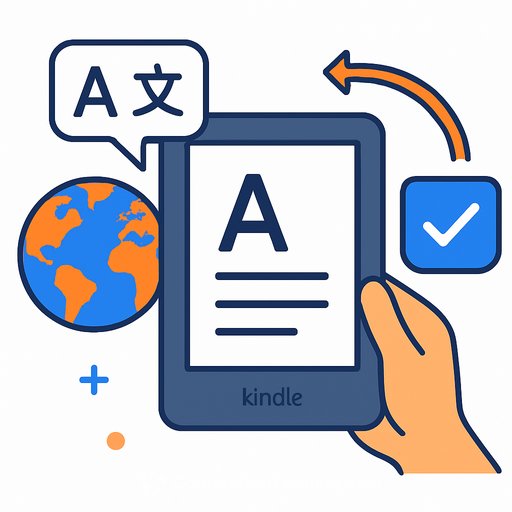
Amazon has opened a beta for Kindle Translate, an AI-powered translation service built into Kindle Direct Publishing. It launches with English ↔ Spanish and German → English, with more languages promised as the system scales. Translated titles are free to produce during beta and are badged as "Kindle Translate" so readers know AI contributed to the edition.
For working writers, the pitch is speed and reach. An 80,000-word novel can move from draft to translated submission in hours, not months.
How Kindle Translate Works for KDP Authors and Readers
- From your KDP dashboard, choose a target language for an existing title.
- Review the AI draft, make edits, set pricing, and publish.
- Amazon runs automated accuracy checks before the book goes live.
- Readers see a "Kindle Translate" label and can sample before buying or borrowing via Kindle Unlimited.
Early Scope and Language Coverage
Amazon frames this move as closing an access gap: fewer than 5% of store titles exist in multiple languages. Starting with Spanish makes sense-there are hundreds of millions of native speakers and strong U.S. readership growth for Spanish-language ebooks, per Instituto Cervantes.
German → English unlocks inbound translation of European backlists for the largest paid English-language ebook market. Expect Amazon to prioritize languages with healthy Kindle adoption and active genre communities.
What This Means for Indie Authors and Self-Publishers
Cost has been the blocker. Human translation for trade fiction often runs $0.08-$0.12 per word, or roughly $6,000-$10,000 for a standard novel. Free AI translation during beta removes that upfront check you've been writing before you even test demand.
Distribution is the other lever. AI-translated editions are eligible for KDP Select and Kindle Unlimited, so you can earn page-read royalties in addition to à la carte sales. Series writers who previously translated Book 1 as a loss leader for KU discovery can now scale that play across more territories.
Quality still lands on you. A practical workflow: use Kindle Translate for the first pass, then hire a native-language editor for post-editing, sensitivity reads, and localization of back matter. Boost results by localizing your product page, keywords, categories, and even series titles for each storefront.
Quality Safeguards and Transparency
AI-labeled translations are a clear disclosure move. Amazon says titles pass automated accuracy checks, likely referencing internal benchmarks similar to standard MT metrics (e.g., COMET/BLEU), though details aren't public.
Author guardrails worth adopting:
- Spot-check idioms, humor, and dialogue for regional fit.
- Confirm proper nouns, brand names, place names, and quotes.
- Maintain a series term list (magic systems, tech terms, character quirks) across books.
- For nonfiction: verify terminology, figures, footnotes, and citations.
- Review KDP's terms for translation rights and territory handling before you publish.
Competition and Market Context
The field is busy: DeepL, Google Translate, and Microsoft Translator offer broad language coverage, while open-source options like Marian NMT and OpenNMT serve teams with custom needs. Amazon's differentiator isn't raw model breadth; it's the turnkey pipeline tied directly to Kindle merchandising and royalties.
CSA Research estimates the language services and tech market at nearly $50B worldwide, and digital reading keeps shifting toward libraries and subscriptions. Breaking the translation barrier feeds Kindle's long tail and gives KU readers in non-English markets more to read. Source: CSA Research.
What to Watch Next
- Pricing after beta: Will there be per-word fees, tiers, or KU-linked incentives?
- Language expansion cadence, including right-to-left and CJK languages.
- Glossary and style controls for series consistency.
- Recommended human review levels by genre (romance vs. hard sci-fi vs. children's).
If Amazon maintains quality and low cost, Kindle Translate could become a default step in indie workflows-another line item next to cover design and proofreading. The upside is clear: more markets, more formats, and more ways for readers to find you.
A Simple Action Plan for This Week
- Pick one backlist title with steady U.S. sales and clean reviews.
- Run a Spanish translation, then hire a native editor for a light post-edit pass.
- Localize your product description, keywords, and categories; publish and enroll in KDP Select.
- Track read-through and KU pages for 30 days; if it holds, move your next title.
Helpful Resources
- AI tools for copywriting - shortlist tools to speed up blurbs, ad copy, and localization.
Your membership also unlocks: