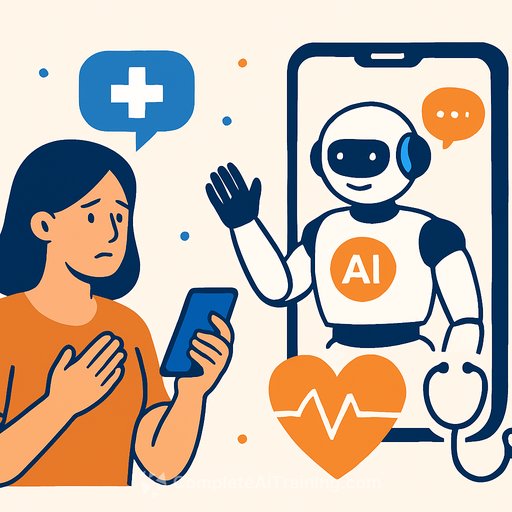
Amazon's Health AI assistant quietly tackles what clinics struggle with
Amazon One Medical rolled out a Health AI assistant inside the One Medical app - an example of AI for Healthcare. It offers 24/7 personalized guidance, books appointments on its own, and manages prescriptions for members across the network.
Amazon is positioning this as an answer to fragmented care. The assistant pulls from each patient's complete chart-medical history, labs, current medications-so answers reflect real context, not generic advice.
What's live now
- Always-on guidance: Patients can ask symptom, condition, treatment, and wellness questions without waiting for an appointment.
- Autonomous logistics: The agent books visits and handles medication management tasks inside existing One Medical workflows.
- Record-aware responses: It explains labs and next steps with each patient's history, results, and meds in view.
- Privacy commitments: Amazon states the system operates with HIPAA-compliant safeguards. See HHS HIPAA for the baseline requirements.
How Amazon frames the problem
Neil Lindsay, SVP of Amazon Health Services, calls U.S. care "fragmented," with each provider only seeing part of the picture. The assistant aims to assemble those pieces for a more complete, actionable view inside a single app.
The rollout targets One Medical members first. Amazon notes that hundreds of millions have touched its broader health services, and this assistant is meant to complement-not replace-the clinician relationship.
Why this matters for healthcare operators
- Front-door triage shifts: Many patient questions get resolved without a visit. That can reduce call volume and inbox traffic while accelerating scheduling for those who truly need care.
- AI for Operations: Autonomous booking and refills tighten the loop between intent and action, which can improve adherence and reduce no-shows if capacity is managed well.
- Experience expectations: Patients will start to expect on-demand, chart-aware answers. That raises the bar for response speed and personalization across the board.
Clinical governance questions to answer early
These governance, risk, and rollout considerations are core topics for AI for Executives & Strategy.
- Safety and scope: What questions should the assistant answer directly vs. escalate? Define red flags, contraindications, and escalation pathways.
- Auditability: Every autonomous action needs a clear audit trail-who prompted it, what data was used, what decision logic fired, and who approved when required.
- Medication workflows: Clarify refill rules, drug-drug interaction checks, allergies, and communication with prescribers. Keep humans-in-the-loop for exceptions.
- Accuracy and drift: Set thresholds for confidence, periodic review of responses, and monitoring for model drift or bias-especially across diverse populations.
- Data boundaries: Reconfirm PHI access controls, consent, and disclosures. Align with HIPAA and local/state requirements for sensitive data.
Integration realities
One Medical's integrated stack makes this possible. Outside that environment, the heavy lift is data liquidity-getting complete, current records into one place with reliable identity matching and low-latency sync.
Scheduling needs capacity-aware logic to avoid overbooking. Medication management needs tight linkage to e-prescribing, formulary checks, and pharmacy fulfillment updates.
Practical use cases you can model today
- Lab follow-up: Explain abnormal results, suggest appropriate next steps, and pre-book follow-up slots if certain thresholds are exceeded.
- Chronic condition nudges: Medication reminders, refill coordination, vitals tracking prompts, and education tied to the patient's regimen.
- Symptom sorting: Clear self-care guidance for low-acuity issues; immediate escalation to virtual or in-person care for red-flag patterns.
What to watch as this scales
- Escalation performance: How fast and accurately the assistant hands off to clinicians when risk rises.
- Quality signals: Changes in ED utilization, readmissions, refill adherence, and time-to-appointment.
- Patient trust: Perceived clarity, empathy, and correctness of responses-especially for sensitive topics.
- Clinician workload: Net impact on inbox, visits, and administrative burden once autonomous tasks stabilize.
Action steps for healthcare teams
- Map your top 10 high-volume patient questions and build response templates with clear escalation criteria.
- Set policies for autonomous bookings and refills, including exception handling and clinician approvals where needed.
- Establish a cross-functional review board (clinical, compliance, data, ops) to oversee AI behavior and outcomes.
- Pilot with a defined cohort, measure safety and satisfaction weekly, then expand by condition and workflow.
Bottom line
This is less about flashy tech and more about removing friction from routine care. If the assistant keeps answers accurate, respects guardrails, and closes loops end-to-end, it will raise patient expectations for everyone.
The organizations that win will pair automation with strong governance and human backup. Clear roles, clean data, and disciplined escalation will make or break results.
If you're planning clinician- and ops-ready AI upskilling, see our practical course collections by role at Complete AI Training.
Your membership also unlocks: