Amazon Reviews AI Coding Practices After Outages Draw Scrutiny
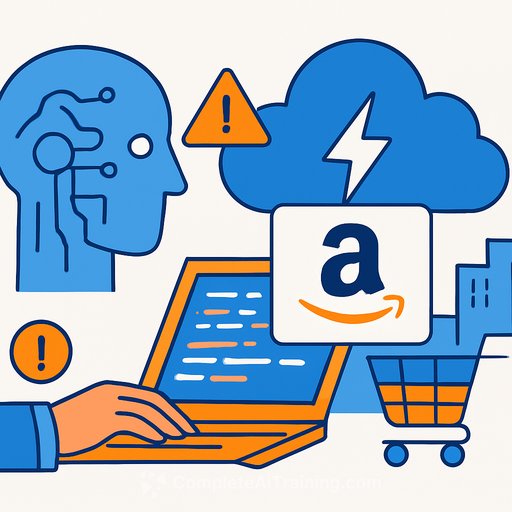
Amazon is reviewing whether generative AI coding tools played a role in recent outages that hit its retail site and related services. Leadership reportedly called a mandatory meeting to assess the incidents and the influence of automated code changes. This is the tension every engineering org feels: ship faster with AI, or slow down to protect reliability. Speed without control is an expensive bet.
What happened
Internal communications pointed to a trend of high blast-radius incidents over the past few months. According to reporting, the company is examining whether AI-assisted code modifications were a contributing factor alongside other technical causes.
Cybersecurity consultant Lukasz Olejnik flagged the internal meeting in a social post. Elon Musk responded with a short warning: "proceed with caution." It's a fair summary of the mood across engineering teams adopting AI for code.
Customer impact and scope
One of the disruptions started just after midnight in India, then spread as U.S. complaints surged. Downdetector recorded reports peaking around 22,000 before dropping below 650 as recovery progressed.
Users saw checkout failures, price glitches, crashes, and missing order histories or product pages. Some reported issues with Prime Video and parts of AWS.
Amazon attributed at least one event to a software code deployment, apologized, and said services were restored. The episode revived memories of the October 2025 outage that rippled through thousands of applications built on AWS.
Beyond code: physical hits to infrastructure
Complicating matters, several Middle East data centers suffered damage after drone strikes. Two facilities in the UAE were directly hit, and nearby strikes in Bahrain affected infrastructure at another location.
AWS cited structural damage, power disruptions, and water damage from fire suppression, with recovery expected to take time. The takeaway is clear: reliability spans code quality and physical resilience, and both can fail at once.
Why this matters for engineering leaders
Generative AI is now standard in many developer workflows: scaffolding functions, drafting tests, and updating docs. It also produces code that "looks" right while hiding subtle logic errors that surface only in production-scale conditions.
Financial platforms, payment processors, and trading systems frequently run on AWS and similar clouds. Even short outages can block transactions and access to funds, so governance around AI-generated code is now a board-level issue, not just an engineering preference.
Practical guardrails for AI-assisted code at scale
- Label provenance: Tag AI-generated diffs in commits and PRs; store prompts and model versions for traceability.
- Review with ownership: Require human approvers who own the service. No self-merge of AI-origin changes.
- Contract and property tests: Add contract, fuzz, and property-based tests that catch logic drift, not just syntax issues.
- Progressive delivery: Use feature flags, canaries, and region-scoped rollouts with automatic rollback on SLO breaches.
- Blast-radius containment: Cell-based architecture, circuit breakers, bulkheads, and aggressive timeouts/rate limits.
- Policy-as-code in CI/CD: Linting, SAST, SCA, IaC scanning, and secret detection as hard gates, not advisory checks.
- Change-aware observability: Correlate deploys with errors, saturation, and latency; surface "who shipped what" on dashboards.
- Runtime safeguards: Guardrails, kill switches, and config freezes during peak periods; disallow schema and auth changes in the same deploy.
- Secure AI usage: Curate context, strip secrets, and constrain tool access. Block models from writing infra or auth code without extra review.
- Infra sensitivity: Prefer one-way-door decisions rarely; default to two-way doors with instant rollback paths and state-safe migrations.
- Resilience drills: Game days and chaos tests for failover, degraded modes, and dependency failures (including region loss).
- Blameless RCAs with AI flags: Capture whether AI influenced design, code, or config; turn findings into patterns and guardrails.
A short implementation checklist for this week
- Add an "AI-generated" label to PR templates and require a human owner sign-off.
- Turn on deploy-to-incident correlation in your tracing and error tooling.
- Ship one service via canary + feature flag and wire auto-rollback to SLOs.
- Freeze risky config classes during traffic peaks; document the kill switch.
- Run a one-hour rollback drill with your on-call team and measure time-to-recover.
What to watch next
Expect deeper internal reviews on how AI-assisted changes move through large platforms, and how much automation is safe without new controls. Also watch for industry-wide patterns in outage postmortems that call out AI contributions explicitly.
If your team is adopting code-generation tools, upskill before you scale. Start with the practices and training collected here: Generative Code.
Further reading
Your membership also unlocks: