Amazon to Expand AI Access for 1.5 Crore Small Businesses and 40 Lakh Government School Students by 2030
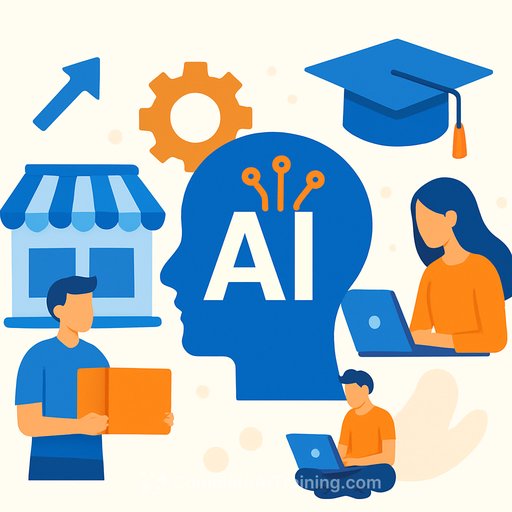
Amazon announced a nationwide push to offer AI services to 1.5 crore small businesses and bring AI literacy and career awareness to 40 lakh students in government schools by 2030. The company said it remains on track to invest $12.7 billion in local cloud and AI infrastructure by the end of the decade, as outlined in May 2023.
"We're building AI infrastructure and tools at scale," said Samir Kumar, Country Manager, Amazon India. The plan includes AI curriculum, hands-on experiments, career tours, and teacher training for government schools.
Why this matters for government stakeholders
This move can lower the digital gap across districts and help MSMEs that sell to or work with public programs operate with better efficiency. It also strengthens local cloud capacity that ministries, PSUs, and state departments increasingly depend on for digital services.
For education departments, structured AI literacy and teacher enablement can translate into classroom adoption without extra administrative load-if the rollout is coordinated with state boards and training institutes.
What Amazon is offering
- Seller Assistant: a generative AI expert for instant answers and guidance.
- Next-generation seller central: faster task management and customizable dashboards.
- AI-powered listings: create high-quality product listings from a brief, image, or URL in minutes.
- Creative Studio: concept-to-ad workflows across formats.
- Video generator: professional-quality video ads within minutes at no additional cost.
Amazon Web Services (AWS) highlighted that customers in India are already using agentic AI capabilities across sectors, including DigiYatra, Apollo Tyres, and Axis Bank. For officials evaluating proof points in public services, DigiYatra offers a useful reference case.
DigiYatra (official)
AWS Skill Builder
Skilling at scale: students, teachers, and the workforce
AWS says it has trained over 6.2 million individuals in India with cloud skills since 2017 through programs like AWS Skill Builder, AWS Educate, AWS re/Start, and new AI courses. The school-focused initiative will add AI curriculum, career exposure, and teacher training to government schools through 2030.
For education departments, the immediate opportunity is to integrate these resources into existing teacher development calendars and ICT programs, and to set up simple feedback loops at the block level to measure classroom outcomes.
Implications for MSMEs that work with the public sector
Many small businesses supply goods and services to government projects. Faster product listing, better catalog quality, and AI guidance can reduce paperwork, cut errors, and improve compliance readiness. Departments that rely on MSME participation may see improved response quality and on-time delivery if adoption spreads.
Infrastructure and public sector alignment
The $12.7 billion investment in local cloud and AI infrastructure, slated through 2030, could improve availability, latency, and resilience for India-hosted workloads. This is relevant for departments running critical applications or considering AI pilots that require secure, high-uptime environments.
How departments can engage
- Identify 2-3 priority use cases with clear KPIs (citizen support, document processing, teacher training support).
- Pilot with non-sensitive data first; scale only after baseline accuracy and cost are validated.
- For education: coordinate with SCERT/DIETs to align training schedules and classroom toolkits.
- For MSMEs: share simple playbooks that explain how to use listing and ad tools for public procurement contexts.
- Build a small cross-functional review group (IT, legal, program owners) to track outcomes and risks.
Risk, compliance, and guardrails
- Data classification: define what data can/cannot be used with external AI tools.
- Privacy and security: ensure logging, access control, and clear data-retention policies.
- Fairness: test outputs for bias, especially in citizen-facing workflows.
- Cost control: set usage budgets and monitor API or service consumption.
- Continuity: plan for fallbacks if AI services are degraded or unavailable.
Action checklist for the next 90 days
- Nominate a department AI lead and a small working group.
- Select one education use case (teacher training support, student projects) and one MSME support use case (catalog assistance, documentation help).
- Run a 6-8 week pilot with clear success metrics and a weekly review cadence.
- Draft a lightweight AI use policy covering data, approvals, and monitoring.
- Plan a basic skills pathway for staff and teachers using free/low-cost courses.
Where to build skills quickly
Officials and educators can get started with structured, modular learning. Begin with foundational AI concepts, then move into practical workflows that match department needs.
Curated AI courses by job role (Complete AI Training)
Bottom line: Amazon's push brings more AI capacity, tools, and training into the market. For government teams, steady pilots, clear rules, and targeted skill-building can convert these offerings into measurable public value.
Your membership also unlocks: