Amazon's Vanguard: Robotaxis, Blitz Deliveries, and AI Teammates - What Product Leaders Should Do Next
Amazon is stress-testing three bets that could reset expectations for urban mobility, logistics, and software work: Zoox robotaxis, under-an-hour delivery, and "AI teammates" that take on multi-step tasks. For product teams, this isn't distant future talk. It's a roadmap for how to build, ship, and scale complex systems in messy environments.
Robotaxis as a Platform Move
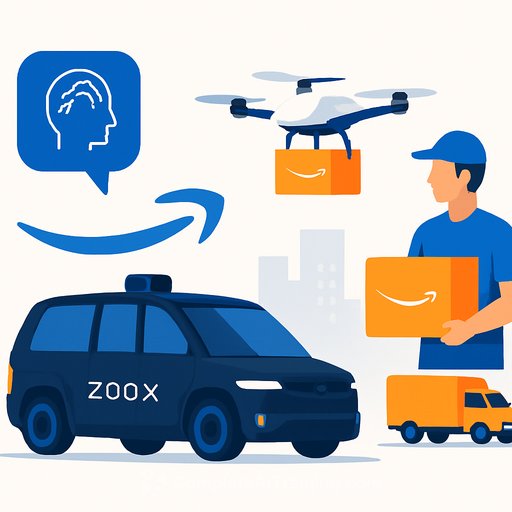
Zoox's purpose-built, bidirectional vehicle runs without a steering wheel or pedals. Early rider reports describe a smooth, driverless trip on the Las Vegas Strip-controlled routes, dense signals, high distraction. A good stress test.
The hard part isn't the demo. It's expansion: broader operational domains, unpredictable behavior from humans, and the safety case required by regulators. Expect long lead times and staged rollouts. Reference points: approvals from agencies such as the National Highway Traffic Safety Administration
Strategically, this fits Amazon's network thinking: autonomous vehicles that can move people today and-eventually-move goods, data, and services. Competitors like Waymo and Cruise are pushing here too. The winner will earn distribution and data advantages, not just press.
Ultrafast Deliveries: Under an Hour
Amazon's ultrafast pilots focus on 30-minute (or faster) delivery windows for high-velocity SKUs. The ingredients: micro-fulfillment sites, tight SKU curation, and AI that forecasts local demand to keep the right stock within minutes of the customer.
Last mile blends options. Drones still sit behind regulatory gates with the Federal Aviation Administration
Ground robots and drivers pick up the slack. The constraint isn't tech alone-it's urban congestion, weather, labor timing, and cost per drop. The bet: convenience becomes habit, which becomes retention.
AI Teammates: From Tool to Collaborator
AWS leaders are pushing "agentic" systems that plan tasks, write code, test, and iterate with limited prompts. Internal deployments already manage inventory flows and front-line support. This is less autocomplete, more autonomous workstream.
For product orgs, the impact is clear: faster iteration loops, fewer handoffs, and new review rituals. The risk moves from "can we build it?" to "can we supervise it well?" Governance, observability, and prompt policy become part of your SDLC.
Robotics Hits Scale
Amazon reports a warehouse robotics fleet north of one million units. New systems like Blue Jay (multi-armed picking) and Project Eluna (agentic support for front-line teams) point to a future where hardware and software co-develop the operation.
An AI foundation model coordinates the fleet: routing, predictive maintenance, and adaptive behaviors through feedback from real facilities. Think less single robot, more organism. That's where throughput gains compound.
Strategy Signals and Market Ripples
Zoox doubles as a learning bed for autonomy that could feed delivery fleets. Mobile micro-hubs become plausible. Competitors-Tesla's robotaxi plans, Uber partnerships, Waymo deployments-keep the bar high and the timelines honest.
On the worker side, Amazon is testing smart glasses and guided tools that compress error rates and time to proficiency. Under the surface, AWS continues to push infra speed (even at the fiber level), which matters when AI workflows run for hours or days.
What This Means for Product Development
Here's how to translate the headline moves into your roadmap.
- Define the operational domain first. Where does your system work today? What's explicitly out of scope? Publish the edges.
- Stage outcomes, not features. Pilot in one city, prove a KPI, then scale. Keep the blast radius small.
- Agent-first workflows. Treat AI as a teammate: assign goals, set guardrails, require logs, and design human checkpoints.
- Micro-fulfillment thinking. Co-locate compute, inventory, or capability near demand. Shorten the physical or digital path.
- Safety case as a product. Versioned evidence, test suites for edge cases, red-teaming, and incident response drills.
- Human factors up front. Trust cues, explainability, fallback modes, and clear ownership when automation hands off.
- Data is the flywheel. Close the loop from field telemetry to model updates to routing and inventory decisions.
Metrics That Matter
- Autonomy: disengagements per 1,000 miles, critical events per 10k miles, time-to-safe-stop, ODD expansion rate.
- Ultrafast delivery: on-time under 60 minutes, per-drop cost, item in-stock accuracy, micro-fulfillment utilization.
- AI teammates: cycle time to PRD/prototype/merge, defect escape rate, human review time per task, rollback frequency.
- Ops/finance: contribution margin per order, inventory turns, SLA adherence, customer repeat rate at 30/90 days.
90/180/365-Day Implementation Plan
- Day 0-90: Stand up a micro-fulfillment or edge-compute pilot. Pick 50-200 SKUs or one workflow. Add observability, define stop conditions, and pre-wire an incident process.
- Day 90-180: Introduce an AI teammate for one codebase or operations task. Require structured prompts, decision logs, and human gates. Compare to a control team.
- Day 180-365: Scale to two cities or two business units. Add a digital twin for demand and routing. Establish a safety review board and a quarterly audit for models and hardware.
Risk Map and Countermeasures
- Regulatory delay: build a living safety case, share test data, and run "shadow" ops before live service.
- Model drift: schedule retraining windows, add data quality checks, and run canary deployments.
- Trust gaps: add transparency UI, clear overrides, and fast fallbacks that fail safe.
- Capex shock: lease, partner, or adopt mixed fleets; use micro-pilots to sequence spend.
- Labor pushback: co-design workflows, offer upskilling, and tie incentives to safety and quality improvements.
- Weather and congestion: dynamic routing, weather-aware SLAs, and flexible delivery windows that protect margins.
Tech Stack Sketch
- Autonomy: perception + planning + safety supervisor; policy engine with kill-switches; event recorder.
- Ultrafast: demand forecasting, micro-fulfillment orchestration, courier/robot fleet management, ETA engine.
- Agentic AI: goal planner, tool-use router, code runner sandbox, dataset registry, evaluation harness, audit logs.
- Shared: digital twin for supply/demand, feature store, observability, cost telemetry, and RBAC with policy-as-code.
Where to Skill Up
If your team is standing up agentic workflows or micro-fulfillment pilots, targeted training helps. A practical place to start is curated learning paths by job role.
Bottom Line
Robotaxis, ultrafast delivery, and AI teammates are converging on one idea: compress cycle time between intent and outcome. If you're in product, that means clearer operational domains, staged experiments, strong safety cases, and agents that do real work under supervision. Move now, measure hard, and scale only what proves itself under load.
Your membership also unlocks: