Amazon One Medical launches Health AI assistant: what it means for providers, payers and employers
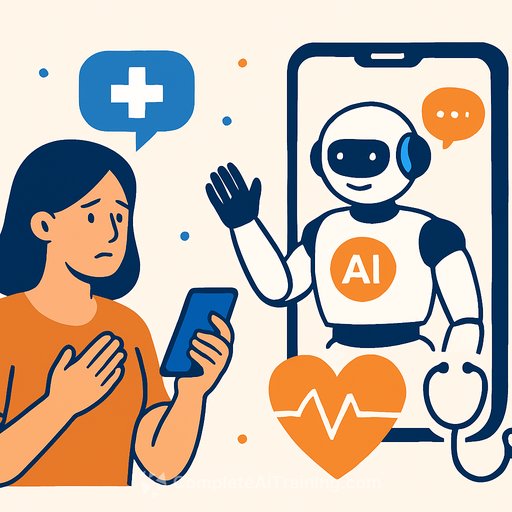
Amazon One Medical has rolled out a Health AI assistant inside the One Medical app for members. The assistant answers health questions, books appointments, manages medications, explains lab results and connects patients to their providers via messaging or same/next-day visits.
Amazon says it personalizes guidance using each patient's medical records, labs and current medications-without asking patients to manually upload data. The experience is covered by HIPAA-compliant privacy and security safeguards, with clinical guardrails that route members to licensed care when needed.
What it does
- Pulls in past conditions, test results, vaccinations and active medications to personalize answers.
- Guides patients to the right care setting: virtual visit, in-person primary care, or urgent care.
- Books appointments and supports medication renewals, including through Amazon Pharmacy.
- Escalates to clinicians for emergency or sensitive issues based on built-in protocols.
Why this matters for finance, healthcare and insurance leaders
Consumer behavior is already here. Millions of people use AI tools for health questions every day, with 1.5-2 million weekly queries tied to insurance topics like plan comparisons, billing and claims. If patients start with general-purpose AI, health systems and payers lose context, control and safety checks.
By tying AI to a unified medical record and a provider network, Amazon aims to keep the conversation inside a clinically governed environment. That could reduce leakage, speed triage and nudge patients into in-network options-pressuring incumbents to match experience, accuracy and access.
Privacy and safety signals
- HIPAA compliance is highlighted, covering data handling and safeguards. See official guidance from HHS on HIPAA.
- Clinical leadership involvement and escalation protocols reduce risks tied to misdiagnosis and AI hallucinations.
- Direct handoff to providers through the app keeps liability and care continuity inside the system.
Operational and financial angles to consider
- Access and throughput: AI triage and self-service scheduling can compress time-to-visit and fill idle capacity.
- Call-center deflection: Expect lower inbound volume for routine questions and logistics. Track containment rate and CSAT.
- Care routing: Steering to the lowest safe setting (virtual vs. urgent care) impacts medical cost trend and site-of-care mix.
- Medication adherence: Easier renewals may lift adherence on chronic meds, improving outcomes and reducing avoidable utilization.
- Network integrity: Keeping AI inside the member app can guide patients to in-network services, affecting leakage and out-of-network spend.
- Risk and compliance: Documented guardrails, audit logs and model monitoring are essential for regulators and enterprise customers.
What to watch next
- Accuracy and safety metrics: escalation rate, adverse event reports, and resolution times for urgent symptoms.
- Integration depth: lab interoperability, specialty referrals, prior auth handoffs and payer EOB/billing support.
- Employer adoption: bundled offerings that tie navigation, virtual care and pharmacy for self-insured plans.
- Payer partnerships: co-branded experiences that address benefits questions, coverage verification and price transparency.
The larger trend
This launch follows new sector-specific AI products, including OpenAI for Healthcare and deployments such as ChatGPT for Healthcare across major systems. Early adopters include:
- AdventHealth
- Baylor Scott & White Health
- Boston Children's Hospital
- Cedars-Sinai Medical Center
- HCA Healthcare
- Memorial Sloan Kettering Cancer Center
- Stanford Medicine Children's Health
- University of California, San Francisco
The market is moving from generic chatbots to clinically governed assistants that sit on top of real patient data. The winners will combine safe automation with fast escalation to humans, then prove it with outcomes and cost data.
Provider and payer checklist
- Define escalation thresholds: which symptoms and intents must route to a clinician instantly?
- Measure ROI: baseline pre-launch metrics (access, no-shows, conversion, ED diversion) and track monthly deltas.
- Close the loop: every AI interaction should link to documentation, messaging threads and visit notes.
- Align incentives: ensure routing logic respects network design, quality measures and coverage rules.
- Governance: set up model monitoring, bias reviews, prompt/content policies and incident response.
Access and availability
The Health AI assistant is available to One Medical members inside the One Medical app. Learn more about the service at One Medical.
On the record
"The U.S. health care experience is fragmented, with each provider seeing only parts of your health puzzle," said Neil Lindsay, senior vice president of Amazon Health Services. "Health AI in the One Medical app brings together all the pieces of your personal health information to give you a more complete picture - helping you understand your health, and supporting you in getting the care you need to get and stay well. Health AI makes getting healthcare easier and more convenient, so patients can focus on what matters most: their health."
Bottom line
Patients want fast, accurate answers tied to their actual records, with a clear path to a clinician. Amazon's move raises the bar on experience and integration. Providers, payers and employer plans should respond with their own clinically governed assistants, measurable safety practices and tight handoffs to human care.
If your team is building skills for AI in healthcare and insurance, explore practical training by role at Complete AI Training's AI for Healthcare.
Your membership also unlocks: