
AI news ·
AMD positions itself as a viable alternative to Nvidia in AI infrastructure heading into 2026
AMD has grown into a major AI infrastructure supplier, with its EPYC server CPUs and MI300 GPUs now deployed across AWS, Microsoft Azure, and Google Cloud. Its main obstacle is ROCm software, which still trails NVIDIA's CUDA in developer adoption.
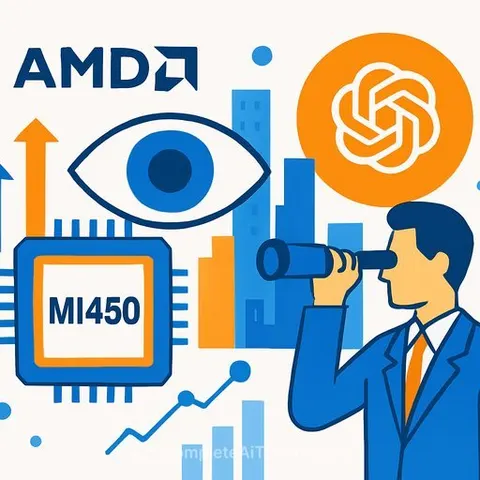
AMD Positions Itself as NVIDIA Alternative in AI Infrastructure Race
AMD has shifted from a niche chipmaker to a major supplier of AI infrastructure components, driven by strong demand for its data center processors and graphics processing units. The company's revenue growth now centers on EPYC server CPUs and MI300 GPUs, with partnerships across Amazon Web Services, Microsoft Azure, and Google Cloud Platform.
CEO Lisa Su attributed the momentum to "accelerating adoption of high-performance EPYC and Ryzen CPUs and significant growth in the data center AI business." AMD's strategy involves offering customers a complete product stack-CPUs, GPUs, networking, and embedded systems-from a single vendor, reducing supply chain risk compared to relying solely on NVIDIA.
The Competitive Advantage
AMD partnered with TSMC to close performance and cost gaps with Intel while building a chiplet-based processor architecture. The company now competes directly against NVIDIA in AI accelerators, a market where NVIDIA's pricing power has created demand for alternatives.
Major hyperscalers-AWS, Microsoft, Meta, Oracle, and others-have publicly stated they want multiple suppliers for AI compute. This preference for dual-vendor strategies gives AMD a structural advantage as customers seek to avoid single-source dependencies.
AMD's software ecosystem remains a constraint. The company's ROCm platform needs to mature further to attract developers currently committed to NVIDIA's CUDA. Increased MI300X deployments and the planned MI400 ramp in the second half of 2026 should accelerate adoption, but software execution remains critical.
Financial Position and Growth Drivers
AMD's data center business generates higher-quality revenue and stronger cash flow than its legacy PC chipset business. The company is no longer a point supplier but a platform supplier, with acquisitions expanding its product portfolio.
In Q4 2025, AMD announced strong results and upgraded data center revenue guidance. The company also demonstrated a 6-gigawatt partnership with OpenAI, providing concrete evidence of large-scale deployments.
Server CPU market share gains continue to build. AMD's EPYC processors are taking share from Intel, while its MI300 and upcoming MI400 accelerators position the company as a credible second source for AI compute.
Valuation and Risk Factors
As of April 22, AMD traded at a trailing price-to-earnings ratio of 109 and a forward P/E of 42.37. The stock has already priced in substantial future growth, leaving limited margin for execution missteps.
Three risks could undermine AMD's position. First, ROCm software maturity lags behind CUDA, potentially slowing developer adoption regardless of hardware performance. Second, supply chain constraints could limit AMD's ability to capitalize on demand. Third, negative analyst sentiment has driven sharp intraday swings-a recent downgrade caused a 4% drop despite strong momentum.
Quarterly guidance accuracy and execution will determine investor confidence. Each quarter functions as a vote on AMD's GPU capabilities, server share gains, and software progress.
For Product Development Professionals
AMD's strategy illustrates how product architecture decisions-chiplet design, full-stack integration, and ecosystem development-create competitive advantage. The company's focus on solving customer problems (supply diversification, cost reduction) rather than chasing NVIDIA feature-for-feature demonstrates a product-led approach.
The ROCm challenge also highlights a common product development problem: winning on hardware alone isn't sufficient. Software maturity, developer experience, and ecosystem health determine adoption rates, regardless of technical specifications.
For those building AI infrastructure products, AMD's approach offers a case study in how to compete against entrenched players: identify customer pain points (supply risk), build a differentiated product stack, and focus relentlessly on execution. Learn more about AI for Product Development and Generative AI and LLM deployment considerations.
Investment Perspective
The bull case is straightforward: AMD is the only large-scale alternative to NVIDIA in AI accelerators, EPYC CPUs continue gaining share, and major hyperscalers have committed to multi-vendor strategies for years ahead.
The bear case centers on valuation. At current multiples, AMD's stock reflects optimistic assumptions about AI capex cycles and customer willingness to adopt ROCm. A slowdown in either area could trigger significant downside.
For investors, any near-term weakness driven by negative sentiment could present entry points if you believe long-term AI infrastructure spending remains robust. Otherwise, cheaper AI-related stocks may offer better risk-adjusted returns depending on your portfolio construction.