AMD's Datacenter Momentum: What Marketers Can Do With It
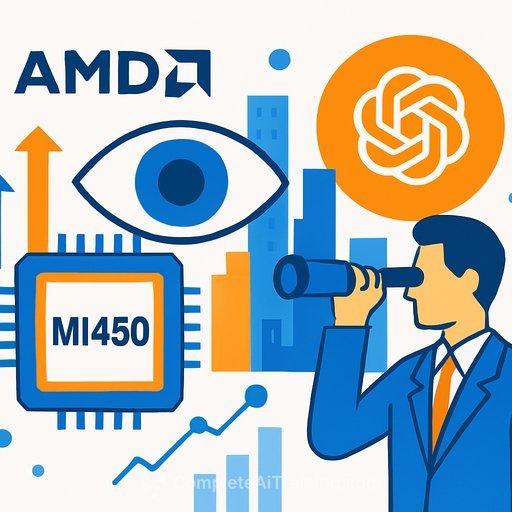
AMD is gaining ground in AI chips as Datacenter sales step up and new accelerators like the MI450 target large-scale training and inference. Customers such as Arista Networks are shifting workloads to AMD hardware, hinting at broader adoption. Management is calling an inflection point, backed by a product roadmap running through 2026 and beyond.
Add one more catalyst: Ariel Kelman joins as Senior Vice President and Chief Marketing Officer. His background at Salesforce, AWS, and Oracle signals a push for full-stack storytelling that links CPUs, GPUs, and software into solutions that can stand up against Nvidia, Intel, and custom hyperscaler silicon.
Why this matters to marketers
AI infrastructure buying is consolidating around trusted platforms. The story that wins is simple: measurable outcomes, predictable delivery, and clear paths off incumbent stacks. If AMD converts its technical wins into reference-rich proof and developer traction, the Datacenter uptick can become durable revenue - and a category narrative marketers can scale.
Your marketing brief for AMD's AI moment
- Unify the platform story: Tie CPU + GPU + software into one offer by workload (training, fine-tuning, inference) with clear SKUs and outcomes.
- Lead with proof: Publish customer references by use case (RAG, vision, speech, fine-tuning) with before/after metrics and deployment timelines.
- Ecosystem first: Show validated partners for networking, storage, MLOps, and model providers. Make "who we work with" an asset, not a footnote.
- Developer motion: Invest in docs, sample repos, migration guides from competitor stacks, and office hours. Reduce time-to-first-kernel and time-to-inference.
- Competitive clarity: Translate MI450 advantages into buyer math: throughput, latency, availability, and total cost per token trained or served.
- Partner-led GTM: Co-market with cloud providers, integrators, and ISVs. Push reference architectures and fast paths to production.
Messaging angles that land with buyers
- Time-to-value: How fast can a team move from POC to production on MI450-based platforms?
- Economics that scale: Cost per trained parameter and cost per million tokens served - apples-to-apples versus alternatives.
- Openness and portability: Support for common frameworks, container images, and orchestration so teams aren't boxed in.
- Supply and delivery: Availability, lead times, and capacity commitments matter as much as benchmarks.
- Reference designs: Clear blueprints for LLM training, RAG, and low-latency inference, including networking with partners like Arista.
KPIs marketers should watch
- Share of voice versus Nvidia and hyperscaler silicon across enterprise and developer channels.
- Reference velocity: net-new public case studies per quarter in cloud and on-prem.
- Time-to-POC and win rate for competitive takeouts or dual-sourcing deals.
- Developer engagement: SDK downloads, docs usage, sample repo stars/forks, and workshop attendance.
- Attach rates: CPU + GPU + software sold together on targeted workloads.
- Efficiency: Operating expenses versus Datacenter revenue to gauge how well demand gen converts.
Risks to factor into your plan
- Heavier marketing and ecosystem spend for AI infrastructure can limit near-term operating leverage while competing with Nvidia, Broadcom, and in-house hyperscaler chips.
- Concentrated AI customer exposure raises the bar on execution for large, complex deployments.
Where the upside sits
- Strong Datacenter revenue trends and a deeper accelerator roadmap give AMD more surface area in AI infrastructure spend.
- A CMO with cloud and enterprise experience can sharpen the message, strengthen partner motions, and improve developer pull.
Plays you can run this quarter
- Category POV: Publish a clear stance on training vs. inference economics and where MI450 wins today.
- Proof library: Build a public, filterable gallery of benchmarks, TCO calculators, and migration outcomes.
- Workload pages: Create solution pages for RAG, fine-tuning, and streaming inference with bill-of-materials and sizing guides.
- Developer programs: Launch challenges, sandboxes, and migration bounties with certified partners.
- Co-selling kits: Give partners ready-to-send pitches, ROI one-pagers, and demo scripts tied to reference architectures.
What to watch next
- Tighter platform messaging, more public reference customers, and visible developer outreach following Kelman's appointment.
- Operating expenses versus Datacenter revenue to judge whether heavier AI-focused spend is driving adoption relative to competitors.
- Progress on MI450 execution, follow-on products, and the pace at which large customers scale deployments and multi-year deals.
Helpful sources
Level up your team
If you're leading AI messaging or product marketing, upskilling your org pays off fast. Consider the AI Learning Path for Business Unit Managers to tighten GTM and cross-functional alignment, the AI Learning Path for Technology Managers to accelerate deployment and developer enablement, or the AI Learning Path for CIOs for governance and enterprise IT strategy.
Note: This article is informational and not financial advice. Do your own research before making investment decisions.
Your membership also unlocks: