AMD in the AI supercycle: what product leaders need to know
Advanced Micro Devices (NASDAQ: AMD) has moved from challenger to core supplier across CPUs, GPUs, and adaptive computing. As of December 12, 2025, its bets on AI accelerators, EPYC server CPUs, and Ryzen AI PCs are translating into growth and share gains.
If you build products that rely on compute, memory, or acceleration, AMD's roadmap and partnerships now directly influence your timelines, BOM, and performance ceilings.
Quick history that explains today's strategy
- 1969-2008: From logic chips and x86 second-source (IBM era) to Athlon, 64-bit Opteron, and the ATI acquisition; spun off manufacturing into GlobalFoundries in 2008.
- 2014-2020: Dr. Lisa Su resets the company; Zen architecture returns AMD to high performance. Ryzen and EPYC change the trajectory.
- 2022-2025: Xilinx acquisition adds FPGAs/adaptive SoCs. Follow-on deals (Pensando, Nod.ai, Silo AI, ZT Systems) extend networking, software, and systems capability. Engineering headcount doubles; R&D roughly quadruples since 2019.
Business model in one page
- Fabless design: Manufacturing outsourced (primarily TSMC). AMD focuses on architecture, packaging, and software.
- Revenue engines: Client (Ryzen), Data Center (EPYC + Instinct + FPGAs/Adaptive), Gaming (Radeon + console SoCs), Embedded (CPU/GPU/APU/FPGAs/SOMs).
- Customers: Consumers, enterprises, cloud providers (Azure, Google, Oracle, Alibaba, OpenAI), console OEMs, and embedded integrators.
- Services/IP: Support, developer tools (ROCm, Vitis AI), and IP licensing.
Products and roadmap (PD view)
- CPUs: Ryzen, Ryzen PRO, Threadripper/PRO, EPYC. AI PCs add NPUs (XDNA) for on-device inference.
- GPUs: Radeon for gaming/pro; Instinct accelerators (MI300A/X, MI350 series) for training and inference in data centers.
- Adaptive: Zynq, Versal, Spartan, Artix, Virtex for edge, networking, 6G, automotive, and data center offload.
- Cadence: Annual AI accelerator updates (MI325/350/400/450/500 series). CPU roadmap moves to advanced TSMC nodes (e.g., 2nm "Venice"/future Zen generations).
- Software: Open ecosystem push with ROCm and deep partnerships with PyTorch and Hugging Face. ROCm docs
- PCs: Next-gen "Gorgon" and "Medusa" target big gains in on-device AI.
Financial snapshot (Q3 2025)
- Revenue: ~$9.2B (+36% YoY, +20% QoQ). Data Center ~$4.3B (+22% YoY). Client + Gaming ~$4.0B (+73% YoY). Embedded ~$857M (-8% YoY).
- Margins: GAAP gross 52%; non-GAAP gross 54%. GAAP operating margin 14%; non-GAAP 24%.
- Net income: GAAP ~$1.2B (EPS $0.75). Non-GAAP ~$2.0B (EPS $1.20).
- Balance: ~$7.24B cash and equivalents vs. ~$3.22B debt.
- Cash flow: ~$1.79B from operations; record ~$1.53B free cash flow.
- Guide: Q4 2025 revenue ~\$9.6B; non-GAAP gross margin ~54.5%.
- Valuation context: High multiples (P/E, P/S, EV/EBITDA) signal strong growth expectations.
Competitive dynamics
- CPU share (Q3 2025): Overall x86 ~25.6% AMD; desktop ~33.6%; mobile ~21.9%; server ~27.8% and climbing.
- GPU share (Q3 2025): Discrete GPUs ~92% NVIDIA, ~7% AMD, ~1% Intel.
- AMD strengths: Zen architecture execution, multi-chiplet design, value in CPUs/GPUs, adaptive computing from Xilinx, open software momentum, and annual AI cadence.
- AMD constraints: ROCm maturity vs. CUDA, dependence on foundries, smaller balance sheet vs. peers.
Industry currents that will move your roadmap
- AI/HPC demand and HBM growth drive compute design, memory bandwidth, and power delivery choices.
- Chiplets and advanced packaging improve cost/performance; AMD was early here.
- Supply chain is concentrated (Taiwan, Korea, U.S.) with long lead times and cost inflation.
- Geopolitics and export controls influence SKU availability, pricing, and delivery windows. See CHIPS resources.
Key risks to plan for
- Foundry reliance: TSMC capacity, node availability, and potential geopolitical shocks.
- Export controls: MI308 hit led to an ~$800M inventory charge and a ~$1.5-$1.8B 2025 revenue impact; fast pivots to MI350/355X are underway.
- Scaling and yield: AI accelerator demand can outstrip supply; slips ripple through customer commitments.
- Software gap: CUDA retains a wide lead; ROCm adoption must keep improving.
- Custom silicon: Hyperscalers' in-house ASICs can cap TAM for merchant GPUs.
- End-market swings: PC/Gaming cycles, embedded variability, and macro slowdowns.
Opportunities and near-term catalysts
- Data Center AI: Company targets >60% revenue CAGR for data center and >80% for data center AI over 3-5 years.
- Design wins and partnerships: $50B+ since 2022; OpenAI deal (6 GW), plus Azure, Google, Oracle, Alibaba.
- AI PCs: 250+ platforms planned; big gen-over-gen NPU gains on the roadmap.
- China: Potential reopening for certain AI SKUs could expand addressable demand.
- M&A: Silo AI, ZT Systems, Nod.ai, Enosemi, Brium deepen full-stack capability.
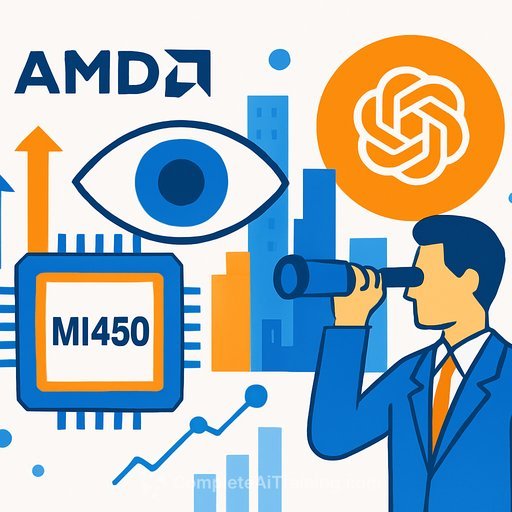
- Launches: RDNA 4 mainstream GPUs, Ryzen 9000X3D, Ryzen Z2 (2025); MI450 and "Helios" systems in 2026; MI500 in 2027.
What product leaders should do next
- Architect for heterogeneity: Combine EPYC (compute), Instinct (training/inference), and FPGAs/Adaptive (offload, networking) to match workload profiles.
- Design for software choice: Treat ROCm as a first-class target alongside CUDA; budget time for kernels, compilers, and ops tooling.
- Plan for HBM constraints: Optimize memory footprints; prioritize tensor sparsity, quantization, and caching strategies.
- Spec multiple SKUs: Maintain export-compliant, mid-tier, and high-end options to keep global channels open.
- Adopt a multi-vendor stance: Qualify AMD and NVIDIA builds early; keep BOMs flexible to handle supply shifts.
- Stress test TCO: Compare throughput/$, energy/$, and cluster density under your real models, not just benchmarks.
- Bring inference to the edge: Use Ryzen AI NPUs and Adaptive SoCs where latency, privacy, or cost demand local processing.
- Co-design for interconnect: Budget for fabric bandwidth and NIC upgrades (SmartNIC, AI NIC) to avoid cluster headroom loss.
90-day implementation checklist
- Week 1-2: Map AI workloads (training vs. inference), memory bandwidth needs, and interconnect limits. Set acceptance criteria.
- Week 3-6: Stand up ROCm stacks; port 3-5 priority models; compare against existing CUDA baselines.
- Week 7-8: Run TCO studies across EPYC + Instinct + HBM configs; document perf-per-watt and throughput-per-dollar.
- Week 9-10: Define A/B hardware BOMs (export-friendly, mid-tier, flagship). Lock alternate suppliers.
- Week 11-12: Build an AI PC pilot for product teams using Ryzen AI laptops to validate on-device inference use cases.
Leadership and governance notes
- CEO Dr. Lisa Su led the turnaround and continues to set an aggressive CPU/GPU/Adaptive roadmap supported by a seasoned executive team and a board focused on execution and ESG.
- Governance and sustainability programs are formalized with strong external recognition.
Outlook: bull vs. bear (and how to respond)
- Bull case: Annual AI cadence lands; MI350/450/500 adoption scales; EPYC crosses 50% server share; ROCm momentum compounds. Response: Invest in AMD-first builds and lock long-term capacity.
- Bear case: CUDA moat holds; foundry or export limits slow ramps; Intel regains CPU ground; hyperscaler ASICs trim TAM. Response: Keep dual-vendor paths, emphasize adaptive/edge designs, and renegotiate SLAs tied to delivery milestones.
For skill-building and team enablement
- Upskill PM/Eng teams on AI platforms and deployment patterns by job role: AI courses by job
Fast facts for context
- Stock (approx. 12/12/2025): ~$221.43; 1-year change ~+70%; 5-year ~+141%; 10-year ~+7,600%.
- Q3 2025: Record revenue, strong cash flow, high margins; guidance implies continued top-line growth.
- Market share: CPU share rising; discrete GPU and AI software share still behind NVIDIA, but improving.
Bottom line
AMD has earned a seat at the table for AI infrastructure, high-performance CPUs, and adaptive computing. For product teams, the practical move is clear: qualify AMD builds alongside existing stacks, pressure-test workloads on ROCm, and keep multiple SKUs ready to ship. That mix of optionality and hands-on validation will protect schedules and unlock better TCO as the AI cycle continues.
Your membership also unlocks: