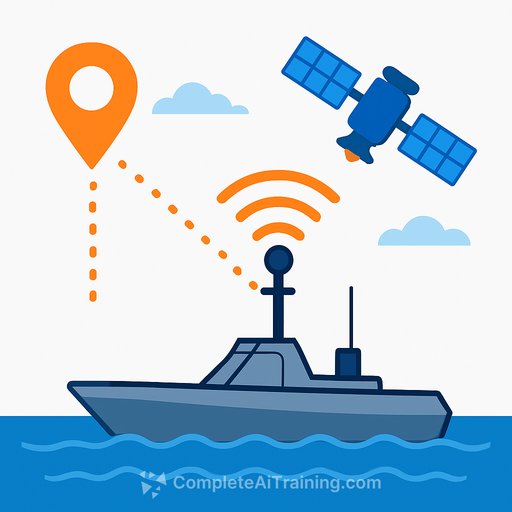
Plug-and-play GPS-denied navigation for next-generation and legacy maritime platforms
Anello Photonics and Mythos AI are joining forces to make maritime navigation resilient when satellite signals drop out or degrade. The solution combines Anello's Silicon Photonics Optical Gyroscope (SiPhOG) with Mythos AI's autonomy stack and sensor fusion to deliver a plug-and-play module that holds course without GPS.
It's built to drop into both new builds and legacy vessels with minimal integration. A multi-mission open systems architecture supports defense, commercial, and hybrid operations at scale.
Why GPS independence matters at sea
Offshore operations depend on reliable Positioning, Navigation, and Timing. Yet interference, spoofing, and coverage gaps are real. A resilient, GPS-independent backbone keeps vessels on mission when signals fade.
For background on PNT resilience and risks, see NIST's overview of Positioning, Navigation, and Timing (PNT).
What the collaboration delivers
- SiPhOG-based inertial navigation: Optical gyroscope sensing for stable heading and motion data without satellite dependence.
- Advanced sensor fusion: Integrates inertial data with external sensors to maintain accuracy across conditions.
- AI-driven collaborative autonomy: Intelligent decision layers that support higher autonomy levels and fleet operations.
- Plug-and-play integration: Drop-in form factor and open interfaces to cut engineering time.
- Open systems architecture: Multi-mission framework for defense, commercial, and hybrid use cases.
Strategic focus: autonomy and USVs
The initiative zeroes in on the fast-growing unmanned surface vehicle (USV) sector, where dependable end-to-end navigation underpins safety and mission success. USVs now support offshore energy, maritime security, hydrography, environmental monitoring, and defense.
Learn more about USVs here: Unmanned surface vehicle.
Key advantages for operators and integrators
- Greater operational assurance in GPS-denied or contested environments
- Improved autonomy and mission continuity during signal disruptions
- Lower integration complexity for OEMs and system integrators
- Scalability across diverse vessel sizes and mission profiles
Where it fits
- Legacy retrofits: Add resilient navigation to existing fleets without re-architecting systems.
- New platforms: Speed time-to-sea with a pre-integrated autonomy and navigation core.
- Multi-mission fleets: One architecture for energy, survey, security, and defense roles.
Collaboration model
Anello and Mythos AI will work directly with OEMs, integrators, and end users to align performance and interfaces with evolving operational and regulatory needs. The goal: shorten deployment cycles and deliver predictable outcomes in GPS-challenged waters.
What researchers and R&D teams should watch
- Performance drift characteristics of SiPhOG in long-duration missions
- Fusion strategies that blend inertial, perception, and maritime data feeds
- Collaborative autonomy behaviors across multi-vessel operations
- Validation methods in contested or denied PNT scenarios
Building autonomy and sensor fusion for maritime systems? Explore the AI Learning Path for Research & Development Engineers.
Bottom line
This partnership pairs photonic-grade inertial sensing with intelligent autonomy to keep vessels on track when GPS is unreliable. It's a direct path to dependable, scalable navigation for USVs and crewed platforms across commercial and defense missions.
Your membership also unlocks: