Anti-Generative AI Protest at the Annecy International Animation Film Festival
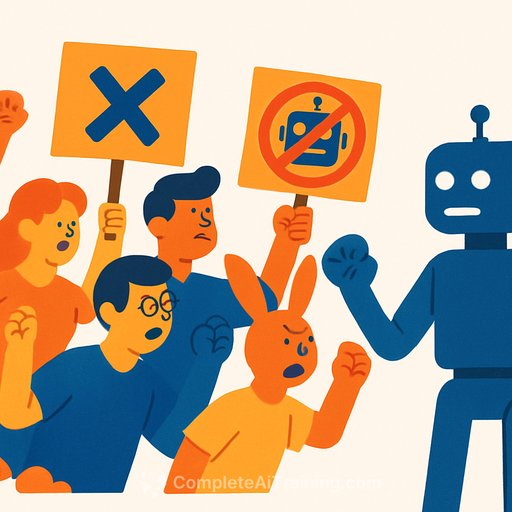
On Thursday, representatives from international animation guilds, screenwriters, and actors came together at the Annecy Animation Film Festival to protest against the rise of generative AI and its impact on their crafts and creativity. Around 150 participants gathered on Le Paquier, the grassy area in front of the Bonlieu National Theater, holding guild flags and banners to express their opposition to AI in creative work.
The topic of AI, especially generative AI, has sparked intense debate at Annecy this year. Many professionals in animation worry about what AI means for their creative skills and job security. Meanwhile, a smaller group promotes embracing the technology. Lauri Sanders, a Belgian director and artist leading the AI task force at Belgium’s animation workers union ABRACA, voiced key concerns in a statement on behalf of over 20 guilds worldwide.
“Generative AI is neither a tool, nor effective, nor cheap. It is a copying machine that is flawed, destructive, and expensive to run. GenAI literally builds upon and draws not only from the copyrighted works it was trained on, but also from the local human cultural values and norms embedded within those works,” the statement reads.
Signatories include guilds from the UK (Bectu), Ireland (GWUI, AWI), the US (The Animation Guild), the Netherlands (Kunstenbond), and numerous French organizations such as La Guilde, Syndicat des Scénaristes, and SPIAC-CGT. The statement highlights the risks of unchecked generative AI and demands consent for training AI on copyrighted works, fair compensation for creators, and control over how their work is used.
The protest was led by France’s Les Intervalles, an association fighting abuse and discrimination in animation. French actor and animator Milo Hustache-Mathieu called the gathering “historic,” emphasizing the unprecedented unity across international unions and organizations. He urged others to join the cause, emphasizing solidarity as crucial to protect creative workers.
Howard Wimshurst, a UK hand-drawn animation specialist and influencer, also spoke to the crowd. He stressed that the protest is an essential step, highlighting the solidarity represented by the guild flags. Wimshurst warned against voices promoting generative AI as “just a tool,” explaining that AI technology is being used as a means to exploit creators and their lifelong work.
The Full Statement Highlights
The animation industry has faced significant challenges in recent years. Economic difficulties linked to streaming, pandemic-related budget changes, studio closures, layoffs, and outsourcing have all taken a toll. Generative AI’s rapid adoption is seen by some as a supposed fix, promising easy content creation from vague prompts.
However, the statement firmly rejects this notion. Generative AI is described as a flawed and costly copying machine that threatens creative innovation and cultural diversity. It risks pushing artists out of their fields and privatizing the artistic process, replacing human creativity with biased outputs controlled by a few.
The statement also points to wider societal harms linked to AI, including misinformation, fabricated evidence, privacy violations, and environmental damage from the massive energy and water demands of AI computation.
Key Demands for Ethical AI Use
- Consent: AI training using copyrighted works must require informed consent from the creators.
- Compensation: Creators deserve fair payment when their work—be it illustrations, writing, voice work, or likeness—is used in AI-generated content.
- Control: Creators must maintain authority over how their work and identities are adapted or reproduced by AI to protect their intellectual property and reputation.
The statement calls for regulators and governments to enact laws protecting creative workers and cultural value. It urges producers and studios to prioritize the workforce and their work. Most importantly, it calls on creative professionals worldwide to unite, support human-made art, oppose unregulated AI implementation, and organize through unions.
Supporting Organizations
- ABRACA (Belgium, animation workers union)
- AGrAF (France, directors, graphic authors and writers association)
- BECTU (UK, Broadcasting, Entertainment, Communications and Theatre Union)
- AWI (Ireland, animation workers union)
- CNT-SIPMCS (France, press media culture and show union)
- CSVI (Spain, video game union)
- FIA (International Federation of Actors)
- FIM (International Federation of Musicians)
- FNSAC-CGT (France, Federation of Entertainment Unions)
- La Guilde française des scénaristes (France, writers union)
- GWUI (Ireland, videogame workers union)
- Les Intervalles (France, association against abuse and discrimination in animation)
- Kunstenbond (Netherlands, illustration, comic and animation workers)
- La Ligue des auteurs professionnels (France, authors union)
- Syndicat des Scénaristes (France, writers union)
- SFA-CGT (France, actors dubbing and comedians union)
- Snam-CGT (France, musicians union)
- SNTPCT (France, animation and VFX workers union)
- SPIAC-CGT (France, animation workers union)
- STJV (France, video game workers union)
- The Animation Guild (USA, animation workers and writers union)
- TouchePasàMaVF (France, actors dubbing association against GenAI)
- Uni MEI (International Art and Entertainment Alliance)
For writers and creators concerned about AI’s impact, this movement highlights the importance of asserting control over your work and demanding fair treatment. Staying informed and connected with unions can help protect your creative rights and livelihood. For those looking to strengthen their skills in AI and related fields, resources like Complete AI Training offer relevant courses.
Your membership also unlocks: