AI agents are coming for your team's work. Here's how to lead through it.
Borsi Cherny, a leading engineer at Anthropic, didn't sugarcoat it. He says advanced AI agents will swell into nearly every computer-based job - engineering, product, design - and the shift will hurt before it helps. His point: this isn't a toy. It's a new operating system for how digital work gets done.
At the front of this shift is Anthropic's coding agent, Claude Code. Unlike a typical chatbot, it can run commands, build sites, and execute complex tasks end to end. Early signal: productivity per engineer has already ticked up since its release, and Cherny even floated that the "software engineer" title could vanish by 2026. Bold? Yes. Dismiss it at your own risk.
Why this matters for managers and product leaders
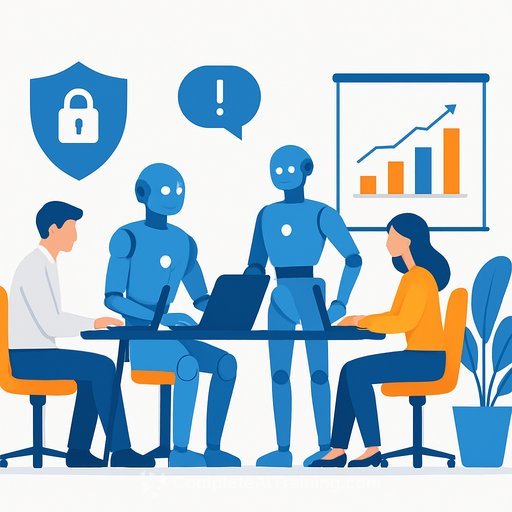
AI agents aren't just automating tasks - they're changing process ownership. Work that used to require a queue, a meeting, and two sign-offs can now run on demand. Your job shifts from assigning tasks to designing systems where humans and agents co-own outcomes.
If you haven't touched Claude or similar agents, you're operating blind. The teams that learn to delegate to agents - safely and measurably - will outpace those that wait for "clear policy."
What changes first
- Engineering: Spec-to-PR flows, boilerplate generation, refactors, tests, dependency upgrades, CI fixes, first-draft services.
- Product: PRD drafts, requirement grooming, acceptance criteria, analytics queries, experiment setup, stakeholder summaries.
- Design and research: variant exploration, UX copy, heuristic reviews, survey synthesis, design QA scripts.
- Customer and QA: support macros, triage, test generation, regression hunts, incident timelines.
- Ops and data: report building, data cleaning, cohort cuts, basic forecasting.
The growing economic signal (don't ignore it)
Concerns about displacement aren't abstract. A Federal Reserve Governor recently warned that AI is already pushing out entry-level roles in areas like customer service and software development. And Oxford Economics estimates that up to 20% of the U.S. workforce could face automation-driven disruption over the coming decades.
For context, see the Federal Reserve and Oxford Economics.
Your 90-day plan
- Pick 3 high-volume workflows where errors are tolerable and data sensitivity is low. Example: writing unit tests, grooming Jira tickets, creating release notes.
- Define guardrails: what agents can access (repos, analytics), run permissions (read-only vs. write), and when a human must approve.
- Assign clear KPIs: cycle time, PR throughput, escaped defects, support resolution time, experiment velocity, artifact quality.
- Run a controlled pilot with 5-10 people. Time-box it to 4-6 weeks. Compare against a baseline.
- Codify "agent runbooks" (inputs, prompts, steps, fallback rules, rollback plan). Treat them like playbooks, not magic.
- Upskill your PMs and leads to think in agent orchestration, evaluation, and risk. Start with this AI Learning Path for Product Managers.
- Update job descriptions to include agent supervision and evaluation. Reward outcomes, not keystrokes.
Build your "agent stack"
- Agent capability: coding, analysis, retrieval, and tool use (terminals, browsers, CI/CD).
- Orchestration: task routing, memory, handoffs between agents and humans.
- Data access: least-privilege to code, docs, tickets, analytics. No plaintext secrets.
- Execution sandbox: isolated environments with audit logs and resource caps.
- Evaluation and monitoring: automated checks, red-team prompts, drift alerts, cost dashboards.
- Identity and permissions: treat agents as users with roles, keys, and expiring tokens.
Redesign roles (titles will follow the work)
- Engineers: from implementers to system designers who specify constraints, review diffs, and own reliability.
- PMs: from task routers to problem owners who frame objectives, set success criteria, and supervise agents.
- Designers: from pixel editors to experience architects who set principles, validate flows, and guide agent-generated variants.
- QA and analysts: from finders of bugs to evaluators who build tests, benchmarks, and guardrails.
Governance without the bureaucracy bloat
- Human-in-the-loop by default for code commits, production data access, and public-facing content.
- Prohibit secret handling by agents; rotate keys often. Log every action with a tamper-evident trail.
- IP and compliance checks on generated assets (licensing, PII, security). Make it a checklist, not a meeting.
- Incident playbook for rollbacks and disable-switches when agents misfire.
Metrics that actually move the business
- Throughput: PRs merged per engineer per week, tickets cleared per agent-hour.
- Speed: lead time from idea to deploy, time-to-first-value on experiments.
- Quality: escaped defects, UX defects per release, post-release hotfixes.
- Cost: unit cost per feature/test/support resolution including agent spend.
- Risk: number of agent actions requiring rollback, policy violations caught pre-merge.
About Claude Code - and what to try first
Cherny points to Claude Code as proof that agents can do real work: run commands, create websites, and handle complex sequences. Start small: have it produce test suites, draft service scaffolds, or refactor modules behind feature flags. Measure. Keep what works. Kill what doesn't.
Then expand to product tasks: PRD drafts from call transcripts, experiment setups, and crisp stakeholder summaries. Agents do the grind. Your people do the judgment.
The bottom line
Don't fear the agents. Train them. Supervise them. And redesign your org so humans set direction and validate outcomes while agents handle the repeatable work.
This isn't hype. It's a manager's new job description.
Your membership also unlocks: