Anthropic joins the AI push into healthcare with new Claude tools
Anthropic introduced a suite of healthcare and life sciences features that let people share access to their health records with Claude. The move closely follows OpenAI's ChatGPT Health launch, signaling a wider shift: large AI models are stepping into patient-facing and provider-facing workflows.
Both efforts focus on personalizing health conversations using data from medical records and fitness apps like Apple Health and Android Health Connect. They are not for diagnosis or treatment; the goal is to help people make sense of information and manage tasks that take time and attention.
What's available now
Claude's health records functions are live in beta for U.S. Pro and Max users. Integrations with Apple Health and Android Health Connect are rolling out in beta to those plans this week.
OpenAI's ChatGPT Health requires a waitlist. Both companies say the tools can summarize complex reports, surface trends, and reduce routine admin work.
Why this matters for clinicians and health systems
The immediate upside is workflow relief. Anthropic highlights use cases such as drafting prior authorization packages, mapping clinical guidelines to chart data for appeals, and assembling documentation that often stalls care.
Health tech vendors see an opening to cut clicks and rework. Commure's CTO said Claude's features could save clinicians millions of hours annually-time that can be redirected to patient care.
Privacy, security, and compliance
Anthropic says health data shared with Claude is excluded from model memory and not used for training. Users can disconnect or change permissions at any point.
For enterprise use, Anthropic cites a "HIPAA-ready infrastructure" and connections to federal coverage databases and provider registries. As always, confirm Business Associate Agreement (BAA) terms and audit trails against your internal policies and regulatory requirements. For a refresher on HIPAA rules, see the U.S. HHS overview here.
Guardrails and risk
Major AI companies, including Anthropic and OpenAI, continue to warn that models can make mistakes and should not replace professional judgment. Anthropic's acceptable use policy requires a qualified professional to review any healthcare decisions or outputs before they are finalized.
This comes amid scrutiny of chatbots giving mental health and medical guidance. Treat these tools as assistants for summarization, drafting, and triage support-never as final arbiters of care.
For patient-facing use
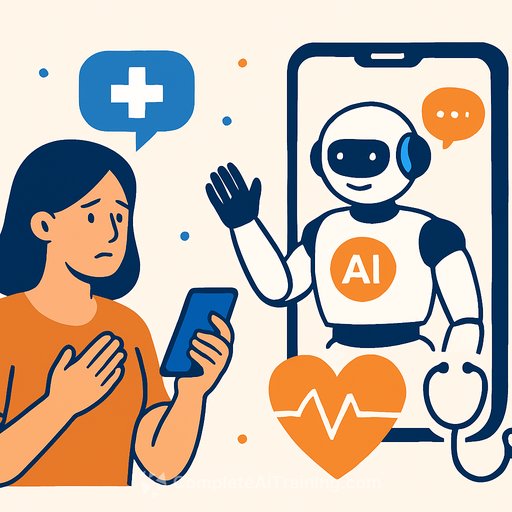
Patients can link health records and fitness data to ask clearer questions and get plain-language explanations. Expect better recall of past labs, medications, and care plans, plus reminders about follow-ups and documentation they may need.
Set expectations up front: the assistant provides education and administrative support, not a diagnosis. Provide escalation paths for urgent symptoms or mental health concerns.
For provider and admin teams
- Chart summarization: distill long notes into key problems, meds, allergies, and timelines.
- Prior authorization prep: assemble clinical criteria, relevant encounters, and guideline references.
- Appeals support: match payer policies to chart facts, draft letters, and cite sources.
- Patient education: generate plain-language after-visit summaries and action steps for adherence.
- Inbox load reduction: propose drafts for routine messages with clear flags for clinician review.
How Claude compares with ChatGPT Health (at a glance)
- Access: Claude's health features are in beta for U.S. Pro/Max now; ChatGPT Health uses a waitlist.
- Data sources: Both can use health records and consumer health data (e.g., Apple Health, Health Connect).
- Positioning: Both emphasize education, trends, and logistics-not diagnosis or treatment.
Implementation checklist for healthcare leaders
- Select low-risk workflows first (documentation prep, summarization, appeals drafting).
- Establish review requirements: every draft gets clinician or qualified staff sign-off.
- Governance: define data scope, retention, audit logs, incident response, and patient consent flows.
- Compliance: confirm BAA coverage, access controls, PHI handling, and vendor security posture.
- EHR and data integration: limit to the minimum necessary; validate mapping and provenance.
- Quality and safety: create prompt libraries, red-flag triggers, and evaluation metrics (accuracy, time saved).
- Training: coach staff on effective prompts, verification habits, and documentation standards.
Bottom line
Anthropic's move brings mainstream AI deeper into day-to-day healthcare work. The value shows up where the hours go: documentation, prior auth, appeals, and patient communication.
Treat these systems like strong interns-fast, useful, and always double-checked. With tight guardrails and clear review paths, they can cut administrative drag without compromising care.
If your team needs structured upskilling on Claude and healthcare use cases, explore this practitioner-focused pathway: Claude Certification for Healthcare Teams.
Your membership also unlocks: