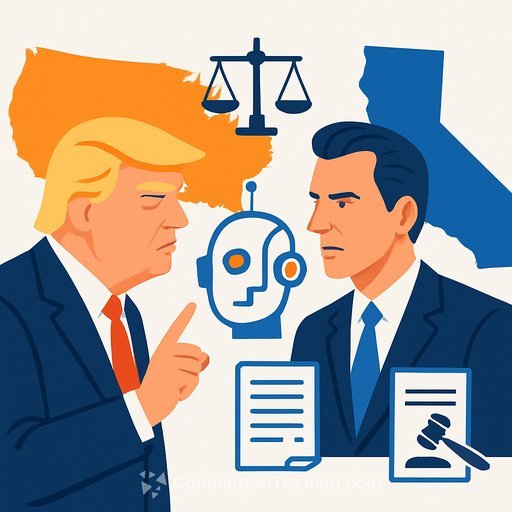
Anthropic Sues to Block Pentagon Blacklist: The Legal Claims, Standards, and What's Next
Anthropic has filed suit to stop the Pentagon from placing the company on a national security blacklist, escalating a dispute over government use of its AI systems. The complaint names the U.S. government, President Donald Trump, and Defense Secretary Pete Hegseth, among others.
The filing also challenges a directive allegedly announced by President Trump on Truth Social directing federal agencies to halt work with Anthropic. The company argues the government's moves were unlawful and punitive.
The Claims at a Glance
- First Amendment retaliation: Government blacklisting allegedly in response to Anthropic's protected speech about AI safety and the limits of its own services.
- Ultra vires presidential action: The President's alleged directive to stop all federal work with Anthropic exceeded his legal authority.
- Fifth Amendment due process: Effective blacklisting without notice or an opportunity to respond.
- Administrative Procedure Act (APA): DoD's supply-chain risk designation and downstream prohibitions were arbitrary, lacked proper procedure, and overstepped statutory authority.
First Amendment Retaliation
Anthropic frames its public and governmental advocacy on AI safety as protected speech and petitioning. The core theory: the government cannot punish a contractor for its viewpoint by terminating or blocking work, subject to the government's interest in efficient operations and security.
Courts typically weigh whether protected expression was a substantial or motivating factor in adverse action and then consider the government's justification. Here, any record tying the blacklist to Anthropic's speech-versus bona fide national security grounds-will be pivotal. Expect disputes over motive, evidentiary sufficiency, and how much of the record can be disclosed.
Background reference: First Amendment.
Ultra Vires Presidential Directive
Anthropic alleges the President's instruction to halt federal work with the company exceeded lawful authority. The analysis will likely turn on the source of any claimed statutory or constitutional power, and where it falls under the familiar separation-of-powers framework.
Court-ordered relief often runs against subordinate officials and agencies, not the President directly. If the directive lacks a statutory hook, agency defendants may try to ground their actions in existing procurement, national security, or supply-chain risk authorities.
Fifth Amendment Due Process
The complaint claims the government imposed a blacklist without notice or a meaningful chance to respond. Contractors often contend they have a protected liberty interest when the government imposes a stigmatizing exclusion that forecloses future work.
Due process typically requires notice of the reasons and an opportunity to contest. The government may argue that national security constraints limit disclosures, pushing for procedures like in camera review or use of classified supplements. The court will balance fairness with protection of sensitive information.
APA Challenge to DoD's Supply-Chain Risk Designation
Anthropic argues the designation, and the resulting prohibition on contractors, suppliers, and partners doing business with it, was arbitrary, procedurally defective, and unsupported by evidence. Under the APA, courts look for reasoned decision-making grounded in the record and within statutory bounds.
Key questions: What statute or regulation DoD relied on, whether the agency followed required steps, and the adequacy of the administrative record. The government may invoke national security or "committed to agency discretion" defenses that can narrow review or the available remedy.
Background reference: Administrative Procedure Act.
Immediate Procedural Moves to Watch
- Preliminary injunction: Anthropic will need to show likelihood of success, irreparable harm (e.g., contract terminations, reputational injury, market exclusion), balance of equities, and public interest.
- Record and classification: Expect fights over the scope of the administrative record, protective orders, and any ex parte or in camera submissions.
- Scope of the alleged directive: Whether the action is DoD-only or government-wide affects standing, remedies, and the breadth of any injunction.
- Defendants and relief: Courts may decline to enjoin the President personally and instead target agency heads and contracting authorities.
Practical Takeaways for Legal Teams
- Preserve all communications and contracting documents that could show motive, timing, and reliance on protected speech versus bona fide security concerns.
- Request formal notice of any exclusion and an opportunity to respond; push for unclassified summaries where possible and a process for handling classified material.
- Prepare parallel tracks: constitutional/APA relief for injunctive and declaratory remedies, and contract-specific strategies for terminations and potential damages under procurement frameworks.
- Build a concrete mitigation record (security controls, compliance posture, supply-chain assurances) to counter generalized risk assertions.
Where This Could Land
If the court sees plausible retaliation or procedural shortcuts, a tailored injunction restoring eligibility or pausing the blacklist is possible while the merits are litigated. If the government substantiates a statutory basis and a reasoned, security-driven decision, the action could survive, potentially with limited disclosure.
The battleground will be motive, authority, and process-backed by a record the court can actually review.
Related Resource
For broader context on how AI intersects with legal practice and government policy, see AI for Legal.
Your membership also unlocks: