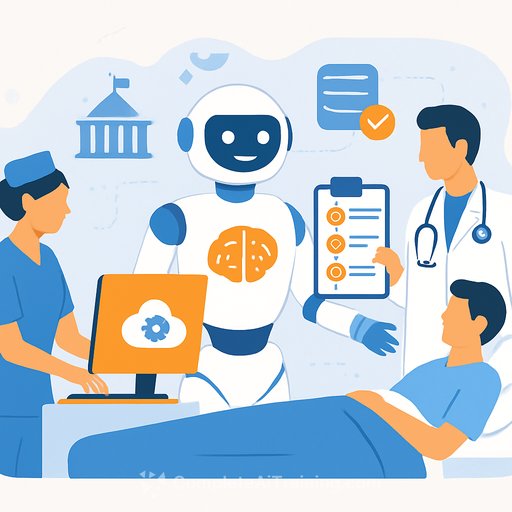
Appian (APPN): What the HL7 AI Challenge Win Means for Healthcare Leaders - and Whether the Stock Still Looks Fairly Priced
Appian's "Bring AI to Work(flow)" platform just won the HL7 AI Challenge, spotlighting a practical push toward cleaner data interoperability and responsible AI use in healthcare. The stock has jumped 30.7% over the past month and 42% over 90 days, though one-year total return sits at 7.2% after prior drawdowns.
The core question for operators and investors: does the healthcare momentum translate into sustained adoption and margin improvement, or has the recent rally already priced in the upside?
Why the HL7 recognition matters for care delivery
HL7's focus is interoperability and data standards. Acknowledgement here signals real progress in connecting clinical workflows to structured data-think cleaner FHIR resources, faster prior authorization, and fewer swivel-chair tasks between systems.
For providers and payers, this points to fewer manual handoffs and better audit trails around PHI handling and model outputs. If Appian's platform continues to reduce friction between EHRs, claims systems, and operational workflows, the impact shows up in throughput, denials, and care coordination speed.
Is the rally already priced in?
Most popular narrative: fairly valued. Consensus fair value is cited at $41.60 versus a recent close near $41.34-basically "about right." The bullish angle leans on operational execution: better sales alignment and eight straight quarters of improving go-to-market efficiency that could expand margins and lift long-term earnings power.
The obvious tension: how much of that improvement is already embedded in the price after the recent run. With sentiment turning, execution needs to keep pace.
The cautious view: DCF points lower
A discounted cash flow look pegs fair value closer to $27.73 per share. That implies the market is baking in ambitious growth and margin gains.
If healthcare deals slip or expansion slows, the downside gap becomes visible fast. Valuation now leans on delivery, not promises.
What healthcare leaders should watch next
- Interoperability depth: quality of FHIR integrations, EHR connectivity, and reduction in manual reconciliation.
- AI governance: provenance, bias controls, human-in-the-loop checkpoints, and documented auditability of model outputs.
- Security and compliance: HIPAA posture, PHI segmentation, encryption, and policy enforcement across workflows.
- Unit economics: continued sales productivity gains, subscription gross margin trend, and operating leverage.
- Adoption signals: healthcare ARR mix, multi-year renewals, and upsells tied to clear ROI (denials, throughput, LOS).
- Implementation speed: time-to-value for pilots, standard templates for prior auth, care gaps, and revenue cycle use cases.
- Competitive pressure: large platforms with embedded workflow and AI stacks (e.g., incumbents in ITSM, CRM, and BPM).
Practical takeaways for providers and payers
- Start small, measure hard: run a 60-90 day pilot over a single workflow (e.g., prior auth or care gap closure) with clear baselines.
- Fit to standards: ensure FHIR-native data handling and clean interfaces to core systems to avoid custom sprawl.
- Quantify ROI: track cycle time, denial rates, staff hours saved, and model error correction costs.
- Guardrails first: require model explainability, PHI controls, and audit trails before scaling.
- Avoid lock-in: push for modular design so you can swap models or components without rewriting the workflow.
Risks to the rosy case
Enterprise competition is fierce, and larger platforms can cross-sell workflow plus AI. Healthcare procurement cycles are long, and budget reallocation can delay expansions.
If customer growth softens, the valuation gap exposed by DCF becomes harder to ignore.
Bottom line
The HL7 win validates Appian's direction on interoperability and responsible AI in healthcare workflows. The stock, however, sits between two stories: "about fairly valued" if execution continues, or stretched if growth wobbles.
For healthcare operators, the decision is simple: prove value on one workflow, codify governance, then scale. For investors, this is an execution story-watch margin progress, healthcare deal velocity, and the durability of sales productivity gains.
Further learning
If you're building internal AI capability for clinical and operational teams, explore curated programs here: AI courses by job.
Note: This article is for information only and is not investment advice.
Your membership also unlocks: