Will Apple's New Legal and AI Leadership Structure Shift Its Long-Term Growth Narrative?
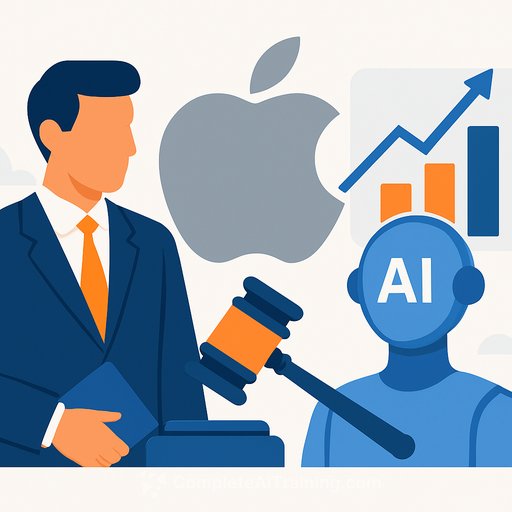
Apple is consolidating power where it matters: law and policy. With general counsel Kate Adams and environment chief Lisa Jackson retiring, and former Meta chief legal officer Jennifer Newstead slated to lead a merged Legal and Government Affairs group in 2026, the company is building a single command center for antitrust, platform policy, and product launches tied to Apple Intelligence.
Add the planned retirement of AI head John Giannandrea and you get the bigger picture: Apple is aligning senior talent around AI, services, and regulatory exposure. For legal teams watching from the outside, this is less about headlines and more about execution discipline under tighter rules, especially on the App Store and default-service controls.
Why Newstead's Appointment Matters to Legal Pros
Combining Legal and Government Affairs sets one playbook for litigation, compliance, and product policy. Expect faster policy-to-product loops, clearer enforcement lines, and fewer internal contradictions that regulators love to find.
Newstead's background suggests a global posture: heavy litigation experience, platform policy at scale, and a read on how governments move. That matters with the DOJ's antitrust suit in the U.S. and DMA obligations in the EU pressing on distribution, steering, and default settings.
- U.S.: DOJ complaint targets alleged exclusionary conduct and mobile ecosystem control. See the case overview from the Department of Justice here.
- EU: DMA enforcement tightens on gatekeepers across app stores, payments, and interoperability. Overview here.
The Investment Narrative (Condensed)
Owning Apple right now means you believe the ecosystem flywheel, services expansion, and Apple Intelligence can carry a premium valuation-even as regulation tightens and hardware growth slows.
Current projections referenced by the market imply $477.4 billion in revenue and $133.6 billion in earnings by 2028. That's about 5.3% annual revenue growth and a ~$34.3 billion earnings lift from ~$99.3 billion today, with a fair value framing near $281.75 per share-roughly aligned with recent pricing. The tension: execution on AI and services versus legal outcomes that could compress App Store economics.
Regulatory Flashpoints to Watch
- App Store fees and steering: Commission rates, alternative payment methods, and developer steering rules across geographies.
- Default service status: Search, browser, and wallet placement; potential remedies around choice screens and preinstalls.
- Distribution models: Sideloading and alternative app marketplaces in the EU; knock-on effects for fraud, IP enforcement, and review pipelines.
- Privacy-competition tradeoffs: Claims that privacy is used to favor first-party services; need for measurable, policy-based justifications.
- AI data use: Training data provenance, on-device vs. cloud processing, and auditability for safety and bias claims.
What Changes with a Combined Legal + Government Affairs Org
- Single strategy: Aligns litigation, policy advocacy, and product requirements under one hierarchy.
- Faster mitigations: Policy concessions can translate into product tweaks on compressed timelines.
- Consistent record: Reduces "say-do" gaps regulators cite in remedies and penalties.
Scenario Notes Legal Teams Should Model
- Commission compression: A blended 3-10 point reduction on App Store take rates across key markets could trim Services gross profit. Size your case by assuming the App Store is a material, but not majority, slice of Services.
- Remedies outside fees: Steering permissions and distribution changes may shift developer behavior even without headline rate cuts, impacting attach rates for Apple services.
- Default-setting outcomes: Choice screens and API access changes can dilute first-party usage share; model lower cross-sell for iCloud, Apple Music, and Wallet.
- AI governance cost: Data provenance controls, model evaluations, and on-device constraints increase compliance overhead but may reduce regulatory heat if documented well.
Tactical Questions for In-House Counsel and Policy Leads
- Do product roadmaps document necessity and proportionality for privacy and security controls that affect competition?
- Are steering, payments, and review policies consistent across markets-or do they invite differential enforcement?
- Is there a defensible audit trail for AI data sources, safety testing, and user consent flows?
- What is our response plan if a remedy forces distribution changes within 6-12 months?
- How do we quantify the effect of choice screens on default retention and downstream service revenue?
2025-2026 Watchlist
- Litigation milestones: Key U.S./EU decisions and interim measures on App Store and defaults.
- Policy consultations: DMA implementation updates and guidance that tighten interpretations.
- Leadership handoff: Newstead's onboarding and org design; check for outside hires in antitrust and platform integrity.
- AI launches: Apple Intelligence rollouts beyond early markets; privacy claims versus competitive access.
How This Reframes Risk and Opportunity
The leadership reshuffle doesn't change near-term AI catalysts, but it does put legal outcomes closer to the valuation center. If Apple protects App Store economics while scaling AI-powered services, the 2028 targets look more attainable. If remedies bite, expect a slower profit ramp and higher compliance spend-manageable, but valuation sensitive.
Build Your Own Apple Narrative
Forecasts are opinions in spreadsheet form. Pressure test your case with at least three policy outcomes: mild, moderate, and strict. If you need to tighten your AI literacy for legal and policy work, explore AI courses by job to upskill your team's review standards.
Exploring Other Perspectives
Community fair value ranges of roughly $175-$309 per share show how different assumptions on regulation and services can swing outcomes. Before you anchor on a single number, align your legal risk map with your growth drivers and test the edge cases.
About NasdaqGS:AAPL
Apple designs, manufactures, and markets smartphones, personal computers, wearables, and accessories worldwide.
Your membership also unlocks: