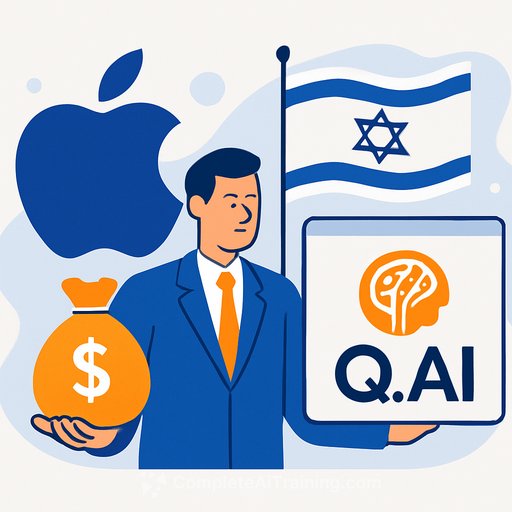
Apple buys Israeli start-up Q.AI for close to $2bn - what finance teams should do next
Apple has acquired Israeli start-up Q.AI for close to $2bn in a push to build AI-first devices. It's a bold check, even by Apple standards, and a clear signal that on-device AI is moving from slideware to product roadmap.
For finance leaders, this is less about headlines and more about modeling, risk, and timing. Here's a practical read on what matters and how to respond.
What's confirmed (and what isn't)
- Deal size: close to $2bn.
- Target: Q.AI, an Israeli start-up focused on AI capabilities that Apple wants inside future devices.
- Strategic intent: accelerate AI features built into hardware, not just the cloud.
- Official filings and granular financials aren't public yet. Treat specifics as directional until Apple updates investors.
Why this makes sense for Apple
- Talent and IP: Apple historically buys teams and technology that fit its silicon and privacy-first approach to on-device intelligence.
- Vertical integration: pairing AI models with Apple silicon can improve speed, battery life, and user experience without leaning on external cloud spend.
- Time-to-market: a $2bn check is faster than building everything from scratch, especially with the current hiring market for senior AI researchers.
How to model the deal (quick framework)
- Funding: expect all-cash. With Apple's balance sheet, the cash impact is negligible at the company level.
- Purchase accounting: allocate to identifiable intangibles (developed tech, in-process R&D, customer assets if any), with the remainder to goodwill. Amortization of intangibles will hit GAAP operating income.
- Retention: assume a multi-year expense for stock-based comp and stay bonuses. GAAP vs. non-GAAP gaps may widen near term.
- EPS effect: likely immaterial in year one given Apple's scale, but watch for opex drift as the team is integrated and scaled.
Valuation context
Apple rarely does multi-billion acquisitions. A near-$2bn price tag puts this among its larger technology buys and suggests scarcity value for talent and IP that enable on-device AI. The premium isn't about revenue today; it's about shortening the path to AI-native features across iPhone, Mac, and wearables.
What to watch next
- Disclosures: any color in Apple's next earnings call or 10-Q on allocation to intangibles and expected amortization.
- Hiring velocity in Israel: headcount growth is a strong tell for how aggressively Apple plans to scale this bet.
- Product breadcrumbs: references to on-device AI frameworks, upgraded NPUs, or SDK announcements that hint at distribution into the developer ecosystem.
- Supplier chatter: indications that component orders are shifting toward AI-optimized silicon and memory.
Implications for public markets
- Apple: supports a thesis of higher device ASPs tied to AI features and deeper services engagement. Watch gross margin guidance and commentary on AI-driven upsell.
- Chipmakers: on-device inference boosts demand for NPUs, high-bandwidth memory, and energy-efficient compute. Track commentary from key semiconductor suppliers.
- Israeli tech: positive signal for AI valuations and acqui-hire activity in the region.
- Competitors: expect faster follow-on deals from other OEMs looking to secure similar capabilities.
Risk checklist
- Integration: culture fit, retention of key researchers, and aligning research roadmaps with product deadlines.
- Regulatory: standard antitrust review, plus any cross-border approvals. Nothing unusual, but timing matters.
- Geopolitical exposure: operating and hiring in Israel require contingency planning and insurance review.
- Privacy and data: on-device claims demand tight guardrails; any misstep would carry outsized reputational risk.
Actions for finance and corp dev teams
- Update AI M&A comps with a separate cohort for on-device capabilities; price talent and IP differently than cloud-only plays.
- Revisit your product P&L assumptions: model AI features as ASP and margin drivers, not just cost centers.
- Build a purchase accounting template now (ASC 805 / IFRS 3) for faster scenario work when details land.
- Map supplier exposure to AI-capable silicon and memory. Negotiate capacity early if your roadmap depends on similar parts.
Helpful sources
- Apple Investor Relations - watch earnings materials for acquisition and capex commentary.
- IFRS 3: Business Combinations - for purchase price allocation mechanics (parallel to ASC 805).
Upskill for the next deal cycle
If you're evaluating AI investments or building the finance model behind them, a fast scan of practical tools can help. Start here:
- AI tools for Finance - vetted options to speed analysis, modeling, and reporting.
- AI Research Courses - practical, research-focused resources to help evaluate models and on-device AI capabilities.
Bottom line: a near-$2bn AI acquisition by Apple signals heavier on-device investment across its hardware line. Model the accounting, pressure-test your supply and talent assumptions, and get ahead of the next wave of AI-native products.
Your membership also unlocks: