Apple Accelerates AI Wearables Toward a 2027 Launch
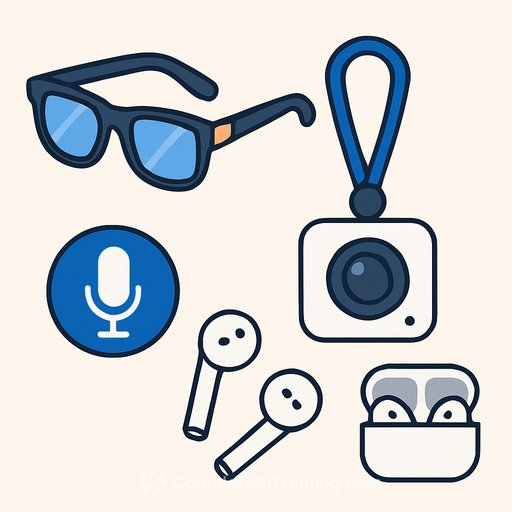
Reports indicate Apple is speeding up development on three AI wearables: a camera pendant, AI-enabled smart glasses (codename N50), and AirPods with new AI features. These devices are expected to tether to the iPhone with Siri at the center of interaction.
Coverage from TechCrunch and Bloomberg points to an aggressive timeline. Production of the glasses could begin as early as December, with a public release planned for 2027.
What Apple Is Building
- AI pendant: A shirt-mounted camera device roughly AirTag-sized. Expect quick-capture, context cues, and Siri-triggered actions linked to the iPhone.
- Smart glasses (N50): Likely to include a high-resolution camera. Positioned as more premium and feature-rich than the pendant and AirPods, with production potentially starting this year and release in 2027.
- AirPods with AI: Voice-first interactions, smarter context detection, and tighter Siri integration.
Why This Matters for IT and Development Teams
Apple appears to be standardizing around iPhone + Siri as the control plane for camera, audio, and ambient context. For teams building apps and services, this points to voice-first flows, low-latency vision features, and on-device inference where possible.
- APIs to watch: SiriKit/App Intents for hands-free actions, Vision frameworks for on-device image understanding, Core ML for optimized inference, and Nearby Interaction/UWB, Bluetooth LE, and LE Audio for device orchestration.
- Data flow design: Short bursts of camera capture with immediate on-device processing, summarized metadata to backends, and privacy-preserving defaults.
- Privacy and compliance: Clear camera/mic prompts, fine-grained consent, and strict retention policies. Assume conservative App Store review on background capture and bystander privacy.
- Power and performance: Budget around thermal limits and battery. Favor quantized models, efficient codecs, intermittent capture, and event-driven processing.
- UX patterns: Fast, glanceable confirmations; subtle capture indicators; voice, tap, and auto-triggered intents; always provide a no-camera fallback.
- Enterprise readiness: MDM policy support, audit trails for regulated use cases, and offline-first behavior for field environments.
Competitive Context
Apple is moving into a space where Meta and Snap already have momentum-Snap's next Specs are expected this year. Apple's edge is the iPhone installed base, tight hardware-software integration, and Siri as a unifying interface.
- Cross-platform opportunity: If you serve mixed fleets, design features that degrade gracefully on non-Apple wearables while still taking advantage of Apple-only APIs when available.
- Distribution advantage: Expect strong adoption if setup is as simple as pairing through iOS and permissions mirror existing app flows.
Practical Build Roadmap (Start Now)
- Identify high-leverage use cases: Field service, retail assistance, logistics scanning, guided workflows, accessibility, coaching, and quick video notes.
- Prototype with today's stack: iPhone + AirPods + App Intents/Siri Shortcuts for hands-free tasks; test camera-triggered flows with background processing constraints in mind.
- Stand up multimodal backends: Accept voice, image, and short video snippets; store structured summaries; implement human-in-the-loop where accuracy matters.
- Optimize models for edge: Convert to Core ML, quantize, prune, and benchmark on-device. Gate heavier workloads to server with clear user consent.
- Lock down compliance: Explicit Info.plist usage strings; role-based access; redaction for faces/license plates if your app captures public spaces.
- Plan for MDM and support: Remote policy updates, kill-switches for capture, and diagnostics that respect user privacy.
Signals to Watch Through 2027
- WWDC announcements on Siri/App Intents, Vision, Core ML, and any new wearable-specific SDKs.
- Accessory and certification programs that hint at third-party ecosystem support.
- App Store policy updates on continuous recording, bystander privacy, and AI disclosures.
- Early-access developer kits or TestFlight programs tied to the glasses.
Bottom Line
Apple's move expands an iPhone-centered wearable stack where Siri ties together camera, audio, and context. If you build for iOS today, now's the time to shape voice-first, camera-aware workflows and get your on-device AI performance story in order.
If you're skilling up your team for this shift, the AI Learning Path for Software Developers covers the core pieces: on-device ML, API integration, and production-grade app patterns for multimodal experiences.
Your membership also unlocks: