Apple Names Amar Subramanya Vice President of AI: What Executives Should Expect
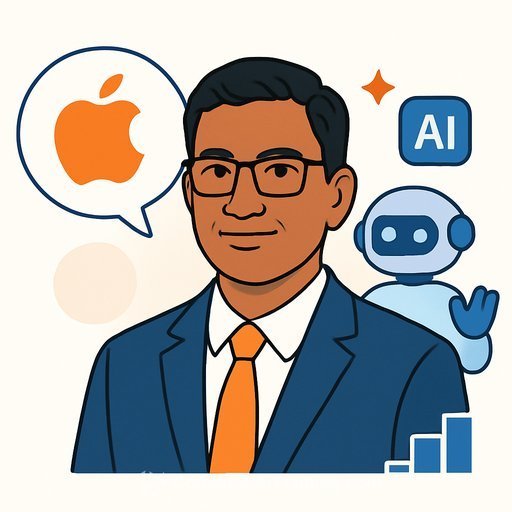
Apple has appointed Amar Subramanya as its new Vice President of AI, signaling a push to strengthen machine learning across products and platforms. He succeeds John Giannandrea, who will remain as an advisor until his retirement in 2026.
This move puts AI closer to the center of Apple's product strategy. The brief is clear: build foundational capabilities, move faster, and ship features that matter to users and the business.
Who Amar Is-and Why He's a strategic fit
Amar's background blends deep research experience with large-scale product execution. He holds an electrical, electronics, and communications engineering degree from Bangalore University (2001) and completed a PhD at the University of Washington, where he also spent time at Microsoft as an intern and visiting researcher.
He spent 16 years at Google, advancing from staff research scientist to VP of Engineering. He worked on-and later led engineering for-the Gemini assistant, giving him hands-on experience building and scaling advanced AI systems. In mid-2025, he became Corporate VP of AI at Microsoft, before Apple recruited him to lead AI end-to-end.
What He Will Lead at Apple
- In-house foundation models: Building core models that can serve on-device and cloud use cases.
- Core machine-learning research: Advancing methods that translate into product advantages.
- AI safety and evaluation: Systems to measure reliability, prevent misuse, and meet regulatory standards.
- Product integration: Embedding advanced AI across Apple's apps, services, and hardware.
He will report directly to Craig Federighi, Senior Vice President of Software Engineering, placing AI closer to software decisions and release cycles.
Why This Matters for Executives
Apple is aligning research, safety, and product integration under one accountable leader. That reduces friction between labs and shipping teams-and usually shortens time to market.
Expect a tighter focus on on-device intelligence, privacy by design, and AI features that feel native to Apple's hardware and software. The likely outcome: fewer splashy demos, more quietly useful features that drive retention, device differentiation, and services revenue.
Signals to Watch Over the Next 12-18 Months
- Platform-wide AI features: Deeper intelligence across Messages, Photos, Siri, Xcode, and productivity apps.
- On-device vs. cloud balance: Where Apple draws the line for latency, privacy, and cost control.
- Model efficiency: Evidence that Apple's models run well on custom silicon without trade-offs in quality.
- Safety benchmarks: Clear documentation of evaluation methods and transparency around limits.
- Developer ecosystem: New APIs and tooling that invite third-party innovation without compromising privacy.
Implications for Your Roadmap
- Plan for Apple-first AI features that can change user expectations for assistants, media creation, search within apps, and automation.
- Budget for testing on Apple hardware to evaluate latency, battery impact, and feature parity.
- Update your privacy posture-Apple will likely reward apps that align with its standards for data use and on-device processing.
- Pressure-test your assistant and content features against potential Siri and system-level upgrades.
Context and Further Reading
For a sense of Apple's research direction, see its public work on machine learning and privacy by design. For background on Amar's prior work, review Google's efforts around its assistant stack.
Upskill Your Leadership Team
If you're aligning product, engineering, and operations around AI initiatives, structured learning can speed up decision quality and execution.
- AI courses by job role for leadership, product, and engineering teams.
- Courses sorted by leading AI companies to mirror how top firms structure their stack and skill sets.
Bottom Line
Apple's appointment of Amar Subramanya concentrates research, safety, and shipping under one leader with proven large-scale AI delivery. Expect a faster pace, tighter integration with hardware, and features that reward ecosystem commitment.
If Apple executes, the bar for user experience-and privacy-first AI-goes up across the industry.
Your membership also unlocks: