Apple's AI reset: what the leadership shake-up signals - and how to respond
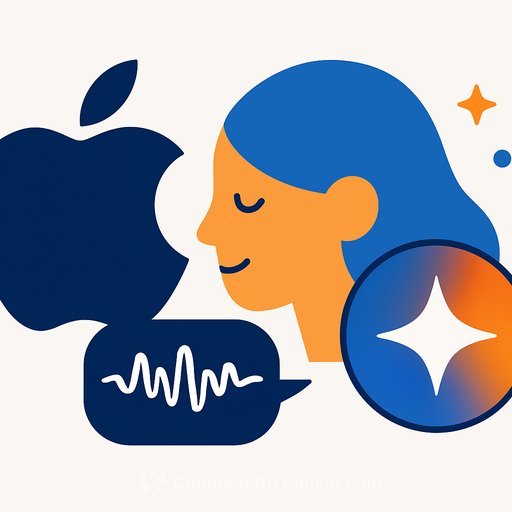
Apple just flipped the board on its AI plan. John Giannandrea is out. Amar Subramanya, a veteran of Microsoft and Google's Gemini assistant, is in. That's more than a personnel move - it's a line in the sand.
While OpenAI, Google, and Anthropic sprint and spend, Apple is choosing a measured route. Delays to the new Siri have fueled the "behind" narrative, but the balance sheet and brand give Apple room to pick its spots.
What's changing - and why it matters
- New leadership, new mandate: Subramanya's track record suggests Apple wants execution speed and product-grade AI that actually ships.
- Partnership over pride: Expect a deeper tie-up with Google to bring Gemini models into Siri. Apple looks ready to license best-in-class models instead of building everything from scratch.
- Distribution is the edge: With a massive installed base, even incremental AI upgrades can move markets. The question is timing and quality, not feasibility.
The strategic read for executives
This is a classic "buy vs. build vs. blend" moment. Apple appears to be blending: external models to accelerate time-to-value, with in-house integration to keep the experience consistent and on-brand.
It's a practical play. Outsource the heavy compute and model iteration. Own the interface, privacy posture, and the billing relationship. That mix reduces risk, speeds learning, and keeps options open.
Signals to watch over the next 12 months
- Siri upgrades: Latency, accuracy, and task continuity across apps. If Siri can reliably complete multi-step actions, the narrative flips.
- Model sourcing: Which Gemini variants power which features, and where Apple uses its own models at the edge.
- Privacy guarantees: Clear lines on-device vs. cloud. Any backsliding here will be noticed.
- Developer hooks: New APIs that let third-party apps chain actions through Siri without duct tape.
- Unit economics: Evidence that inference costs are contained via smart routing (on-device, smaller models, and caching).
What this means for your roadmap
- Stop debating. Blend: Pair licensed frontier models for complex tasks with smaller, cheaper models for the 80% use cases. Reduce cost and keep performance where it counts.
- Own the interface: The win is in the interaction layer - prompts, workflows, and embedded actions inside your core product. Don't outsource that.
- Plan for model fluidity: Write contracts and architecture assuming you will swap models every 6-12 months. Keep your data and logs portable.
- Instrument everything: Track time-to-complete, error rate, abandonment, and cost per successful task - not just "accuracy."
- Governance first: Human-in-the-loop for risky operations, audit trails, and red-teaming before launch. No heroics in production.
Why Apple's approach can still win
Being late hurts headlines, not outcomes - if the final product is reliable, private, and deeply integrated. Apple doesn't need the most novel model; it needs the most trusted assistant on devices people use all day.
If the Google partnership lands and Siri gets real task completion, the narrative shifts from "behind" to "effective." Distribution plus a frictionless interface beats lab demos every time.
Practical next steps
- Run a two-track plan: Immediate licensing for high-impact use cases, in parallel with small in-house models fine-tuned on proprietary data.
- Map your "golden workflows": Identify the top 10 tasks users repeat. Automate those first. Ignore edge cases until you've nailed the basics.
- Negotiate for observability: Demand token-level logs, cost transparency, and clear SLAs from model providers.
- Prototype inside the product: Ship micro-features monthly. Learn from real usage, not demos.
For context on Apple's current direction, see Apple's overview of Apple Intelligence here, and Google's official Gemini documentation here.
If you're building your AI capability
Upskilling your team around model selection, prompt interfaces, and cost control will pay back fast. Curated learning paths by role can speed this up - see a practical set of options here.
Bottom line: Apple's reset favors speed, partnerships, and a tight focus on the interface. That's the same playbook most leadership teams should run right now.
Your membership also unlocks: