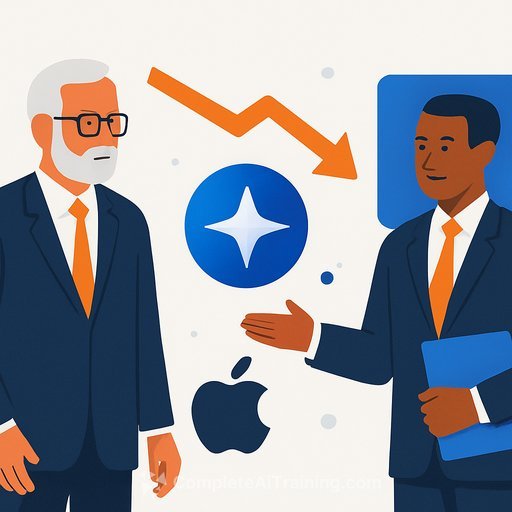
Apple's AI Chief Steps Down: What It Means for Your Strategy
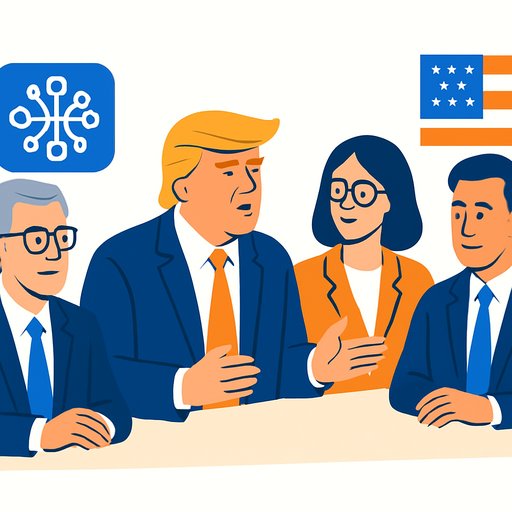
Apple announced a leadership change in AI. John Giannandrea, senior vice president for machine learning and AI strategy since 2018, is stepping down and will retire in 2026.
Amar Subramanya will take the helm after a brief stint as corporate vice president of AI at Microsoft and more than a decade at Google. Notably, he will report to Craig Federighi, one of CEO Tim Cook's deputies, rather than to Cook directly as Giannandrea did.
"AI has long been central to Apple's strategy, and we are pleased to welcome Amar to Craig's leadership team and to bring his extraordinary AI expertise to Apple," Cook said.
Why this move matters
- Product-first alignment: Shifting the AI lead to report under Federighi suggests tighter coupling of AI with OS-level features and shipping cadence.
- Partner strategy signal: Apple has integrated ChatGPT in a permissioned way and is reportedly nearing deals with Google's Gemini, Perplexity, and Anthropic. Expect a multi-model approach to balance capability, cost, and control.
- Execution pressure: Apple delayed its upgraded Siri earlier this year, acknowledging it would take longer than planned. Leadership change often comes with a reset on scope, timelines, and accountability.
- Privacy posture: Any external model integration will have to pass Apple's privacy bar. That will influence where data runs (on-device vs. cloud) and which features make the cut.
- Investor expectations: With peers advancing quickly, the market will watch for concrete product milestones, not just demos.
Product timing: Siri and Apple Intelligence
Apple introduced Apple Intelligence on June 10, 2024, promising deeply integrated, private-by-default features across devices. "With Apple Intelligence, we've introduced dozens of new features that are powerful, intuitive, private and deeply integrated into the things people do every day," Cook said.
Earlier, Apple delayed the upgraded Siri, saying it would "take us longer than we thought." Apple now targets spring for release, per recent reporting, with Cook adding, "We're making good progress on it, and… we expect to release it next year."
Today, with user permission, Siri can tap into ChatGPT's broad world knowledge and present answers directly. Those integrations remain limited, with potential expansion via partnerships under evaluation.
Apple's Apple Intelligence announcement
Market context
Perceived lag in AI services has weighed on sentiment, even as Apple remains the world's second-largest public company at roughly $4.2 trillion, behind Nvidia. Year to date: Apple +13%, Oracle +20%, Nvidia +34%, Alphabet +65%, while the S&P 500 is up nearly 16%.
Translation for operators: timing and clarity matter. The next few quarters need visible, user-facing wins.
Executive takeaways you can apply this week
- Re-map reporting lines: Seat AI leaders where shipping decisions happen. Tie model roadmaps to product owners with P&L accountability.
- Adopt a portfolio of models: Use a primary model plus specialized models by use case. Negotiate usage caps, privacy terms, latency SLAs, and cost per 1K tokens.
- Privacy by design: Treat data boundaries as product features. Codify on-device vs. cloud criteria by sensitivity, latency, and cost.
- Set hard milestones: Quarterly gates for Siri-like assistants-intent coverage, latency, task completion rate, and user satisfaction (CSAT/NPS).
- Control the last mile: Keep UX, context windows, and retrieval layers in-house. Swap models behind the scenes as economics and quality shift.
- Communicate to investors: Share a simple AI scorecard-shipping features, monthly active users touched by AI, cost per AI interaction, and safety performance.
- Talent barbell: Pair senior applied scientists with strong product managers. Incentivize shipped outcomes, not just research outputs.
Key players
- John Giannandrea: retiring in 2026 after leading Apple's machine learning and AI strategy since 2018.
- Amar Subramanya: incoming AI lead; prior roles at Microsoft (corporate VP of AI) and Google (over a decade).
- Craig Federighi: senior leader to whom Subramanya will report, signaling tighter OS and product integration.
- Tim Cook: reinforcing AI as central to Apple's strategy and pacing investor expectations.
Signals to watch in the next two quarters
- Siri upgrade delivery against the spring target, including measurable improvements in task completion and latency.
- Depth of partner integrations (Gemini, Perplexity, Anthropic) and whether they stay permissioned, on-device, or cloud-routed.
- On-device model advances vs. cost to serve in the cloud-watch for mixed inference strategies.
- Safety and privacy posture-red-teaming cadence, audit trails, and opt-in clarity for users.
- Hiring moves under Subramanya-senior applied science and platform leaders are leading indicators.
For further action
Bottom line: Apple is tightening the connection between AI leadership, OS teams, and shipped features, while keeping optionality through external model partnerships. If you run product at scale, mirror that playbook: align AI under delivery, keep your model choices flexible, and make privacy and reliability visible features-not footnotes.
Your membership also unlocks: