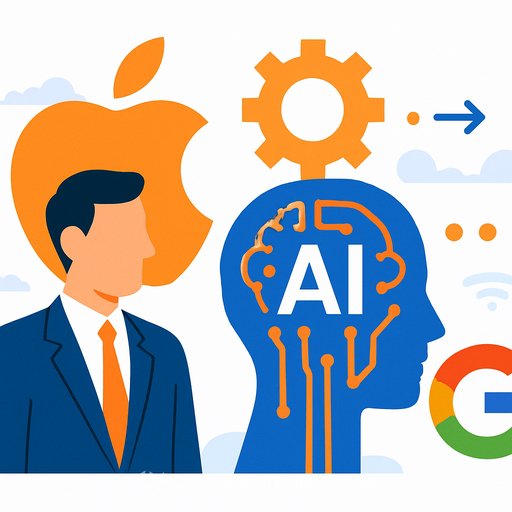
Apple's executive exits signal an AI strategy reset - not a fire drill
Apple just lost a cluster of senior leaders. In isolation, any one move is normal. Together, it looks like intent: reset the company's AI approach and move faster.
Financially, Apple is fine. Stock near highs, a market cap north of $4T, record iPhone sales, and strong Services growth. That strength buys time - but not unlimited time - to fix the AI gap.
Who left - and why this cluster matters
- Jeff Williams, COO and long-seen successor to Tim Cook, is out.
- John Giannandrea, AI/ML chief, is out; Amar Subramanya steps in and reports to software head Craig Federighi.
- Lisa Jackson, government affairs head, is out.
- Alan Dye, VP of design, is leaving for Meta to lead Reality Labs design.
- Kate Adams, general counsel, is out.
One exit is routine; five in quick succession points to a strategic turn. Analysts say Cook wants Apple leading in AI rather than following.
The real problem: AI that trails Google and Microsoft
Apple's AI story hasn't matched Google's Gemini or Microsoft's services. The next-gen Siri, previewed in 2024, is now delayed to 2026. Reporting indicates Apple may pay roughly $1B a year to use Google's models as a bridge, then swap to its own when ready.
Apple has a public baseline for its strategy with Apple Intelligence on iPhone, iPad, and Mac. If you want the official picture, see Apple Intelligence.
Why the fundamentals don't remove the urgency
Apple's user base is loyal and locked in. People aren't fleeing over Siri. That's the opportunity: fix AI while the core business is humming.
The risk is lag turning into loss of default status with AI-first buyers. Criticism of Siri stacks up. If the gap persists, share erosion follows - slowly, then suddenly.
Signals to watch (and what they imply)
- Org design: AI now sits tighter with software under Federighi. Expect faster decision cycles and clearer accountability.
- Build vs. rent: Short-term reliance on Google's models suggests a pragmatic "ship now, replace later" plan. Watch how quickly Apple swaps to in-house models.
- Siri milestones: Dates matter. A public beta before 2026 would indicate schedule pull-in and confidence.
- Design talent flow: Dye's move to Meta hints at a battle over AI-centric hardware experiences. Expect Apple to double down on cross-device AI UX.
- Developer story: On-device vs. cloud inference, APIs for third parties, and how Apple lets apps call Apple models vs. external LLMs.
- Capex and partners: GPU commitments, training runs, and any model licensing beyond Google are leading indicators.
- Low-cost MacBook rumor: A cheaper Mac could expand EDU and value segments (per TF International's Ming-Chi Kuo) while Apple seeds AI features broadly.
What this means if you run a P&L or product org
- Appoint a single owner for the end-to-end AI experience. No matrix fuzziness.
- Set a 12-18 month AI roadmap anchored to three user moments you can demo. Prioritize shipping over polish.
- Decide rent vs. build at the feature level. Use external models to learn fast; build where you need control, privacy, or unique data leverage.
- Ship quarterly. Instrument usage, review retention lift, and cut anything that doesn't move a core metric.
- Stand up a data flywheel. Collection, labeling, evaluation, privacy gating, and on-device inference where it matters.
- Pair design with research. Avoid months of over-polish without real-world feedback. Prototype with guardrails.
- Governance is product. Clear review standards, red-team models, and a comms plan for regressions.
How Apple could thread the needle
- Licensing as a bridge to close the experience gap now, without surrendering the long-term core.
- On-device advantage to differentiate on privacy, latency, and battery. That's Apple's wedge if models reach "good enough" parity.
- Integrated UX across iPhone, Mac, Watch, and CarPlay so AI feels native, not bolted on.
- Developer leverage via simple APIs that turn every app into an AI-aware app with minimal work.
Bottom line
Apple isn't falling apart. It's choosing a harder path: move from safe follower to visible leader in AI. The leadership shuffle is the tell.
If they ship credible Siri upgrades, reduce reliance on outside models, and give developers useful hooks, they'll turn loyalty into defensible advantage. If not, they'll rent differentiation in a market that rewards originals.
Want a structured way to upskill your org for this shift?
See focused, role-based options here: AI courses by job.
Your membership also unlocks: