Aptiv and Robust.AI to Co-Develop AI-Powered Cobots for Real-World Warehouse and Industrial Workflows
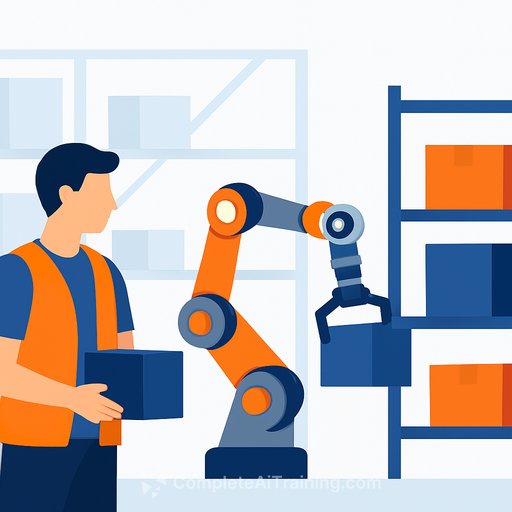
Aptiv (NYSE: APTV) and Robust.AI announced a strategic cooperation to build AI-powered collaborative robots that can work safely alongside humans in warehouses and industrial sites. The partnership blends Aptiv's perception, compute, and software stack-including Wind River platforms-with Robust.AI's robotics platform and human-centered design.
The focus is speed and scale: reliable sensing, low-latency decisioning, and secure workflows that can be deployed across multiple industries. For engineering teams, this points to a practical path from pilot to production without reinventing core infrastructure.
What's inside the stack
- Aptiv PULSE Sensor: Compact surround-view camera fused with ultrashort-range radar for consistent 360-degree sensing.
- Radar ML and Behavior ML: Real-time perception and dynamic path planning technologies stemming from Aptiv's ADAS work.
- Robust.AI Platform Architecture: AI-driven optical sensing and decision models, real-time SLAM, a patented holonomic drive, and a force-sensitive handlebar that hands control to a human instantly when needed.
- Expanded PoC with Wind River: VxWorks RTOS and Helix Hypervisor for deterministic response, virtualization, and flexible system designs.
That combination aims to deliver consistent performance under variable conditions-tight aisles, mixed traffic, occlusions-while keeping latency low and control handoff intuitive. The emphasis on secure, scalable workflows suggests a path for multi-site rollouts without brittle one-off integrations.
Carter: one platform, multiple workflows
Robust.AI's Carter is a software-defined cobot that can act as a picker, point-to-point transporter, and mobile sorter. Teams can adapt it to different workflows on a single hardware base instead of managing separate fleets.
Carter's drop-in approach targets fast time-to-value with data-driven insights on throughput, dwell times, and bottlenecks. Facilities can iterate layouts and logic as demand patterns shift, without replacing the platform.
Why it matters for engineering teams
- Safety + HRI: 360-degree sensing and a force-sensitive handlebar support close-quarter human collaboration without clunky mode switching.
- Determinism where it counts: VxWorks RTOS and virtualization via Helix Hypervisor help isolate critical workloads while keeping latency predictable.
- Path planning under uncertainty: Behavior ML plus perception ties into proven ADAS learnings for dynamic, real-time route decisions.
- Scalability: Aptiv's global supply chain and integration experience reduce risk when moving from prototype to volume deployment.
Notable perspectives
Javed Khan, EVP and President of Software, Advanced Safety and User Experience at Aptiv, highlighted the push to bring perception, compute, and software together at the intelligent edge to deliver measurable outcomes across industries.
Rodney Brooks, Co-Founder and CTO at Robust.AI, emphasized how Aptiv's AI models, sensors, and real-time systems for autonomous vehicles will strengthen Carter's ability to work safely with people in dynamic spaces.
Practical considerations for implementation
- Data pipeline and labeling: Align sensor data schemas early. Define event taxonomies (near-miss, occlusion, handoff) for consistent analytics.
- Timing and sync: Treat clock sync and sensor calibration as first-class concerns; missed timestamps degrade both perception and replay debugging.
- Network QoS: Segment control traffic from telemetry. Budget for peak loads (fleet updates, bursty video) to avoid control-plane contention.
- Safety and compliance: Map features to site-specific policies and required certifications. Document human handoff states and fail-safe behaviors.
- Deployability: Use virtualization to isolate components (SLAM, planning, orchestration) so you can update one without halting the whole stack.
What to watch next
Expect expanded proofs of concept using Aptiv compute with Wind River's VxWorks and Helix Hypervisor across more facility layouts and industry use cases. The big signal will be how quickly teams can standardize on a common software and safety model across multiple sites.
For the full announcement, see the press release on Business Wire. For background on the RTOS foundation, review VxWorks.
Level up your team
If your roadmap includes AI automation and cobot workflows, structured training can shrink the ramp. Explore focused programs at Complete AI Training.
Your membership also unlocks: