
AI news ·
AQ Reaches 140M Users, 60% from Lower-Tier Cities, as Ant Group Scales AI Healthcare
AQ now supports 140M users, 60% beyond top-tier cities. AI agents, senior voice access, and 5,000+ hospital links speed guidance while clinicians focus on complex cases.
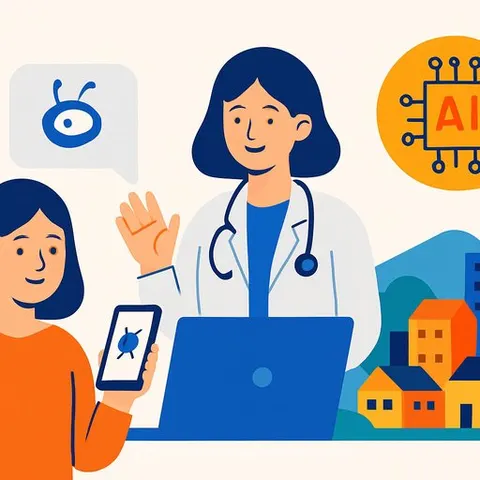
AQ puts AI-assisted care in patients' hands - at national scale
Ant Group's AI healthcare app, AQ, has crossed 140 million users since its June 2025 launch in China, with 60% from tier-three and lower-tier cities. At the 2025 INCLUSION . Conference on the Bund in Shanghai, the company introduced new features aimed at making high-quality care accessible across geographies and care settings.
"We hope AI can empower doctors by extending their reach to more patients, freeing up time for medical research and the fight against complex diseases, while equipping community doctors with powerful AI assistants," said Cyril Han, CEO of Ant Group.
AQ by the numbers
- 140 million users; 60% outside top-tier cities.
- Access to digital services from 5,000+ hospitals and online consultations with 200,000 doctors.
- 300+ specialty AI Doctor Agents co-developed with leading physicians and departments.
- 100+ AI services: doctor recommendations, medical report analysis, personalized health guidance, and more.
Why this matters for healthcare teams
- Hospital leadership: Extends service reach without proportional staffing growth; reduces wait times by routing routine questions to AI while reserving clinicians for higher-acuity cases.
- Community clinicians: Point-of-care support for triage and differential prompts; quicker interpretation of labs and imaging summaries to inform next steps.
- Specialty departments: Publish and maintain AI agents reflecting department protocols; standardize patient education and pre/post-op guidance.
- Nursing and care coordinators: Consistent follow-up instructions and chronic disease reminders that align with care plans.
- IT/Clinical informatics: A single patient-facing front end that connects to hospital digital services and remote monitoring devices.
New features that can move the needle
- AI Agent Development Platform: Doctors and institutions can build their own agents, encoding local pathways and specialty knowledge.
- Senior-friendly access: A hotline launched with China Mobile allows seniors to use voice commands to reach AQ services.
- Unified health archive: Expanded data consolidation and broader integrations with wearables and chronic-disease devices for a clearer longitudinal view.
- AI skin assessment: Photo-based recognition of 50+ skin conditions to support triage and timely guidance.
Early outcomes
In a study of 150 doctors diagnosing 1,000 patients, community doctors using the Urology AI Agent co-developed with Shanghai's Renji Hospital saw diagnostic accuracy improve by 4% to 8%. Results like this point to targeted gains when AI is embedded in a defined workflow and paired with specialty oversight.
How AQ supports different care settings
- Primary care: Symptom intake, triage prompts, guideline reminders, and referral suggestions.
- Specialty care: AI Doctor Agents reflecting department protocols (e.g., cardiology, thoracic surgery) for consistent decision support and patient instructions.
- Telemedicine: Asynchronous Q&A, remote monitoring summaries, and patient education that reduce follow-up load.
- Rural and community clinics: On-demand access to higher-tier expertise and standardization across clinics.
Implementation checklist
- Define two high-volume use cases (e.g., urinary symptoms triage, dermatology screening) and pilot with clear inclusion criteria.
- Map data flow to your EHR and device ecosystem; confirm consent, security, and audit logging.
- Set clinical guardrails: escalation rules, human-in-the-loop checkpoints, and alignment with local guidelines.
- Measure impact: diagnostic accuracy by condition, time-to-answer, referral appropriateness, no-show reduction, and patient satisfaction.
- Train staff: short workflow playbooks and quick-reference prompts for common scenarios.
- Monitor equity: track uptake and outcomes across age, region, and socioeconomic segments; adjust outreach and access points (including voice).
Notable clinical contributors
- Jian'an Wang, Director of the Heart Center, The Second Affiliated Hospital of Zhejiang University School of Medicine.
- Jun Wang, President of Peking University People's Hospital and thoracic surgery expert.
Context and related updates
Ant Group also noted that Ant Fortune, its investment management platform, will open AI tools to financial institutions for research, operations, and content creation. While outside clinical care, this signals broader AI deployment across regulated industries.
Where this fits in digital health
AI-enabled telemedicine is becoming core infrastructure for access and continuity, especially in underserved regions. For broader context on virtual care, see WHO's overview of telemedicine frameworks and use cases: WHO: Telemedicine.
Upskill your team
If you're building AI fluency across clinical and operations roles, explore curated training by job function: Complete AI Training - Courses by Job.
Bottom line
AQ combines wide patient reach with specialty-built AI agents and practical access points like voice for seniors. For healthcare teams, the value is in targeted workflows, measurable outcomes, and tight integration with existing services-so patients get timely guidance and clinicians keep focus on complex cases.