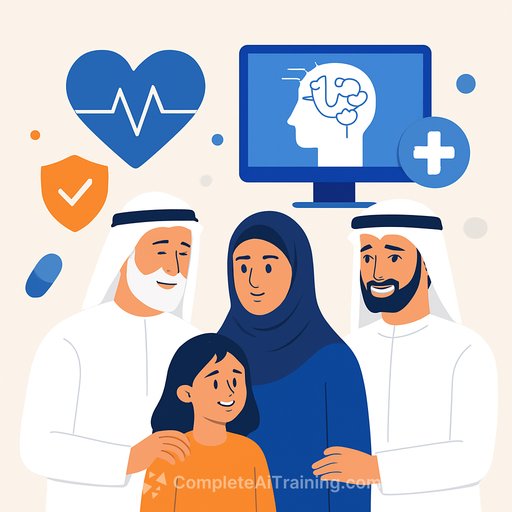
Emirates Health Services puts family-first, long-view care on center stage at Arab Health 2026
Emirates Health Services (EHS) announced a comprehensive vision at the Arab Health 2026 exhibition: long-term investment in human health, built on family-focused care models and data-driven prevention. Over four days starting Monday, EHS will present technologies and strategies aimed at raising care quality and sustainability across the UAE.
This participation highlights integrated solutions aligned with the UAE's declaration of 2026 as the Year of the Family. Expect projects that span early diagnostic models using advanced analytics to digital tools that support patients throughout their care journey.
Healthy longevity and proactive prevention
EHS places healthy longevity at the core of its strategy. The focus: early detection of risk, longitudinal assessment, and preventive action before disease emerges.
The goal is straightforward-extend productive, healthy years and lower the burden of chronic conditions. It's a shift from reactive treatment to proactive health management that anticipates risk and improves outcomes.
Itminan program: stability across life stages
Itminan anchors the long-term approach with comprehensive care models. It addresses physical, psychological, and social health, paired with periodic risk assessments and personalized plans for each age group.
The model emphasizes continuous care and long-term relationships between families and providers. From childhood through healthy aging, individuals receive timely, appropriate support.
Family-centered healthcare models
EHS frames the family as the starting point for sustainable health planning. Prevention, treatment, and supportive services sit within one integrated system.
The intent is a seamless experience: smooth transitions across care levels, less fragmentation, and consistent quality throughout the patient journey.
AI and digital health: from data to decisions
EHS will highlight AI-driven decision support and digital companions that follow patients across episodes of care. Intelligent systems analyze clinical data and guide evidence-based decisions, helping clinicians improve diagnostic accuracy and treatment effectiveness.
For clinical leaders evaluating these tools, focus on real-world validation, interoperability, and how they fit into existing workflows-not just features.
- Interoperability: Confirm standards-based integration (e.g., FHIR), minimal disruption to EMR use.
- Clinical validation: Look for peer-reviewed evidence, bias assessments, and clear performance metrics.
- Governance: Define data stewardship, model monitoring, and update cycles.
- Safety and ethics: Ensure explainability, audit trails, and patient consent models.
- Workforce readiness: Plan training for clinicians, care coordinators, and IT support.
Strategic vision: what it means for providers
According to EHS leadership, the strategy begins with the family, advances healthy longevity as a national priority, and uses AI as a practical tool for better care design. It signals a clear move from treatment-first to prevention-first.
That means earlier prevention, longer-term planning, and a smoother care experience end-to-end. Timelines for rolling out specific programs beyond the exhibition have not been confirmed.
What to watch at Arab Health 2026
- Early risk detection models that combine clinical, lifestyle, and social data.
- Digital tools that enable longitudinal care plans and patient follow-up.
- Care coordination layers that reduce handoff friction across primary, specialty, and community services.
- Metrics that track added healthy life years, adherence, and reduced acute utilization.
- Provider enablement: clinical pathways, training programs, and change management kits.
Implementation checklist for health systems
- Data foundations: Clean data, shared terminology, and APIs that connect EMR, labs, and registries.
- Population health: Stratify risk, define cohorts, and set prevention targets by age and family unit.
- Care models: Embed screening and preventive touchpoints into primary care and home health.
- Workforce: Upskill clinicians on AI-enabled workflows and patient communication.
- Outcomes: Track clinical, operational, and patient-reported results with transparent dashboards.
- Equity: Monitor access and outcomes by demographic groups to avoid widening gaps.
Resources
Build AI fluency across your teams
If your organization is accelerating digital and AI initiatives, structured upskilling reduces risk and shortens time to value. Explore role-based tracks and practical courses for clinical and non-clinical teams.
- AI courses by job function
- For analytics and governance teams, consider the AI Learning Path for Data Scientists to build practical skills in model development, validation, and deployment.
Your membership also unlocks: