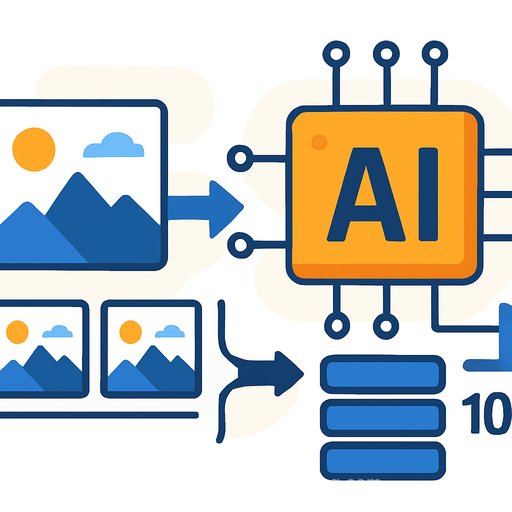
Real-Time AI Cuts Data Analysis Delays at Research Facilities
Argonne National Laboratory has deployed an AI system that processes imaging data instantly at the source, eliminating weeks of manual review. The move addresses a fundamental problem in scientific research: the gap between data collection speed and human analysis capacity.
Modern light sources and electron microscopes generate data faster than researchers can evaluate it. When errors occur-a misaligned sample or incorrect instrument setting-they often go undetected until the experimental window has closed, wasting resources and time.
The SYNAPS-I Platform
A multilab team built the Synergistic Neutron and Photon Science - Intelligence (SYNAPS-I) AI platform specifically for imaging analysis. Unlike general-purpose systems, it incorporates the physics of coherent imaging directly into its design, allowing it to process data the way the instruments themselves operate.
Researchers tested the system using ptychography, an X-ray technique that reconstructs high-resolution images from overlapping diffraction patterns. Testing at the Advanced Photon Source and the Center for Nanoscale Materials-both Department of Energy Office of Science facilities-showed the AI performs complex reconstructions in seconds rather than hours or days.
Edge Computing Benefits
Processing data at the beamline rather than in a distant data center produces measurable gains:
- Results are processed 100 times faster than traditional workflows
- Real-time detection of material defects ensures only successful runs proceed
- Data storage costs drop by allowing selective refinement of high-value datasets
- Researchers identify subtle correlations and generate hypotheses without manual intervention
Mathew Cherukara, leader of the Argonne SYNAPS-I team, said the platform enables laboratories to function as intelligent, self-driving systems. The model was trained on data from more than 100 beamlines, making it applicable across the Department of Energy complex.
Rethinking Laboratory Workflow
Adopting real-time data analysis requires laboratories to treat processing as part of experimental design, not a post-experiment task. Researchers can now make decisions during experiments-adjusting manufacturing processes or identifying valuable materials instantly.
This approach frees researchers from managing data backlogs and lets them focus on interpretation. For fields ranging from microelectronics to biomedical research, the ability to process data at collection speed provides a competitive advantage.
Learn more about AI for science and research applications.
Your membership also unlocks: