
AI news ·
Argonne National Laboratory uses artificial intelligence and robotics to conduct autonomous scientific experiments
Argonne National Laboratory is testing AI robotic platforms that run 1,000 experiments simultaneously. The systems aim to accelerate discovery by a factor of hundreds.
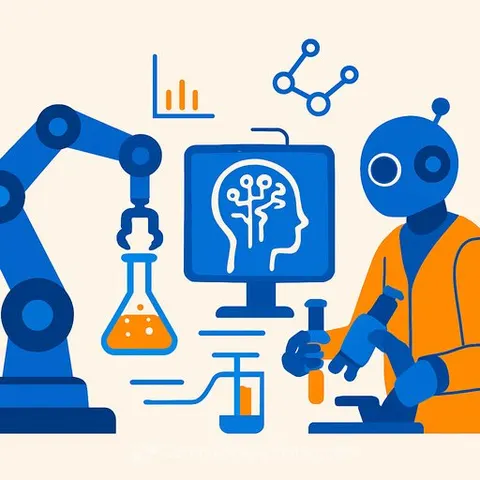
The U.S. Department of Energy's Argonne National Laboratory is developing robotic autonomous platforms that pair AI with physical experiments, aiming to speed up scientific discovery by a factor of tens to hundreds. The lab's RAPID (Robotic Autonomous Platforms for Innovative Discovery) initiative combines robotic arms, AI-driven analysis, and closed-loop decision-making to run experiments around the clock without human fatigue.
How the RAPID labs operate
Inside Argonne's RAPID-200 facility, a serpentine robotic arm moves along a motorized rail, picking up chemical solutions and placing them into analysis instruments inside a glass-walled enclosure. A command station with six monitors relays instructions from AI models, and the system tests materials for energy storage, quantum computing, and microelectronics. Ilke Arslan, deputy associate laboratory director for Physical Sciences and Engineering, describes it as a "closed-loop scenario" where the computer and robots circulate information until the desired result is achieved.
"Data is analyzed by the computer, and AI would make the decision about which experiment to do next," Arslan said. "So, you would tell it, 'I want to optimize this parameter,' and if it did not optimize that parameter, it will go back and start over again with a different set of solutions."
Training AI on scientific literature
Ian Foster, director of Argonne's Data Science and Learning division, is building the software that drives the robots. His team uses large language models (LLMs) to mine scientific papers and extract experimental protocols, then trains models on that domain-specific knowledge. "We mine large amounts of scientific literature and prepare that data to train models that we hope will be more knowledgeable than other LLMs in particular areas of science," Foster said.
Foster, who co-leads the Autonomous Discovery initiative with Arslan, compares the current systems to the earliest computers he worked with three decades ago. "A human can plan and execute one experiment at a time, but they can't perform 1,000 experiments simultaneously," he said. The robots can run overnight, generating data that human researchers analyze the next morning.
Biosciences and antimicrobial peptides
In the RAPID-350 lab, Biosciences Division Director Dion Antonopoulos applies the same autonomous approach to designing new antimicrobial peptides-molecules that can outmaneuver antibiotic-resistant microorganisms. Smaller robotic arms dispense microliter droplets into trays, move them into incubators, and then place them under a spectral spectrometer to determine success. The loop is the same: computational model, automated lab test, feedback into the model.
"What's different with this whole enterprise isn't just the automation," Antonopoulos said. "It's the idea of, I have a problem, I have a computational model of that problem. I'm going to go test and validate that model in the lab, and I'm going to do that in an automated fashion."
Scaling toward a warehouse of experiments
Argonne researchers are already planning next steps: formulating new cathode materials in batteries, running experiments in vacuum chambers to protect air-sensitive materials, and developing light-tuned proteins. Antonopoulos envisions a larger facility that can mix and match workflows without becoming a rigid assembly line. "For scientific inquiry, it's a meandering path," he said. "We need to be agile and flexible, to pivot, to be able to move on from the workflow we've been doing before and to do it in an automated fashion."
Foster does not see autonomous labs replacing human scientists. "The expertise of the people employed will probably change over time, as it always does," he said. "But I don't foresee fewer people being employed or scientists taken out of the loop. I see more science getting done."
Why this matters for science and research professionals
Autonomous discovery shifts the researcher's role from manual, one-at-a-time experimentation to designing high-throughput experimental campaigns and interpreting the resulting data. Scientists who build skills in AI model training, protocol extraction, and closed-loop system design will be better positioned to use these platforms as they move from early prototypes to broader deployment. The U.S. Department of Energy's Office of Science supports this work as part of a larger push to accelerate physical sciences research through automation.