
AI news ·
Arizona court rules lawyers face sanctions for citing nonexistent cases generated by AI
Arizona courts now sanction lawyers for citing fake AI-generated cases. Researchers tracked 40 such errors in the state since 2024.
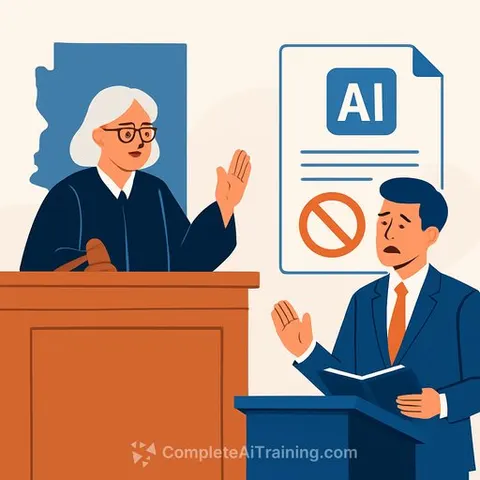
Lawyers in Arizona who use generative AI to draft legal briefs can now be sanctioned if they cite cases that do not exist. In a July 2026 ruling, the Arizona Court of Appeals determined that submitting fake citations - even unknowingly - is sanctionable conduct, a decision that carries immediate consequences for both attorneys and self-represented litigants.
The ruling stemmed from a probate dispute between two family members. The respondent, who represented himself, filed a brief containing inaccurate and false legal claims. He later admitted he had relied on generative AI to prepare the document and did not use conventional legal research tools or materials to verify any of the case citations.
The court's response to AI-generated errors
The appeals court made clear that the person signing a brief bears ultimate responsibility for its contents. "The person signing the brief has to make sure all of the cases they cite are real and accurate," the court said, emphasizing that the duty to verify remains unchanged even when AI is part of the drafting process. Sanctions for violating that duty can include contempt of court, dismissal of the case, monetary fines, or imposing attorneys' fees.
While the court acknowledged that AI tools hold promise for legal work, it refused to treat their output as excusable. The ruling treats the citation of hallucinated content - a known failure mode of large language models - the same as any other misrepresentation to the tribunal.
Tracking the spread of fake citations
Damien Charlotin, a legal technologist and researcher, has built a database that tracks court decisions involving generative AI errors. According to his records, approximately 40 such cases since 2024 have involved jurisdiction in Arizona. The problem is not isolated; courts across the country are grappling with briefs that reference fabricated cases, statutes, or quotes.
As legal teams increasingly adopt AI for Legal tasks like research memos and document drafting, the Arizona decision offers a clear warning: the technology can accelerate work, but it does not replace the professional obligation to check every citation against primary sources.
Why this matters for legal professionals
For practicing attorneys, the Arizona ruling removes any ambiguity about who is accountable when AI invents case law. A supervising lawyer or a self-represented litigant cannot shift blame to the software. The practical takeaway is immediate: every AI-assisted filing needs a verification step that mirrors traditional cite-checking. Firms that skip that step risk sanctions that can derail a case and damage a lawyer's standing before the court.