Armenia Moves to a Unified AI Call and Chat Platform for Public Services
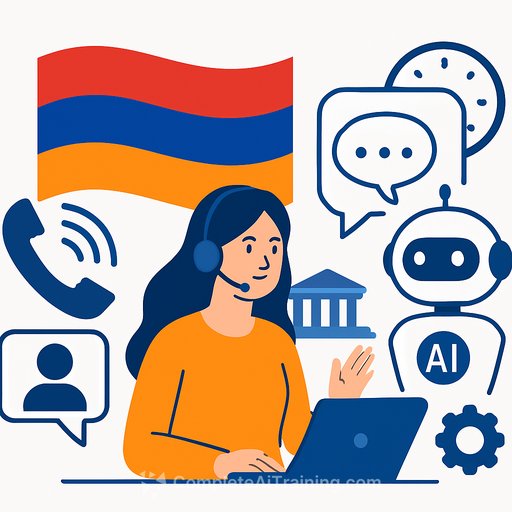
Yerevan, February 2 - Armenia is exploring a single AI-powered call and chat center to support state and municipal services. The concept was discussed at a meeting led by Minister of High-Tech Industry Mkhitar Hayrapetyan with representatives of the "AI Call Center" community and Nerses Yeritsyan, Director of the Information Systems Agency of Armenia (ISAA). Deputy Minister Ruben Simonyan also took part.
The focus: design and implementation options, market findings, information security, and personal data protection. The intent is clear-reliable 24/7 service aligned with Armenian legislation.
What's being built
- Unified platform serving multiple agencies and municipalities.
- Channels: chatbot and voice agent, with seamless handoff to a live operator.
- Administrative module for configuration, oversight, reporting, and quality control.
- Languages: Armenian and English.
- Service level: accurate, always-on support with compliance at the core.
Why it matters for government teams
- Consistent answers across agencies, fewer repeat calls, shorter queues.
- Shared infrastructure lowers cost and simplifies maintenance.
- Centralized analytics for demand forecasting and policy feedback.
- Clear audit trails for decisions, transfers, and data access.
Key priorities highlighted in the meeting
- Design and implementation: architecture, channels, and operating model (AI Design Courses).
- Market research: capabilities, pricing, and feasibility.
- Security and privacy: information security controls and personal data protection (AI Research Courses).
What your department can prepare now
- Service inventory: list top citizen requests, required data, and current wait times.
- Knowledge base: policy-backed answers, documents, and source links.
- Call/chat flows: greeting, authentication, triage, resolution, and escalation rules.
- Quality and compliance: draft a privacy impact assessment and data retention plan.
- Accessibility: check voice and chat accessibility needs, including language nuances.
- Metrics: agree on KPIs (first-contact resolution, ASA, deflection rate, satisfaction, and accuracy).
Suggested pilot approach
- Select 1-2 high-volume, low-complexity services with clear policies.
- Build a minimal knowledge base and decision trees; validate with frontline staff.
- Run a time-boxed parallel test (AI + human oversight) to compare outcomes.
- Track accuracy, handoff rates, and citizen satisfaction; fix gaps before expanding.
Governance and security guardrails
- Human-in-the-loop: fast escalation to live operators for edge cases or sensitive issues.
- Access control: role-based permissions for the admin module and audit logging.
- Data handling: purpose limitation, minimal collection, encryption in transit and at rest.
- Content controls: policy grounding for responses and banned topics list.
- Testing: stress, bias, and language quality testing in Armenian and English.
Practical risks and how to reduce them
- Incorrect answers: use policy-grounded knowledge, retrieval, and post-answer validation on sensitive topics.
- Vendor lock-in: require open standards and exportable knowledge bases.
- Fragmentation: central configuration with agency-level controls and shared SLAs.
- Public trust: clear disclosure, complaint channels, and visible oversight.
Who is involved
Minister of High-Tech Industry Mkhitar Hayrapetyan, Deputy Minister Ruben Simonyan, ISAA Director Nerses Yeritsyan, and representatives of the "AI Call Center" community discussed the initiative as a joint effort between the Ministry of High-Tech Industry and ISAA.
What to watch next
- Procurement or RFP signals for the unified platform.
- Standards on knowledge management, security, and escalation.
- Announcements of pilot agencies and timelines.
If your team needs to upskill operators, analysts, or admins ahead of a pilot, consider targeted courses on system design and governance referenced above.
Your membership also unlocks: