Armenia to roll out AI in government call centers
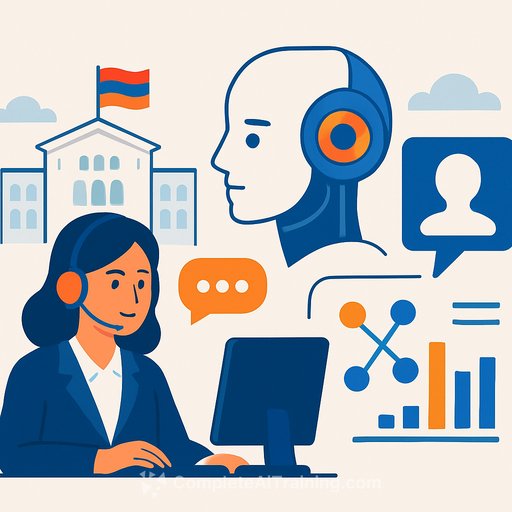
Armenia plans to implement artificial intelligence in the call centers of government departments. Minister of High-tech Industry Mkhitar Hayrapetyan shared the update while presenting the Ministry's 2025 activity report to Prime Minister Nikol Pashinyan.
According to the minister, Armenian-language voice-to-text and text-to-voice technology is already available and developed by local tech companies. The goal is a seamless "end-to-end" experience so citizens can call or message and get quick, accurate answers.
What's planned
In the first half of 2026, the government will develop specifications for a "citizen-artificial intelligence" dialogue platform. Based on those specs, it will either run a competition or sign a contract with a qualified organization.
The platform will deliver information related to ministry functions, programs, and powers via phone and electronic channels, with AI participating directly in the interaction.
Why this matters for government teams
- Faster responses and shorter queues for high-volume questions.
- 24/7 access to consistent, policy-aligned information.
- Human agents freed up for complex or sensitive cases.
- Better visibility into common citizen needs through conversation analytics.
Practical steps for implementation
- Governance and oversight: Assign a product owner, a legal lead, and a security lead. Define approval processes for knowledge updates. Consider leadership training such as the AI Learning Path for CIOs to guide strategy, governance, and risk oversight.
- Procurement readiness: Draft specs that cover accuracy targets, Armenian language quality, uptime, data retention, access controls, and audit logs.
- Data and knowledge: Centralize FAQs, policies, and scripts. Version them and mark authoritative sources for the AI to reference.
- Integration: Plan APIs for your CRM, ticketing, and knowledge base so conversations create or update cases automatically.
- Privacy and security: Minimize data collection, mask sensitive fields, set clear retention windows, and log model inputs/outputs.
- Accessibility and inclusion: Support Armenian speech clarity, accents, and plain-language responses. Provide SMS or chat options for hearing impairments.
- Training and change management: Train agents to supervise AI, review transcripts, and take over escalations smoothly. For program delivery and rollout skills, see the AI Learning Path for Project Managers.
- Metrics: Track first-contact resolution, wait time, handoff rate to humans, citizen satisfaction, and error rates.
- Pilots: Start with narrow, high-volume topics. Iterate weekly based on transcripts and citizen feedback.
Risks to manage
- Accuracy: Prevent incorrect or outdated responses with source grounding and regular reviews.
- Bias and fairness: Test across dialects and demographics; monitor for disparities in outcomes.
- Consent and privacy: Provide clear notices for recorded calls and data use; allow opt-outs where feasible.
- Failure modes: Define clear escalation rules and give citizens an easy path to a human agent.
- Cost control: Cap usage by channel and topic; audit vendor invoices against logs.
- Vendor lock-in: Favor open standards, exportable data, and modular components.
Standards and guidance
To strengthen requirements and oversight, consider aligning with established guidance such as the NIST AI Risk Management Framework. It offers practical practices for trustworthy AI across accuracy, privacy, and governance.
NIST AI Risk Management Framework
What to prepare now
- Inventory your top 50 citizen questions by volume and impact; map the authoritative answers and owners.
- Draft a knowledge maintenance calendar tied to policy changes and service updates.
- Define service levels for AI responses and human handoffs, including after-hours coverage.
- Coordinate with legal and data protection units early to avoid rework at procurement time.
If your team needs structured upskilling for AI-enabled service delivery, explore role-based learning paths here: Complete AI Training - Courses by Job.
Your membership also unlocks: