Army doctrine writers are using AI-carefully. Here's what working writers can learn
The US Department of War (DOW) is pushing AI deeper into its workflows, and Army doctrine writers are already putting it to work. The Combined Arms Doctrine Directorate (CADD) says it's building a four-pronged strategy to equip every doctrine author with the skills and tools to use AI effectively. In the Army, doctrine is the core guidance for how operations are conducted-so accuracy is non-negotiable.
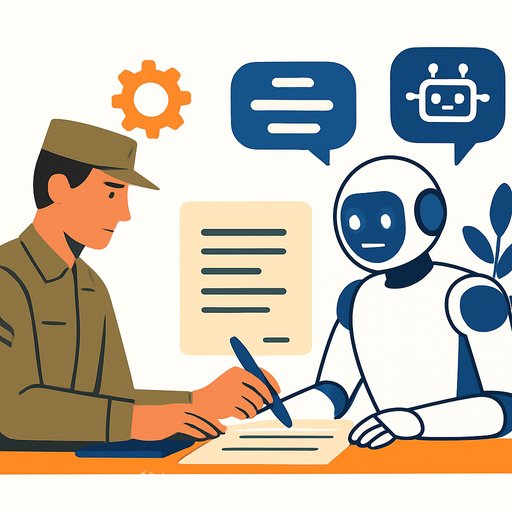
The stance is clear: AI is an assistant, not a decision maker. Think of it like a sharp junior officer-helpful, fast, and energetic-but not a source of truth.
What AI is doing for doctrine writers
- Rapid research: internal tools can search across hundreds of texts for relevant historical vignettes in minutes instead of days.
- Idea generation: breaking creative blocks, proposing structures, and offering angles to explore.
- Editing support: grammar, clarity, and readability passes to tighten drafts faster.
There's a big caveat. Models hallucinate-mixing sources, inventing facts, or pulling from outdated manuals. In one case, an AI-generated test question referenced an old field manual, not the current standard. As CADD's director put it: "Humans will review every line of what a [large language model] produces for accuracy." That only works if the humans reviewing it know their craft.
The Pentagon's AI push (and its friction)
The Pentagon launched GenAI.mil in December 2025, powered by Google's Gemini for Government, giving nearly three million personnel access to generative AI. In July 2025, the Chief Digital and AI Office announced partnerships with xAI, Anthropic, Google, and OpenAI-each with contracts worth up to $200 million. You can read more about the CDAO's work on the official site: Chief Digital and AI Office.
Not every partnership is smooth. Reports say the DOW may cut ties with Anthropic over usage restrictions, while the department seeks models usable for "all lawful purposes." According to the Wall Street Journal, Anthropic's Claude was used in a US military operation in Venezuela targeting former leader Nicolas Maduro. Anthropic's CEO, Dario Amodei, has voiced concerns about "fully autonomous weapons and the domestic mass surveillance of Americans."
Steal this playbook: a writer's approach to "AI as assistant"
- Define your ground truth first: list approved sources, the current standard, and the voice you must keep. AI sits on top of this, not the other way around.
- Assign AI specific jobs: summarize this chapter, find five contrasting examples, propose three outlines-no open-ended "write the thing for me."
- Force source discipline: ask the model to quote and cite passages you provide. If it can't verify from your sources, it should say "unknown."
- Build a review wall: do line-by-line human checks for facts, policy, classification, and tone. Have a senior reviewer sign off before anything ships.
- Keep versions and prompts: save prompts, outputs, and source packs. If something's off, you need a paper trail.
- Use AI to speed research, not conclusions: let it surface candidates (vignettes, references, counterpoints), then you validate against current manuals.
Prompt patterns that reduce errors
- "Only use the excerpts below. If a claim isn't supported, reply: 'unknown.' Then list what extra sources you'd need."
- "Draft three outlines with different structures: historical vignette first, definition first, counterexample first. Keep under 150 words each."
- "Rewrite for clarity at a grade-10 reading level. Keep terminology intact. Flag any sentences that could be ambiguous."
- "Compare these two passages and list factual conflicts, outdated terms, and missing citations."
Tooling notes for working writers
- Purpose-built beats generic. CADD is working with industry to build an internal tool-tight scope and curated sources reduce hallucinations.
- Model choice matters. Some vendors restrict military or sensitive use cases; others allow "all lawful purposes." Know your policy before you draft.
- Auditability wins. Whatever you use, make it easy to attach sources, log prompts, and export a review pack for legal or editorial checks.
If you're upgrading your workflow
- Practical training for content teams: AI for Writers
- Get better outputs with better inputs: Prompt Engineering
Bottom line
Use AI for speed and breadth; rely on experts for truth. Treat models like capable assistants, not authors. Do that, and you'll ship sharper drafts faster-without sacrificing accuracy where it matters most.
Your membership also unlocks: