The Case for Difficulty: Why Writers Must Protect the Work
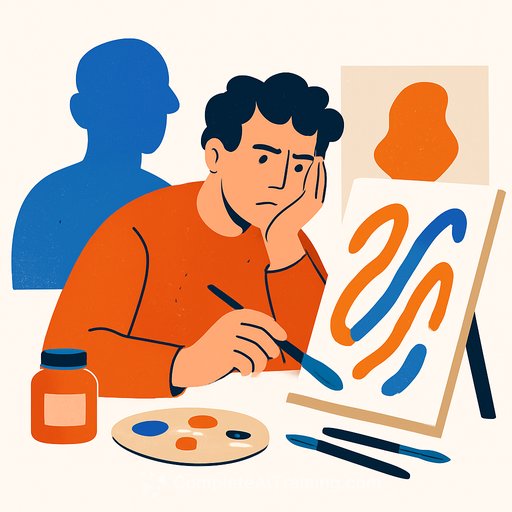
None of this is supposed to be easy. Not writing, not life, not love.
If you make things for a living, the struggle is not a glitch-it's the operating system. Ask any writer who has stared at a line for months and refused to move on because settling would feel like lying.
The House on Marshland: A lesson in failure
Louise Glück's early drafts of "The House on Marshland" didn't work. She called them terrible. Yet the idea wouldn't leave her: houses meant for comfort, built on unreliable ground. She tried again and again, failed again and again, and then-years later-used the fragments to unlock another poem, "To My Mother."
The point isn't that the poem took time. The point is that the time changed the poem-and the poet. That's how the work works. It breaks you open and reassembles you into someone capable of finishing it.
Ego is a tool, not a sin
Sharing your writing is an act of ego. That's healthy. It says: my voice is worth your time, and I accept the responsibility that comes with that.
Great art requires that kind of spine. We can forgive the human flaws of writers while recognizing that conviction fuels the long, lonely work. The ego, properly aimed, serves the reader.
The machine promises speed. Art asks for time.
AI tools promise books in minutes. That's not creation; it's output. Understanding Generative AI and LLM can help you see where assistance ends and replacement begins.
The struggle feeds the art. Joy Williams wrote of Jane Bowles that "each word is built, each step painful, each transition a rope bridge thrown over a chasm." You can feel the heat of that effort on the page.
Time is the unpaid collaborator
Tillie Olsen said, "Substantial creative work demands time," and listed what happens when life steals it: unfinished work, small attempts, silence. Honoré de Balzac described execution as raising a child-clothing it in new garments again and again, never rebelling against the toil.
Henry James saw in Balzac not a monk confined to a room, but a writer who transcended that room through the work. That's the model: devotion without shortcuts.
Hold to what is difficult
Rilke wrote, "We must hold to what is difficult; everything alive holds to it." Faulkner warned that without the old truths-love, honor, pity, pride, compassion, sacrifice-stories are doomed to fade.
Being good at art doesn't excuse being bad at life. But the stubborn belief that we can make something original-something that makes others laugh, cry, think-is worth defending.
What struggle looks like in practice
- The one-line rule: Keep a single sentence you refuse to compromise. Let the rest of the piece earn its company.
- Draft compost: Save every failed attempt. Revisit monthly. Cannibalize the strong lines for new work.
- Daily friction window: 45 minutes of writing without prompts, templates, or tools. Sit with the problem. No shortcuts.
- Constraint sprints: 300 words, one setting, present tense, no adjectives. Constraints force decisions. Decisions make voice.
- Read for heat, not comfort: When a page makes you uneasy, study it. That tension is often the lesson your draft needs.
- Revision cycles: Three passes minimum-structure, language, line edits. Different days, different eyes.
Set boundaries with AI (so your work stays yours)
- No machine-written sentences in final drafts. If a tool suggests language, use it only as a mirror for what you already mean-then rewrite it in your voice.
- Keep the hard parts human: concept, voice, structure, core sentences. If you outsource those, you outsource your identity.
- Use time, not prompts: blocks are signals. Sit with them. They often point to a truth you're avoiding. Avoid leaning on Prompt Engineering tricks to paper over that work.
Why we keep writing
Rita Dove once said, "I don't think poetry is going to make anyone a better person, and it is not going to save you." But she kept writing because there's an edge between not-knowing and sudden awareness-where the skin tingles. That edge is the point.
The poem is the point, yes. But so is the struggle that makes the poem possible. Protect it. That's the work.
If you need to understand AI's place in your business (so you can set smart boundaries without outsourcing your voice), explore curated options by job at Complete AI Training.
Your membership also unlocks: