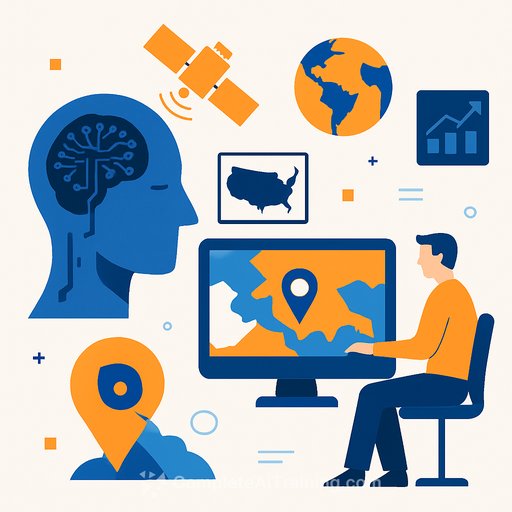
Artificial Intelligence and the Future of U.S. Geospatial Intelligence
ST. LOUIS — Artificial intelligence (AI) is increasingly central to the future of U.S. geospatial intelligence. At the GEOINT Symposium on May 18, National Geospatial-Intelligence Agency (NGA) Deputy Director Brett Markham shared updates on the agency’s AI progress, while stressing that full integration remains a work in progress.
“While we’ve made some significant progress in the last 12 plus months, there’s more work to be done,” Markham said. NGA’s mission involves collecting, analyzing, and distributing geospatial intelligence (GEOINT) to support national security and combat operations. Analysts rely on satellite imagery and spatial data to track global activity, including troop movements, military equipment, and humanitarian disaster response.
AI at the Core of NGA’s Strategy
At the heart of NGA’s AI efforts is the Maven program, launched in 2017 to introduce computer vision into defense intelligence workflows. Maven uses AI to analyze vast imagery and video data, identifying potential military targets such as vehicles, aircraft, and infrastructure. These AI tools help analysts by automating initial detection and flagging anomalies faster than human review alone.
Markham emphasized the need to accelerate AI integration beyond object recognition, embedding AI throughout data collection and operational processes. “It is imperative that we adopt a more aggressive integration strategy relative to artificial intelligence,” he said. More AI-driven tools are necessary to efficiently task NGA’s systems and meet growing demands.
Responding to Growing Demands
The demand for GEOINT is rising due to several geopolitical factors: the Russia-Ukraine conflict, instability in the Middle East, China’s global activities, and expanded military needs from regional commands. NGA also supports domestic and international disaster response efforts, increasing the volume and urgency of its work.
Building AI Infrastructure
To keep up, NGA is developing AI infrastructure that includes standardized training data, reusable AI models, and guidelines for responsible AI use. These initiatives aim to create a scalable, reliable foundation for deploying AI in operational environments while addressing ethical considerations.
Markham acknowledged that despite advances in machine learning and computer vision, the agency has not yet fully tapped its data’s potential. “I don’t think we fully tapped into the capability that is needed to be able to interrogate, manage and manipulate the data that we have before us now,” he said. “We’re in the early stages of AI integration, and I’m excited about what we’ve seen so far.”
Engaging with Industry and Workforce Adaptation
NGA plans several events to engage with the AI industry. On June 9, an AI Industry Day at NGA’s Springfield, Virginia headquarters will provide updates on AI development and highlight technology gaps. Companies are encouraged to submit white papers, with selected proposals invited to an AI Pitch Day. In November, NGA will host a GEOINT AI Summit in Springfield to discuss the future of geospatial intelligence.
Markham also noted the importance of preparing NGA’s workforce for AI adoption. “We must expand the acquisition, the integration and adoption of artificial intelligence across all of our mission areas,” he said. “This will enable us to scale, analyze more images, and locate targets of interest faster.”
For professionals interested in AI training relevant to government and IT sectors, resources such as Complete AI Training offer a range of courses that can help build skills in AI integration and data analysis.
Your membership also unlocks: