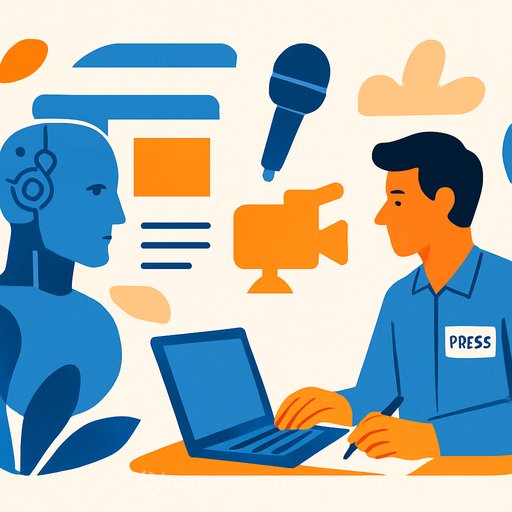
Artificial Intelligence and Media: Press Freedom in a Changing Landscape
Over the past three decades since the UN declared World Press Freedom Day, the landscape of journalistic freedom has shifted dramatically. From a surge of diverse news outlets post-Cold War and during the Arab Spring, we now face increasing restrictions under renewed conflicts and authoritarianism. Reporters Without Borders’ latest World Press Freedom Index reveals that press freedom worldwide is at an all-time low, with conditions rated "poor" in half of the countries.
At the same time, artificial intelligence (AI), large language models, and predictive algorithms have emerged throughout the media sector. These tools offer new opportunities for newsrooms of all sizes, but they also pose challenges to traditional journalism models and open doors for misinformation and manipulation.
How AI is Changing Journalism
The Paris Charter on AI and Journalism, developed by a global commission including the Global Investigative Journalism Network (GIJN), outlines 10 principles to protect information integrity and journalism’s societal role. AI can enhance investigative work by processing vast data efficiently, but it also raises concerns about misinformation, online hate, censorship, and surveillance.
The UN’s recent report on AI’s effect on press freedom highlights both the benefits and risks. AI can help journalists access and analyze information faster, but it can also amplify false content and empower platforms to control information flow, sometimes restricting freedom of expression.
AI and Job Losses in Newsrooms
Financial pressures on media outlets have led some to adopt AI as a substitute for editorial staff. For example, Quartz nearly eliminated its editorial team to focus on AI-driven content. Italy’s Il Foglio published an entirely AI-generated newspaper as an experiment, including fabricated quotes.
Yet investigative journalism remains vital. Detailed, fact-checked reporting based on multiple sources can't be replicated by AI. This type of journalism provides an essential check against misinformation and abuses of power. AI tools, when used responsibly, can assist journalists in sifting through large datasets to uncover critical leads.
AI’s Threats to Democracy and Trust
Algorithmically generated content muddies the information environment, making it harder for the public to trust news sources. The Reuters Institute noted that professional reporting often gets drowned out by low-quality, SEO-driven “AI slop” websites. Ahead of the 2024 US election, NewsGuard identified nearly 1,200 fake sites using AI-generated content to spread partisan views and mimic credible local news outlets.
AI’s role in creating misleading content like deepfakes also undermines democratic institutions. This shift places significant control in the hands of tech platforms and governments, many of which do not prioritize press freedom.
Investigating AI Systems and Accountability
Journalists are increasingly focusing on how AI is used and holding entities accountable. The Pulitzer Center’s AI Accountability Network supports reporters covering this complex topic.
- In one case, a US-Brazil team uncovered Instagram profiles sharing AI-generated child abuse content that Meta’s security missed. Meta removed these profiles shortly after the report.
- Al Jazeera revealed that AI algorithms used in India's welfare system wrongly denied food aid and declared thousands dead.
- Lighthouse Reports exposed algorithmic bias in the Netherlands’ welfare fraud detection software, highlighting errors with serious social consequences.
Using AI as a Practical Tool in Newsrooms
Despite concerns, AI can be an asset for journalists, especially those in smaller or nonprofit outlets with limited resources. AI helps detect bot activity, analyze social media patterns, and speed up research tasks.
For example, reporters use large language models like ChatGPT to quickly compile expert contacts or find initial story ideas. Investigative teams with technical expertise integrate AI into tools that mine extensive datasets, supporting cross-border collaborations.
Journalists must work collectively to ensure AI supports accountability and independence instead of enabling control and misinformation. The UN stresses the need for cooperation to develop AI tools that promote information integrity and protect digital rights.
For PR and communications professionals interested in expanding their AI skills, exploring courses on Complete AI Training can provide practical knowledge on leveraging AI tools responsibly in media and communication roles.
Your membership also unlocks: