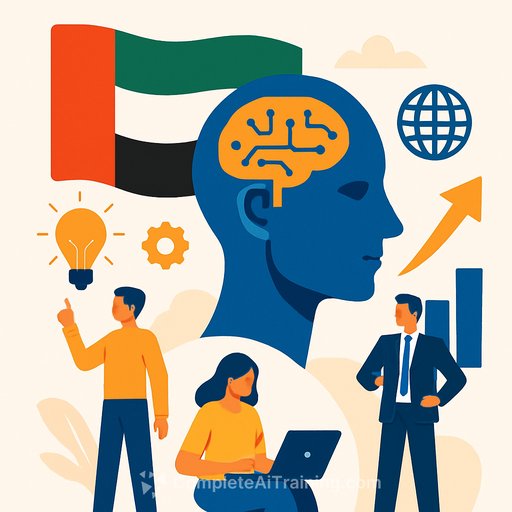
The Power of Artificial Intelligence in the UAE
Artificial intelligence (AI) is transforming many sectors by assisting in diagnosing diseases, managing investments, and creating content like pictures, songs, novels, and essays. The UAE government recognizes this potential and has taken significant steps to integrate AI into its governance and development strategies.
Starting January, the National Artificial Intelligence System will act as an advisory member to the UAE Cabinet, the Ministerial Development Council, and government boards. This follows earlier initiatives like appointing the world’s first Minister of State for Artificial Intelligence in 2017, launching a national AI strategy, and establishing an AI-focused university.
Mohamed bin Zayed University of Artificial Intelligence Graduation
The 2023 commencement ceremony for Mohamed bin Zayed University of Artificial Intelligence took place on June 4 at the Abu Dhabi Energy Centre. Fifty-nine postgraduate students from 25 countries, including the UAE, China, Africa, and other Middle Eastern nations, received their degrees. This reflects the UAE’s commitment to becoming a regional hub for AI expertise.
AI is projected to add $320 billion to the Middle East’s economy by 2030, with the UAE expected to gain the most.
A New Era for Government Services
AI adoption in government services is approaching a tipping point worldwide. Governments are beginning to explore AI-driven solutions to improve service delivery and citizen engagement. This technology changes how public sector employees operate by offering real-time guidance on actions, required forms, and necessary information.
For civil servants, AI tools can streamline workflows and decision-making processes, improving efficiency and accuracy in public service.
Boosting Productivity through AI
AI acts as a cognitive assistant, helping government workers offload routine intellectual tasks like sorting through large volumes of emails or documents. This increases individual productivity and can make work less tedious.
While AI handles repetitive tasks, human oversight remains crucial to verify outputs and ensure quality. This collaboration allows employees to focus on higher-value responsibilities.
AI as a Complement, Not a Replacement
Currently, AI supports rather than replaces human roles. It excels at managing routine duties but still requires human judgment for complex or sensitive decisions. Over time, AI may take over more functions independently, but this shift will be gradual.
The concept of “gigification” suggests AI will reduce the workload by handling simpler tasks, allowing humans to concentrate on the most demanding parts of their jobs. This reshapes roles rather than eliminates them.
Opportunities for Developing Countries
Developing countries stand to benefit from AI by integrating it directly into evolving systems, similar to how rapid mobile phone adoption bypassed landline infrastructure. Agile nations can adopt AI solutions to improve government services without legacy constraints.
Ensuring Fairness and Managing Bias
Bias in AI algorithms is a significant concern, especially in areas like policing, healthcare, and social services where decisions impact many lives. An AI system can process thousands of cases quickly, magnifying the effects of any bias.
However, advances in AI allow for transparent decision-making criteria and the identification of potential biases. With careful design and monitoring, AI can be less biased than human judgment and improve fairness in government processes.
The Path Forward
Adopting AI is becoming essential for governments and organizations aiming to improve productivity and competitiveness. The technology enhances efficiency across diverse public sector functions, and those who delay implementation risk falling behind.
For government professionals looking to build AI skills and understand its practical applications, resources like Complete AI Training’s latest courses offer valuable learning opportunities.
Your membership also unlocks: