Exploring the ethics of AI: Can we use tools like ChatGPT consciously?
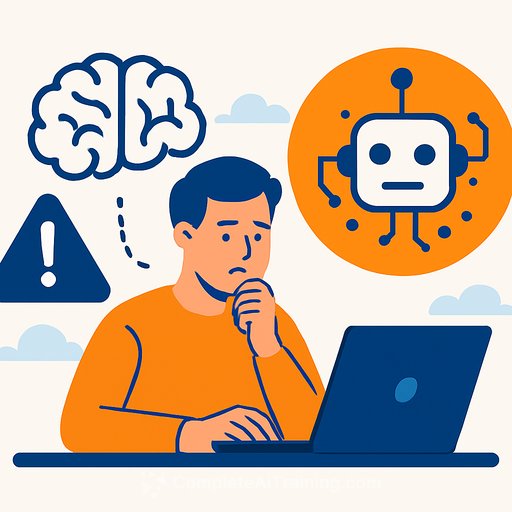
AI tools are spreading across campuses and companies. The default is "adopt-and-go." That speed is useful, but it hides real trade-offs-privacy for convenience, automation for agency, scale for care.
Nikolaus Klassen, a business analyst at Google who teaches Applied AI Ethics at the ATLAS Institute, argues that ethics isn't a debate club for rules vs. outcomes. It's a system for asking better questions, exposing structural problems, and improving defaults. That lens is practical for students, IT teams, and developers deciding how to use tools like ChatGPT day to day.
The trade-off frame is too shallow
We're told: get the tool for free, give up your data. Or: accept risk now, fix it later. That frame is lazy. Real ethics work asks where bias starts, how consent is collected, which defaults push people into choices, and whether we're overusing a tool just because it's there.
Klassen's point is simple: build better choices into the system. Nudge design, log decisions, and make it easier to do the right thing than the fast thing.
Key ethics concepts
- Utilitarianism: Choose the action that maximizes overall benefit and reduces harm for the most people.
- Deontology: Follow clear moral duties and rules, even if breaking them could create short-term gains.
- Moral licensing: After doing something good, people feel justified doing something questionable.
- Law of the instrument: Over-relying on a familiar tool, whether or not it's the right fit.
- Choice architecture: How defaults and interface design steer decisions without removing options.
Why students and early-career pros care
Entry-level work is already being automated. That's exciting and unsettling at the same time. Students are asking if AI is a crutch or a coach, and the answer depends on intent, method, and honesty about the result.
You can see the fallout of sloppy AI use everywhere: privacy leaks, biased outputs, and low-quality content that looks fine at a glance. This isn't abstract-it affects grades, hiring, and trust.
A practical toolbox of questions
- Purpose and people: Who benefits, who is burdened, and who gets excluded?
- Data: Where did it come from, do you have consent, and what's the retention plan?
- Model behavior: What does "good" look like, and how do you measure it before launch?
- Failure modes: How can this go wrong, and what's the blast radius when it does?
- Privacy and security: What never gets pasted into prompts, and how is access controlled?
- Choice architecture: Which defaults nudge users, and are those nudges ethical?
- Accountability: Who owns outcomes, and how do people appeal?
- Equity: Which groups are at risk of harm, and how are you checking for bias?
- Lifecycle: What is the update, rollback, and retirement plan?
- Transparency: What documentation ships with the system, and is it readable?
Using ChatGPT consciously: a lightweight playbook
- Set intent first: Define the job to be done and the decision that will use the output.
- Protect data: Never paste secrets, personal data, or client content without explicit approval and a data-processing agreement.
- Structure prompts: Provide context, constraints, examples, and acceptance criteria. Ask for reasoning and references where appropriate.
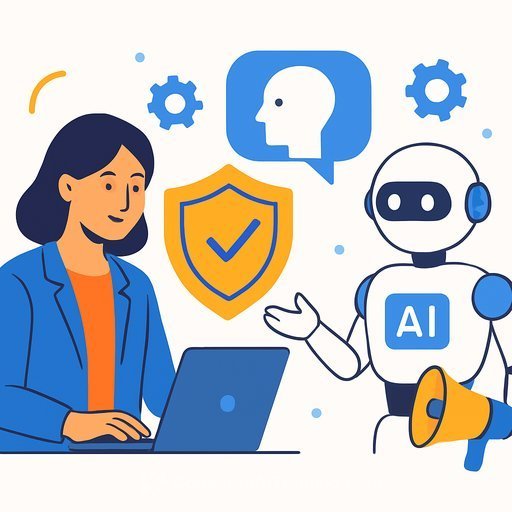
- Keep a human in the loop: Review for accuracy, bias, and missing context. If stakes are high, require a second reviewer.
- Evaluate, don't assume: Test with a small, representative set. Track error types and set thresholds for "good enough."
- Document: Log prompts, versions, and decisions. Save what you ship and why you trusted it.
- Avoid moral licensing: Doing one fairness check doesn't give you a pass to ship risky features.
- Avoid the law of the instrument: If a simple script or a database query solves it, use that instead.
For focused skill-building on this specific tool, see ChatGPT.
For IT and development leaders: make ethics the default
- Adopt a risk framework: Map use cases, harms, and controls. The NIST AI Risk Management Framework is a solid starting point.
- Data minimization by design: Opt-in where feasible, short retention windows, encryption at rest and in transit.
- Guardrails in code, not policy docs: PII filters, content classifiers, rate limits, abuse detection, kill switches, human escalation paths.
- Bias and quality evals: Automated tests for sensitive attributes, representative datasets, and regression checks tied to release gates.
- Transparency: Ship model cards, usage notices, and change logs that real people can read.
- Vendor scrutiny: Review data use terms, fine-tuning sources, and logging policies. Require auditability.
- Upskill the team: Train engineers, PMs, and support on failure modes, privacy, and incident response.
- Feedback loops: Make it easy to report harm. Triage, fix, and close the loop with users.
If you lead engineering teams, explore AI for IT & Development for practical implementation ideas.
The bigger shift-and why it's not too late
Every major tech shift brought gains and pain. Agriculture created cities and class systems. Engines boosted mobility and health while disrupting work. AI will feel similar: more capability, more dependence, and a messy middle.
History says we can course-correct. Worker protections and social ethics improved after earlier shifts. With better questions, better defaults, and steady pressure, we can improve AI the same way.
Fast next steps
- Pick one workflow and apply the ChatGPT playbook this week.
- Run a tiny eval (10-20 cases) to measure accuracy and bias. Write down what fails.
- Set guardrails for prompts: banned data types, approved use cases, and review rules.
- Publish a one-page policy in plain language. Include contacts for questions.
- Teach a 30-minute session on moral licensing and the law of the instrument.
- Instrument your system for logging, alerts, and rollback.
Ethics isn't a roadblock-it's a set of habits that help you ship work you can stand behind. Start small. Improve weekly. Keep asking better questions.
Your membership also unlocks: