
AI news ·
Aspen Digital initiative tests practical AI tools for state and local emergency managers
The AIDE initiative is mapping existing AI tools - from wildfire detection to automated grant reviews - to help understaffed emergency agencies respond faster. Human managers must retain final decision-making authority, organizers say.
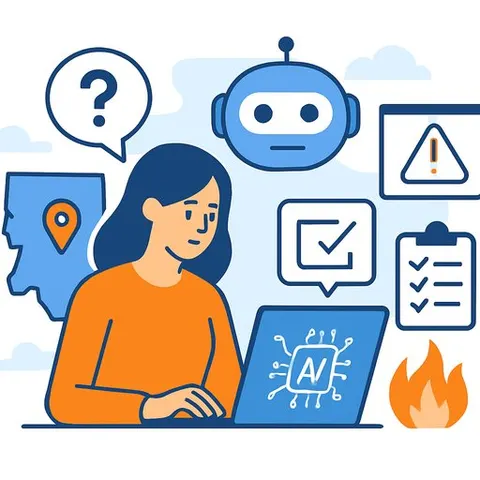
Emergency Managers Turn to AI for Disaster Response - Without Building New Models
A coalition of researchers, technologists and emergency managers is identifying existing AI tools that can help state and local agencies prepare for and respond to disasters more effectively. The AI for Disasters and Emergencies (AIDE) initiative, launched last fall by the Markle Foundation, Aspen Digital and RAND, focuses on practical applications rather than developing new AI systems.
The initiative examines how agencies can use existing technologies to improve emergency communications, situational awareness, resource allocation and recovery operations while maintaining public trust and accountability.
Beyond Generative AI
AIDE evaluates a broader range of technologies than just generative AI tools like ChatGPT. Jeremy Greenberg, director of emergency management at Aspen Digital and a former FEMA official, said the initiative considers predictive analytics, computer vision, geospatial intelligence and automated data processing systems.
Some applications target specific hazards. AI-powered wildfire detection systems in California identify fire starts using infrared imagery. Flood-monitoring technologies in North Carolina analyze stream gauge data to forecast where water may travel. Other tools work across all disaster types-automating grant reviews, developing training exercises and improving situational awareness during active incidents.
The Staffing Problem
Emergency management offices, particularly at the local level, operate with minimal staff. Many departments consist of just one or two people managing preparedness planning, grant applications, training and disaster response coordination.
Greenberg said AI assistants that draft plans, review grants and support training could free managers from administrative work. "The demand of time capability and then what the expectation is when a response happens borderline overwhelms emergency managers," he said.
The goal is to give managers time for tasks requiring human judgment and direct contact with survivors and staff.
Procurement and Governance Barriers
AIDE conducted approximately 35 workshops with nearly 100 state, local, nonprofit and private-sector organizations. A consistent theme emerged: emergency managers want to adopt AI tools but face obstacles related to procurement, training and governance.
Many newer AI tools operate on subscription models-a credit card purchase for commercial users. Government procurement systems don't work that way, creating friction for agencies trying to adopt the technology.
AIDE is developing guidance to help agencies evaluate and implement AI responsibly. But Greenberg emphasized a critical boundary: emergency managers must retain control over major decisions during hurricanes, wildfires and floods.
"Technology can help make emergency managers more efficient and more capable," he said. "But the decisions still need to be made by people."
Learning From Past Technology Shifts
Greenberg compared AI adoption to earlier waves of emergency management technology, including geographic information systems and computer-aided dispatch platforms. Those tools significantly improved situational awareness and resource coordination but required agencies to retrain staff and redesign workflows.
The same pattern will likely repeat with AI. The benefit isn't just reclaimed time-it's enabling managers to leave their desks, interact with disaster survivors and complete after-action reports without exhaustion.
Learn more about how AI Agents & Automation can support operational workflows, or explore AI for Management roles.