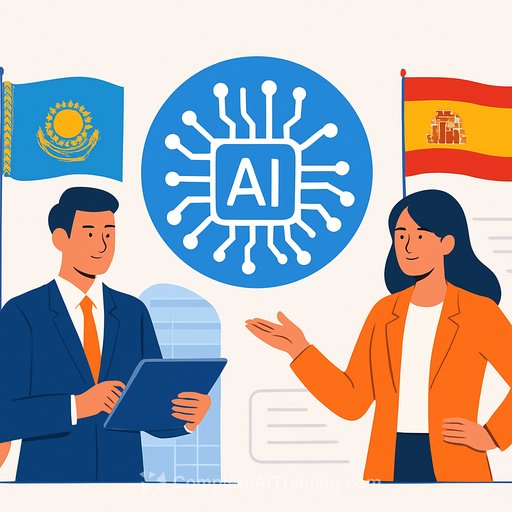
Astana hosts a discussion on AI and scientific collaboration between Kazakhstan and Spain
19:00, 9 December 2025
Astana brought together scholars, diplomats, and students for a focused discussion on artificial intelligence, interdisciplinary research, and a growing Kazakhstan-Spain partnership in education and science.
Photo credit: Diana Bizhanova / Qazinform
Science as a bridge: Spain's perspective
Ambassador Luis Francisco Martínez Montes opened with a survey of Spain's scientific legacy-from early vaccination expeditions to modern medical and technological advances. His message was simple: science builds trust and opens doors for international cooperation.
AI and education: from grading to virtual tutors
Researchers from Nazarbayev University spotlighted practical AI use cases in learning. Vice-Dean for Research Daniel Hernández-Torrano pointed to adaptive education, virtual tutors, and automated assessment as near-term wins.
"You will be able to get educated exactly on what you care about and individualize your learning... With AI, you will have that at the tip of your fingers. There is potential for virtual tutors and automated grading. As a professor, I would love to see a system that allows me to grade the papers of my students in seconds rather than in hours or days... VR in education - lots of potential for the field... I would perhaps choose a data science profession and apply it to education."
Learning how to learn
Gonzalo Hortelano Hap, Dean of the School of Humanities, argued for adaptability over rigid career paths. The core skill is continuous learning-driven by genuine interest.
"Today, the key is to learn how to learn... It is best if you choose something with real passion, whatever it is."
AI in healthcare and genomics
Cardiologist and PhD candidate in Global Health Aida Kabibulatova described how AI is already embedded in research and clinical thinking, especially in genomics. Tools that flag gene targets are making personalized care more achievable.
"There are multiple AI tools that help you identify specific genes to predict or make personalized treatment for a particular disease... The integration of AI into our daily routine and our research is immense... Always use this Spanish passion for your work... That's how you will easily integrate all novelties and AI tools into any path you choose."
Collaboration data: Kazakhstan-Spain on the rise
Hernández-Torrano shared evidence of a sharp rise in Kazakhstan-Spain research ties. Since 2015, annual co-authored publications have climbed to around 150 per year, with strong activity in global health, engineering, environmental sciences, and physics.
Ambassador Martínez Montes also stressed mobility and multilingualism. "English was becoming... the global language of science, but it does not have to be to the detriment of other important languages, including Kazakh... combine both English and your local language."
This momentum aligns with broader institutional outreach, including discussions with the Spanish National Research Council (CSIC).
What this means for researchers
- Explore joint projects in high-traction areas: global health, engineering, environmental sciences, and physics.
- Pilot AI-assisted assessment and feedback loops to free time for mentoring and design of experiments.
- Test AI-driven tutoring or VR modules for lab skills, safety training, or methods refreshers.
- Build multilingual outputs (English + local language) to widen reach and local impact.
- Leverage student and faculty mobility to seed long-term labs-to-labs collaborations.
- For clinical and omics work, evaluate AI tools for variant prioritization and patient stratification with clear validation protocols.
Further resources
- UNESCO: Guidance on generative AI for education and research
- Practical AI for data analysis: certification path
Your membership also unlocks: