ASU Researcher Develops AI-Powered Table Tennis Robot to Support Independent Living
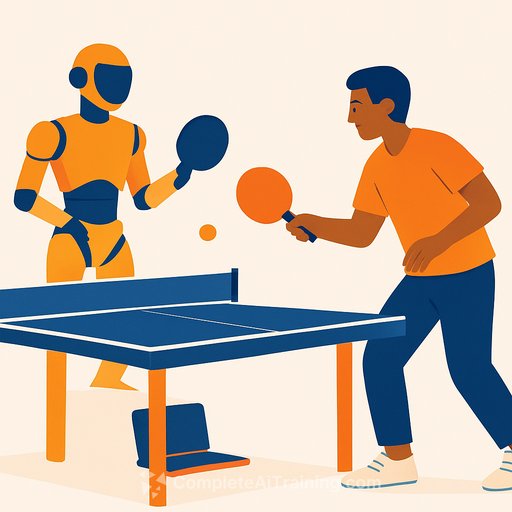
Heni Ben Amor, an associate professor of computer science and engineering at Arizona State University’s School of Computing and Augmented Intelligence, is advancing robotics with an AI athlete built to assist humanity. After spending a year embedded with Google’s DeepMind team, Ben Amor helped create a robot that plays table tennis — but its purpose extends far beyond sport.
The robot’s agility, ability to interpret instructions, and adaptability during the game demonstrate key capabilities for real-world applications. These skills form the foundation for robots that could help aging adults maintain independence by performing daily tasks such as reaching high shelves, preparing meals, or managing household chores.
From Table Tennis to Practical Assistance
Ben Amor’s approach is straightforward: make robots learn dynamic, unpredictable tasks like sports to develop essential skills for home assistance. Robots need to be highly aware of their surroundings and capable of anticipating human behavior to support people effectively.
The AI athlete receives text-based guidance via Gemini, a chatbot powered by Google’s large language model (LLM). Gemini combines user coaching with AI algorithms to progressively improve the robot’s performance. By analyzing game logs and adjusting its actions based on simple instructions, the robot refines its gameplay autonomously.
Additionally, the robot generates “diary entries” describing its adjustments. Gemini processes these notes to explain the robot’s behavior in natural language, increasing transparency and trust. This feedback loop allows users and developers to understand why the robot modifies its actions, addressing concerns about AI opacity.
Performance and Future Directions
In tests, the robot consistently outperformed half of its amateur opponents and even scored points against expert players. While it’s not yet a top-level competitor, the robot is a strong player with room to grow.
Ben Amor and his team, including doctoral students Yifan Zhou and Kamalesh Kalirathinam, will present their findings at the 2025 IEEE International Conference on Robotics and Automation. They are also exploring further collaborations with DeepMind to expand the robot's applications.
Engaging Students and Expanding Impact
Ben Amor uses robotics sports projects to inspire students and develop practical skills. His lab has built robots that play basketball, throw footballs, and now excel in table tennis. These projects provide an engaging entry point for students to learn about AI, robotics, and control systems.
The same AI techniques have been applied to design an intelligent prosthetic limb for individuals with lower-leg amputations. This prosthesis adapts to the user’s gait and terrain changes in real time, reducing musculoskeletal strain. The team patented this design in 2024 and is collaborating with a startup to bring it to market.
Ross Maciejewski, director of the School of Computing and Augmented Intelligence, highlights Ben Amor’s work as crucial for preparing students to lead in robotics research and education. The table tennis robot might attract attention for its skill and flair, but its true value lies in the foundational abilities it develops to support independent living and healthcare.
For professionals interested in AI and robotics training, exploring courses on practical AI applications can be valuable. Resources like Complete AI Training’s skill-based courses offer relevant learning paths.
Your membership also unlocks: