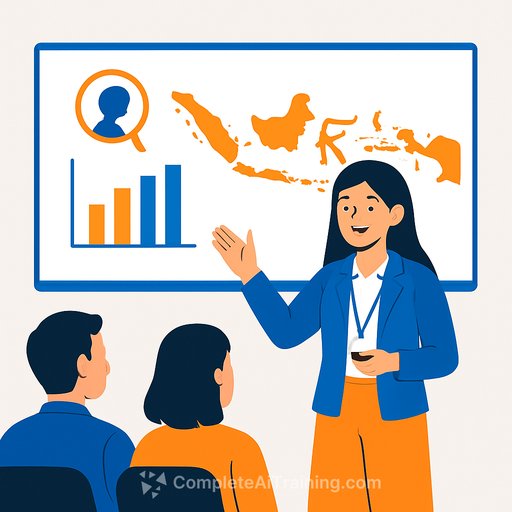
Allysa Kayla Jap to Present AI Research on Intergroup Hate at ICAMIMIA 2025
At 17, Allysa Kayla Jap of Sekolah Pelita Harapan (SPH) Lippo Village has earned a slot to present at ICAMIMIA 2025. Her paper, "Detection of Intergroup Hate on Twitter: A Computational Approach to Cultural and Social Polarization in Indonesia," examines how machine learning and computational linguistics can flag hostile intergroup discourse at scale.
The work has been accepted for publication on IEEE Xplore, giving it global visibility among engineers and researchers. For a high school student, this is a rare achievement-and a useful data point for how early talent can contribute to serious research.
"I've always been fascinated by how data and technology can reveal social patterns and help us understand human behavior online," Allysa said. "Through this research, I wanted to use data science to address real-world issues like cultural divides and online hate."
One of her mentors noted that such analytical depth is unusual at the high school level, adding that her work shows how young researchers can add value to science and society.
Why this matters for researchers
- Context-specific modeling: Indonesian and code-mixed language (Bahasa Indonesia, local languages, slang) stress-test tokenization, lexicons, and context windows.
- Task definition: Intergroup hate is distinct from generic toxicity; signals often hinge on group references, coded speech, and event-driven spikes.
- Generalization: Models trained on one domain or event may underperform on others; drift across time and topics is likely.
- Data gaps: Labeled, high-quality Indonesian hate speech datasets remain limited-especially for intergroup nuance and regional dialects.
- Ethics and governance: Data collection, anonymization, and consent must align with platform rules and local regulations.
Technical angles to watch
- Data pipeline: Sampling strategy (temporal windows, event triggers), bot filtering, and adherence to platform terms.
- Annotation: Schema beyond binary labels (e.g., group-targeted, severity, call-to-action), inter-annotator agreement, and guidelines to reduce bias.
- Models: Comparative baselines (lexicon/traditional ML) versus transformer-based language models; class imbalance handling.
- Evaluation: Metrics such as precision/recall/F1, calibration, subgroup fairness checks, and error analysis on borderline cases.
- Interpretability: Feature attribution, example-based explanations, and audits that surface failure modes and bias.
Potential applications
- Early signals for civil society and researchers tracking polarization dynamics across regions and events.
- Moderation triage and policy experiments that prioritize context-specific interventions over blunt filters.
- Digital literacy programs informed by real patterns in language use, rather than assumptions.
- Cross-disciplinary projects linking NLP with sociology, anthropology, and political science.
The acceptance at ICAMIMIA 2025 and upcoming publication on IEEE Xplore place Allysa's work in a forum where it can be scrutinized, replicated, and extended. That is the real value: shared methods, transparent evaluation, and ideas that other teams can build on.
For researchers updating their NLP toolkit or mentoring student projects, this is a timely reminder to pair technical rigor with problem definitions that matter locally. If you're curating your next skills sprint, you might find this resource useful: AI courses by skill.
Age should never be the ceiling. Curiosity, clear problem framing, and disciplined methods move the needle-no title or seniority required.
Your membership also unlocks: