AI-Native 6G: A Practical Brief for Product Teams
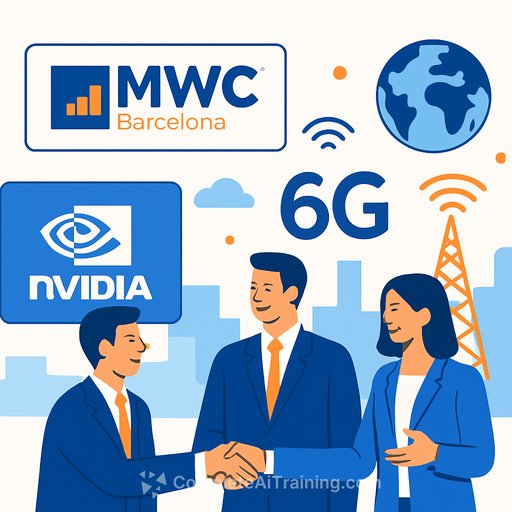
NVIDIA, alongside Booz Allen, BT Group, Cisco, Deutsche Telekom, Ericsson, MITRE, Nokia, OCUDU Ecosystem Foundation, ODC, SK Telecom, SoftBank Corp., and T-Mobile, announced a joint commitment at Mobile World Congress in Barcelona to build 6G on open, secure, and trustworthy AI-native platforms. The goal: a software-defined network stack where intelligence lives across the RAN, edge, and core.
Why this matters for product development: 6G will serve physical AI at scale - autonomous machines, vehicles, sensors, and robots - which raises the bar on latency, safety, security, and trust. Legacy architectures weren't built for this workload mix. The shift to AI-RAN and programmable networks will change how you design features, place models, and ship updates.
Who's involved (and why you should care)
This is a cross-operator and infrastructure effort, not a single-vendor push. The coalition includes global carriers and technology leaders, with ongoing collaborations across Europe, Japan, Korea, the U.K., and the U.S. Expect shared standards, open interfaces, and faster iteration than previous generations.
- Booz Allen
- BT Group
- Cisco
- Deutsche Telekom
- Ericsson
- MITRE
- Nokia
- OCUDU Ecosystem Foundation
- ODC
- SK Telecom
- SoftBank Corp.
- T-Mobile
What "AI-native, software-defined" means for your roadmap
- Programmable networks: Capabilities evolve through software, not hardware refresh cycles. Expect continuous delivery of network features.
- Intelligence in-network: Models sit inside the RAN/edge/core for inference, sensing, and control - not just at the app layer.
- Integrated sensing + comms: Positioning, motion, and environment signals can inform real-time decisions for machines and apps.
- Open and trusted by default: Interoperability, supply-chain resilience, and verifiable integrity (attestation, SBOMs) become product requirements.
Product opportunities to evaluate
- Network-aware experiences: Use network APIs for QoS hints, slice placement, or event triggers to reduce jitter and improve reliability.
- Edge inference: Shift perception, prediction, and safety checks closer to the user or device for tighter latency budgets.
- Sensing-driven features: Explore V2X, smart manufacturing, and robotics where radio sensing augments perception and coordination.
- Closed-loop optimization: Stream telemetry to AI systems that auto-tune models and policies based on live outcomes.
- Trust signals as features: Expose device/network attestation, data provenance, and isolation guarantees to enterprise buyers.
- Always-on upgrades: Treat network and app updates as one pipeline with feature flags and safe rollback.
- Multi-operator portability: Design for portability across carriers and regions with standard interfaces and policy abstraction.
Architecture notes for builders
- Model placement: Decide what runs on-device vs. at the edge vs. in the core. Balance latency, cost, privacy, and update cadence.
- Telemetry design: Collect fine-grained metrics (latency, handovers, interference, energy) and wire them into your MLOps/NetOps loop.
- RIC apps and control loops: Expect programmable control (xApps/rApps) that can influence scheduling, beamforming, and policy in near real time.
- Safety and determinism: Specify worst-case latency and packet loss, not just averages. Build guardrails for degraded modes.
- Energy as a first-class constraint: Optimize for Joules per inference, not just throughput. Consider dynamic scaling across tiers.
- Security baseline: Zero-trust, signed artifacts, reproducible builds, and runtime attestation across device, edge, and core.
Ecosystem moves to watch
- OCUDU Initiative and U.S. FutureG efforts for open, software-defined 6G architectures.
- AI-RAN Alliance growth (130+ companies) pushing AI into RAN scheduling, sensing, and control.
- AI-WIN project: an all-American AI-RAN stack aligning industry and government for 6G acceleration.
- Public programs across Europe, Japan, Korea, and the U.K. focused on interoperability and trusted infrastructure.
Risks and timing
Standards and interfaces are still maturing, and national programs will influence timelines. Plan for vendor diversity, region-specific constraints, and compliance from the start. Build abstraction layers that let you swap components without a rewrite.
What to do this quarter
- Identify 2-3 latency-sensitive workloads (inspection, teleop, cooperative robotics) and define SLOs across device/edge/core.
- Run an edge inference pilot with real network telemetry. Measure p95/p99 latency and energy per inference, then tune placement.
- Engage one operator partner for network APIs, policy, and sandbox access. Validate portability with a second operator.
- Ship a trust baseline: signed containers, SBOMs, and runtime attestation. Expose verifiable status to customers.
- Set a dual KPI frame: user outcomes (reliability, time-to-decision) and unit economics (TCO per active minute or per task).
Voices from the coalition
Leaders across carriers and technology providers emphasize openness, intelligence, and trust. As NVIDIA's Jensen Huang put it, "AI is redefining computing and driving the largest infrastructure buildout in human history - and telecommunications is next." The common thread: software-defined networks that evolve in real time and create room for a broader developer ecosystem.
Resources
Your membership also unlocks: