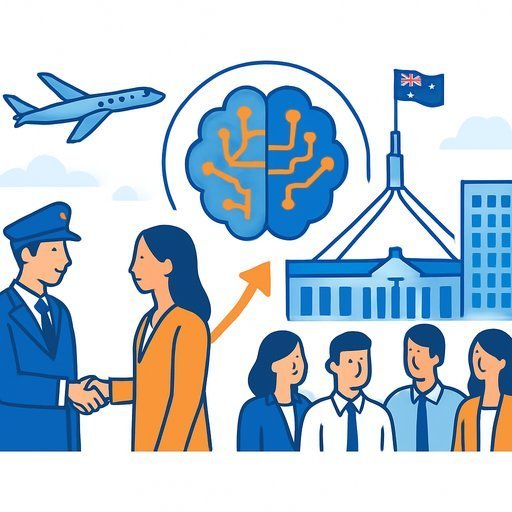
Australia Releases National AI Plan to Guide Adoption - December 4, 2025
Australia has released a National AI Plan to guide responsible adoption across government and the broader economy. For public sector leaders, this is a clear signal: move from pilots and scattered tools to structured, accountable delivery.
You don't need every detail of the plan to act. Use it as a north star for policy, procurement, skills, and risk. The agencies that win will set clear guardrails, measure outcomes, and build capability where it matters.
What this means for government teams
Expect stronger expectations on safety, transparency, auditability, privacy, and value-for-money. Treat AI like any other critical capability: governed, tested, documented, and measurable.
- Put one executive owner on the hook for AI risk and benefits.
- Create an inventory of all AI use (including shadow tools) with status, purpose, and data flows.
- Require human-in-the-loop for decisions with legal, financial, or service impacts.
- Stand up an internal review path: ethics, privacy, security, procurement, and legal sign-off.
30/60/90-day action plan
- 30 days: Freeze unmanaged pilots. Publish interim guardrails (approved tools, prohibited uses, data classification). Start a register of AI systems and vendors.
- 60 days: Run privacy impact assessments on high-risk use cases. Implement basic model/service monitoring (input/output logging, prompt templates, rate limits). Add AI clauses to procurement templates.
- 90 days: Launch a production checklist (security, testing, fairness checks, accessibility, records management). Review workforce gaps and fund priority training.
Governance principles you can operationalise now
- Safety and risk: Use tiered controls by risk level. Require red-teaming for public-facing or decision-support systems.
- Transparency: Disclose AI use to staff and the public where it influences outcomes. Maintain model cards or equivalent system summaries.
- Privacy: Minimise personal data. Prohibit uploading sensitive information to unmanaged tools. Complete Privacy Impact Assessments for moderate/high risk.
- Security: Apply least privilege, network controls, and secrets management. Review supplier security against your agency baseline.
- Fairness and inclusion: Test for bias with representative datasets. Ensure outputs meet accessibility standards (WCAG) and consider First Nations data governance where relevant.
- Accountability: Keep clear decision trails, audit logs, and escalation paths. Humans remain accountable for final outcomes.
Procurement and vendor due diligence
- Document data flows: what is collected, stored, processed, and retained. No training on your data without explicit approval.
- Ask for incident history, uptime SLAs, model update policies, and rollback options.
- Require bias, security, and privacy testing evidence. Prefer exportable logs and open standards for interoperability.
- Include kill-switch terms, audit rights, and data deletion on exit.
Data and infrastructure
- Catalogue datasets with owners, sensitivity, quality scores, and sharing rules.
- Separate development sandboxes from production. Log prompts, responses, and system actions where lawful.
- Use content filters, PII redaction, and guardrails at the platform layer to reduce repetitive risk work across projects.
Workforce and capability
Focus on practical skills: prompt patterns, evaluation methods, risk controls, and change management. Teach teams how to measure value and stop what doesn't work.
- Upskill policy, procurement, and legal on AI-specific clauses and risk indicators.
- Train delivery teams on testing, monitoring, and fallback design for AI-enabled services.
- Create a small internal "AI review desk" to support projects and standardise evidence.
If you need a fast start on role-based upskilling, see government-relevant pathways here: Complete AI Training - Courses by Job.
Measurement and reporting
- Value: time saved per case, service throughput, backlog reduction, accuracy vs baseline.
- Risk: incidents, false positives/negatives, bias findings, privacy/security events.
- Adoption: active users, approved use cases, training completion, audit pass rates.
- Publish a quarterly AI summary to your executive and, where appropriate, the public.
Helpful references
- Office of the Australian Information Commissioner - Privacy Act
- Australian Cyber Security Centre - Essential Eight
Bottom line
The Plan sets the direction; your policies, skills, and systems turn it into results. Start with a clear owner, a live register of use, and a simple gate for risk. Build from there, measure what matters, and keep humans responsible for the outcomes that count.
Your membership also unlocks: