AI flags drunk, drowsy, and aggressive driving through 3D facial analysis
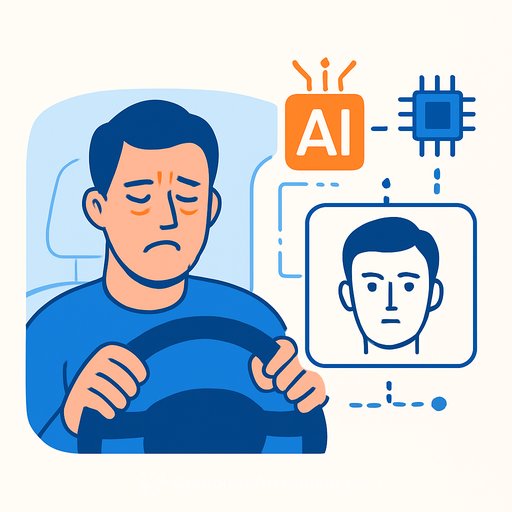
Australian researchers at Edith Cowan University (ECU) have built an AI system that analyzes 3D facial dynamics to detect three high-risk states behind the wheel: alcohol impairment, fatigue, and intense expressions such as anger. A single deep learning model reports nearly 90% accuracy for blood alcohol concentration detection and 95% for drowsiness. It also classifies intoxication levels into sober, moderate, and severe for clearer intervention thresholds.
ECU PhD candidate Abdullah Tariq and the team report that the model reads eye blinks, subtle micro-movements, and progressive facial changes in real time. Unlike a breathalyzer, it can run continuously without driver input, which matters for long-haul trips and high-risk routes. A companion study shows that combining infrared with color video improves reliability in low-light conditions.
What the system is looking at
- Eye blink rate and duration (fatigue signatures)
- Micro-expressions and muscle twitches (affect and stress)
- Head pose drift and stability (drowsiness indicators)
- Gaze behavior and fixation breaks (attention loss)
- Mouth and peri-oral motion patterns (alcohol-related cues)
Because it operates through a single unified model, signals are interpreted together rather than in isolation. That reduces the chance of missing risk when one cue is subtle but others agree.
Why it matters for safety research
Alcohol, fatigue, and anger are among the most consistent predictors of crash risk. A non-invasive, continuous monitor can surface risk earlier than event-based tools and support proactive interventions. For context, see global trends on road traffic injuries from the World Health Organization for scale and policy relevance: WHO road traffic injuries.
Method notes researchers will care about
- Model type: single deep learning architecture for multi-factor detection, not separate models stitched together.
- Outputs: alcohol impairment level (sober/moderate/severe), drowsiness state, and affect signals tied to aggression/anger.
- Sensing: standard RGB plus optional infrared for low-light robustness.
- Operation: real-time, no explicit driver cooperation required.
Validation and deployment questions worth answering next
- Generalization: new drivers, new camera positions, different vehicles, and varied lenses/FOVs.
- Lighting and occlusions: night driving, sunglasses, facial hair, masks, hats, and cabin glare.
- Bias and fairness: performance across skin tones, face shapes, age groups, and genders.
- Ground truth: aligning facial cues to verified BAC, medically validated sleep metrics, and affect labels from trained raters.
- Subject leakage: strict train/test splits to prevent identity cues from inflating accuracy.
- Edge vs. cloud: on-device inference, latency budgets, and thermal limits for continuous video.
- False alarms: protocols for escalating from warning to intervention without distracting the driver.
- Data handling: ephemeral processing, encryption, and policies that avoid storing raw facial video when not essential.
Where it likely lands first
- Commercial fleets and mining/industrial vehicles with existing telematics programs
- Long-haul and night-shift routes where fatigue dominates incidents
- Aftermarket safety retrofits in regions with strict drink-driving enforcement
Practical guidance for teams building or evaluating similar systems
- Define thresholds with domain experts: set BAC class cutoffs and drowsiness metrics tied to action plans.
- Use multi-sensor sync: combine face signals with steering variance, lane deviation, and pedal inputs to improve precision.
- Run continuous A/B field trials: compare model-driven alerts to incident logs and near-miss reports.
- Adopt privacy-by-design: edge inference, on-device redaction, and opt-in consent where regulations require it.
- Plan human factors testing: alerts must reduce risk without adding cognitive load.
For researchers interested in ECU's broader context and collaboration opportunities, see the university's research pages: Edith Cowan University Research.
What this means for policy and standards
A system that distinguishes sober, moderate, and severe impairment enables tiered responses: gentle nudge, route adjustment, or enforced stop. Regulators will ask for standardized testing across demographics, repeatability under controlled protocols, and clear audit trails. Expect guidance to prioritize on-device processing and strict limits on raw facial data retention.
For safety engineers who want to go deeper
If you're tasked with evaluating or deploying AI risk detection in vehicles or industrial fleets, this structured path can help translate research into production:
The big takeaway: multi-factor, non-invasive monitoring can surface risk earlier and more consistently than single-signal tools. With the reported accuracy for alcohol and drowsiness-and improved low-light performance via infrared-this approach is ready for rigorous field trials. The science is promising; the next step is evidence from real roads with strong privacy and fairness controls.
Your membership also unlocks: