
AI news ·
Australian artists and media workers push back against AI data scraping with copyright campaign
Australian artists, journalists, and Indigenous workers have launched the "Stop AI Theft" campaign demanding payment and opt-out rights from companies that trained AI on their work. The campaign targets Amazon, Google, Meta, Microsoft, OpenAI, and X.
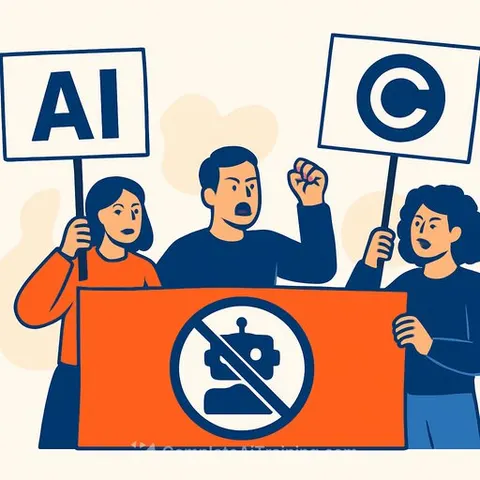
Australian Creatives Demand Payment for AI-Trained Work
Australian artists, journalists, and Aboriginal cultural workers have launched the "Stop AI Theft" campaign to demand stronger legal protections and compensation as generative AI companies train their systems on creative work without permission or payment.
The campaign targets major tech companies including Amazon, Google, Meta, Microsoft, OpenAI, and X. It calls for three specific policy changes: opt-out rights for creators whose work is used in AI training, mandatory compensation for artists whose work trains AI systems, and public disclosure of training materials.
The push comes as generative AI adoption accelerates in Australia. The Tech Council of Australia reported in August 2025 that 84 percent of office workers use AI at work, with potential economic benefits reaching AUD 115 billion annually by 2030.
The Problem: Unpaid Training Data
Voice actors report their work was cloned without consent. Journalists say their reporting appears on AI-generated news websites without attribution. A January 2026 University of Sydney report found that journalists increasingly disappear from AI search results. Indigenous activists point to fake Indigenous art being generated and sold using their cultural materials.
These cases reflect a core business model issue: major AI companies scraped internet content to train their systems without creator permission. Some models produce output nearly identical to copyrighted originals.
Erin Madeley, chief executive of the Media, Entertainment and Arts Alliance, framed the issue plainly: "It is theft, plain and simple - theft of people's voices, their faces, their music, their stories and art."
Policy Wins and Ongoing Battles
The campaign achieved a significant victory in October 2025 when Australia's government rejected proposals to weaken copyright protections. Tech companies had pushed for a "text and data mining exception" that would have given them legal access to Australian creative works for AI training.
The government's December 2025 National AI Plan confirmed this position, stating that existing copyright laws would protect local creators and that "regulation must keep pace" with fast-moving technology.
However, the campaign remains active. Organizers held dialogue with tech companies in August 2025 about transparency and compensation. The #PayUp hashtag emphasizes that tech companies profit while artists lose income.
Joseph Mitchell, assistant secretary of the Australian Council of Trade Unions, said: "We already know that big tech has been profiting from stealing the work of Australia's creative workers and journalists, and calls to legitimize this theft are incomprehensible."
The campaign's open letter to tech CEOs states the position directly: "Our work is not a free input to be fed into your machines. We demand to be paid when our work is used by your company, and we demand compensation for the work you have stolen from us."
Learn more about generative art and how AI affects creatives.