
AI news ·
Australian creatives lobby Canberra to reject AI copyright exemptions
Australian creatives are fighting a plan to let the government seize their work for AI firms. One author got just $3,000 for a book used without consent.
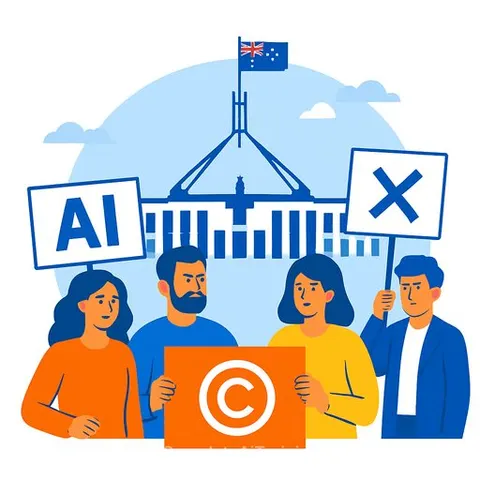
Australian creatives are pushing back against a drive by major US technology firms to dismantle copyright protections, warning that artificial intelligence companies want to use books, songs, artworks and films without consent or fair payment. A delegation of authors, musicians and visual artists travelled to Canberra last week to confront what they describe as an attempt to turn copyright into a government-administered handout system.
The group included writers whose works have been used illegally to train large language models, and representatives of collecting societies for film, books and art. They met with lawmakers to argue against a proposal that would let the government compulsorily acquire creative works and hand them to big tech for a nominal fee. One author present said the scheme would strip creators of control over their own property.
"I don't want a US tech bro as a patron," the author said. "I do not want the government to expropriate my life's work from me."
The Canberra proposal
Technology companies including Google, Meta and Anthropic have been lobbying the Australian government to weaken copyright through a statutory licensing model. Under the plan, firms would donate to a fund that the government would then dole out as payments to creators. This would replace individual licensing negotiations with a compulsory payout system.
Creative professionals say the model is unworkable and insulting. They note that negotiating consent for a book or artwork is straightforward - often a call to a publisher or agent. The Australian Society of Authors estimates six phone calls would locate the rights holders for most of the book industry's copyright works. "They know this is not true," the same author said of claims that finding rights holders is difficult. "They know where we all live. And they know what we're worth."
How AI companies obtained the books
The creators are also highlighting the methods used to gather high-quality text. To build the models, companies first scraped the open internet for material including emails and Reddit posts. For richer language, facts and narrative, they turned to books. Pirated editions were downloaded from illegal sites and fed wholesale into training datasets. In other cases, physical books were sourced secondhand, their spines ripped off, and pages scanned in bulk.
"Words fail me here," the author said. "Aware that books are the high quality text AI needs, big tech calls our product their 'special sauce'. They know its value, and they did anything to get it."
The false link between data centres and copyright
Big tech has tied the proposed copyright changes to the construction of AI data centres in Australia. Creatives call this a red herring - the data centres are being built regardless. The real goal, they argue, is to secure free or cheap access to Australian cultural products. "What they really want is to find a way to make the creative product of our country available to them for free, or for peanuts," the delegation heard.
Last year the government rejected an earlier industry push for a "text and data mining exemption" from copyright law. The latest proposal is seen as a second attempt dressed as a funding mechanism. For the creators, it would mean surrendering the right to decide who uses their work and on what terms.
Copyright: a pillar of creative independence
Copyright was established in 1710, enabling artists and writers to live from royalties rather than relying on patrons. The delegation pointed out that in places where copyright was not respected - such as East Germany - creative freedom and democratic voices suffered. "The development of democracy has gone hand in hand with copyright, and the many voices and views it allows to exist," the author said.
In Australia, copyright is treated as personal property, like land title. Without it, creators say, making new work would be pointless because it could be stolen instantly. The author's books, published in many languages, were ingested into AI systems without permission. One title earned a US$3,000 settlement in a US class action - a fraction of its value.
Why this matters for Creatives
The outcome of this policy debate will shape whether independent writers, designers, musicians and visual artists can continue to earn a living from the work they produce. A compulsory acquisition model would hand pricing power to government and big tech, severing the direct link between a creator and the market for their work. Creative professionals who want to understand the legal and practical implications of AI are increasingly seeking targeted resources - such as AI for Creatives Courses, Certifications & Training - to stay informed and protect their rights. The delegation's message to Canberra was simple: negotiate, don't confiscate.